

James Webb's new technical achievement
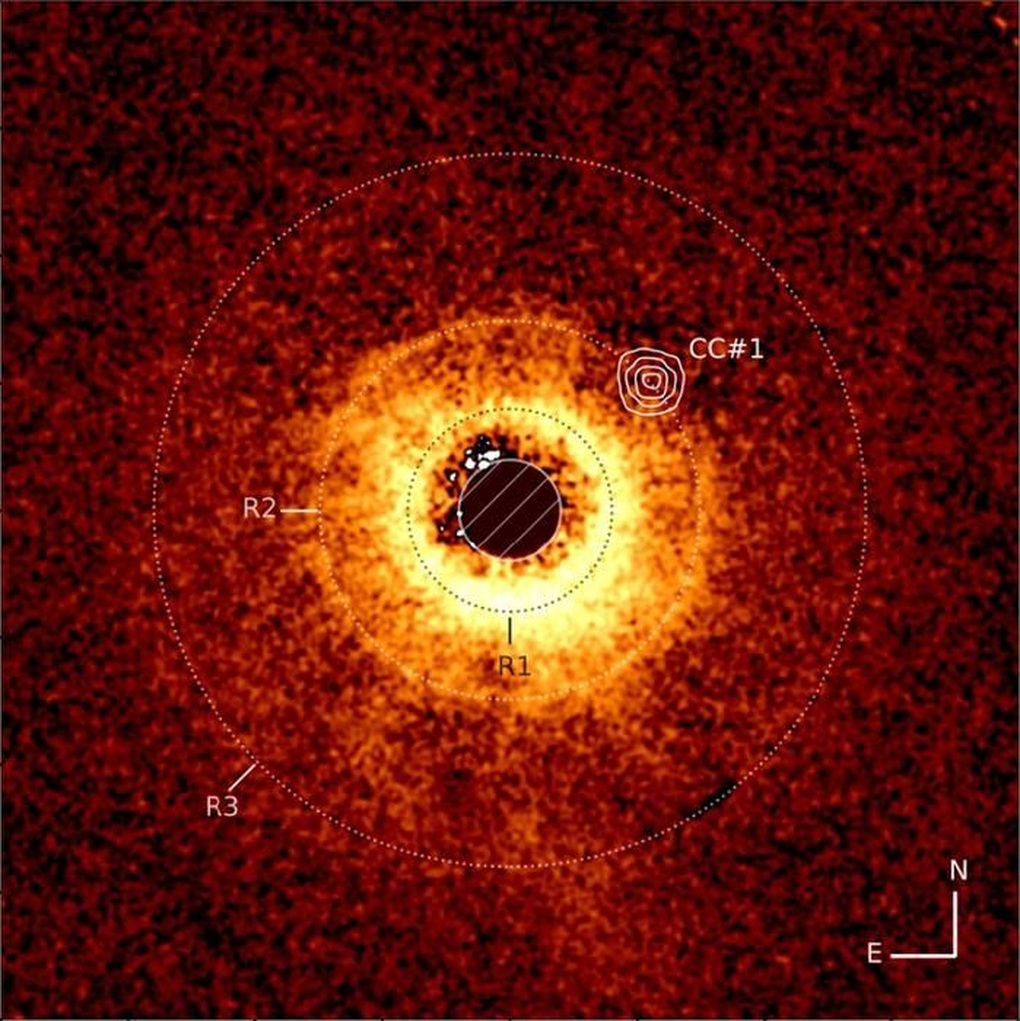
Image of the star CE Antliae located between the exoplanet TWA-7b (Photo: Research team).
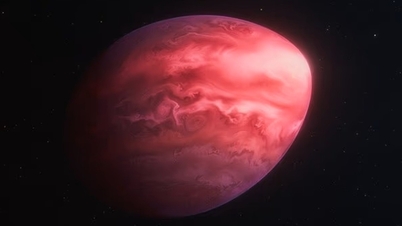
The James Webb Space Telescope (JWST) has just achieved a significant milestone in its journey to explore space, having for the first time discovered and directly photographed TWA-7b.
This is an exoplanet, and also the lightest extraterrestrial world ever directly photographed by humans.
TWA-7b is known to be a cold gas planet with an estimated mass of about 0.3 times that of Jupiter, or approximately 100 times the mass of Earth. This planet orbits a young star called TWA-7, located about 111 light-years from Earth in the constellation Antlia.
What's remarkable is that TWA-7b orbits its parent star very far, at a distance more than 52 times greater than the distance from Earth to the Sun, equivalent to the outer regions of the Kuiper Belt, and even surpassing Pluto's orbit within the Solar System.
The star TWA-7 is still very young, only about 6.4 million years old. It is surrounded by a disk of dust and gas left over from its star formation phase, where planets may be gradually forming.
The structure of this disk is divided into three distinct rings, which contain characteristic voids suggesting the possibility of a young planet clearing out surrounding matter.
It was thanks to one of those gaps that the James Webb telescope was able to detect a faint infrared signal from TWA-7b using its MIRI infrared wavelength meter, combined with a special system that blocks light from the parent star.
This discovery not only directly confirms the existence of a young planet with a mass less than Jupiter, but also validates long-held theories about how planets interact with the disk of matter during their formation.
The lightest planet ever discovered through photography.

The James Webb Telescope at a research facility, before its launch into space (Photo: NASA).
According to a research team led by astronomer Anne-Marie Lagrange from the Paris Observatory (France), TWA-7b is the first exoplanet light enough to be photographed directly, and it is also an indication that the James Webb telescope may be able to detect planets with masses only 25 to 30 times that of Earth in the near future.
Previously, most exoplanets were discovered indirectly, through changes in the star's light as the planet passed in front of it, or small gravitational fluctuations.
Direct imaging is a groundbreaking advancement because it allows for more detailed study of the physical properties, atmospheric structure, and surrounding environments of planets. This data is very difficult to obtain using traditional methods.
Notably, TWA-7b's estimated surface temperature is around 320 Kelvin (approximately 47 degrees Celsius), much lower than that of other hot planets near stars, and it is not significantly affected by its parent star's radiation due to its distant orbit.
These are ideal conditions for conducting future spectroscopic studies to analyze atmospheric structure and chemical composition. This information is crucial in the search for habitable worlds.
To date, humans have confirmed nearly 6,000 exoplanets in the Milky Way, but only about 80 of them have ever been directly photographed.
With his exceptional observational capabilities in the infrared spectrum, James Webb is ushering in a new era for the direct discovery and study of protoplanets, helping to shed light on long-standing mysteries about the formation and evolution of planetary systems.
Source: https://dantri.com.vn/khoa-hoc/buc-anh-dau-tien-ve-ngoai-hanh-tinh-sieu-nhe-20250626094911705.htm





![[Photo] Delegation attending the 14th Congress of the Vietnam Trade Union visits the Mausoleum of President Ho Chi Minh.](https://vphoto.vietnam.vn/thumb/1200x675/vietnam/resource/IMAGE/2026/06/03/1780451842301_ndo_br_img-3824-jpg.webp)






























































































Comment (0)