

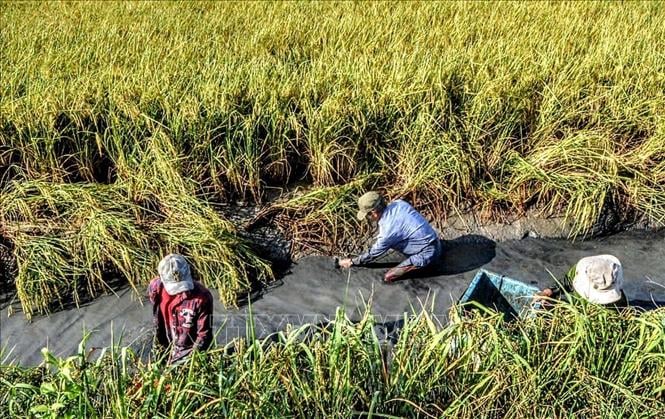
In Vinh Phuoc commune (Ca Mau province), farmers are currently harvesting rice on land previously used for shrimp farming. Mr. Nguyen Van Hue's family (Phuoc Thanh hamlet), with nearly 3 hectares, planted ST25 rice. The harvest yielded nearly 7 tons per hectare, with a guaranteed purchase price of 9,500 VND/kg. After deducting production costs, they earned a profit of nearly 150 million VND. In addition to rice, Mr. Hue also earned over 50 million VND from raising freshwater prawns alongside other fish in the rice paddies, bringing his total profit to nearly 200 million VND.
Similarly, Mr. Vo Van Rang has just finished harvesting over 2 hectares of ST25 rice with a yield of 6.7 tons/ha. The harvested rice was immediately sold under a product purchase contract. Mr. Rang said that his family previously used the "Mot Bui Do" rice variety, then the F1 hybrid variety, and finally switched to the ST25 variety.
This rice variety grows well, is less susceptible to pests and diseases, and yields superior rice quality, which is guaranteed to be purchased at a much higher price than some other varieties. Mr. Rang earned over 100 million VND from rice and freshwater prawns raised in the rice paddies. This money not only provided his family with capital to reinvest in the prawn farming season in early 2026 but also left them with extra money to celebrate the Lunar New Year of the Horse in a comfortable manner.
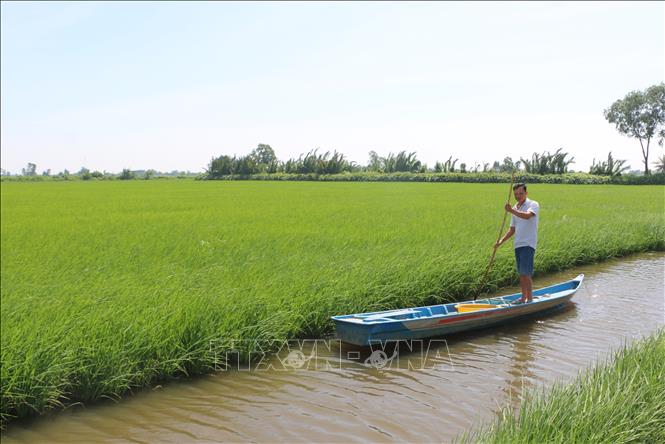
Vinh Phuoc is one of the communes with many advantages in terms of water resources, allowing farmers to sow early. It is also a locality with a large area of rice production on shrimp farming land in Ca Mau province, with nearly 9,000 hectares. This year, 100% of the area uses the high-quality ST25 rice variety, and all products are guaranteed for purchase. This result is due to farmers in the commune organizing cultivation according to a process of producing fragrant rice and clean shrimp. Farmers only use organic fertilizers and no pesticides. Shrimp are not fed and no antibiotics are used, ensuring the product is clean and safe.
Mr. Tran Van Liem, Secretary of the Party Committee of Vinh Phuoc commune, shared that after many years of cultivation, most farmers in the rice-shrimp farming area have gained experience in production. In addition, they have participated in training courses and programs on organic, ecological, smart, emission-reduction, and climate change adaptation, which are being actively implemented. The locality also focuses on investing in infrastructure, dredging canals to facilitate farmers' production. At the same time, it invites capable and reputable businesses to participate in production linkages and product distribution...
In Ninh Thanh Loi commune (Ca Mau province), where nearly 2,000 hectares of rice are sown on shrimp farming land in the 2025-2026 crop season, the rice is currently in the flowering stage. Mr. Nguyen Giai Phong said that his family cultivates 6 hectares, sowing ST25 rice variety in combination with raising tiger shrimp and freshwater prawns. He chose this rice variety because it has proven effective in production over the years. The rice not only tillers quickly, has strong stems, tolerates saline and acidic soils well, is less susceptible to pests and diseases, and has a guaranteed yield, but also has a relatively high economic value.
With his rice-shrimp farming model, Mr. Nguyen Giai Phong earns over 1 billion VND in profit each year. Thanks to this, his family has been able to build a spacious house, purchase many valuable items for production and family life, and provide their children with a good education.
For many years, rice-shrimp farming has been considered a sustainable production model in the face of adverse impacts of climate change. Mr. Nong Van Thach, Chairman of the Board of Directors and Director of Ba Dinh General Agricultural Cooperative (Vinh Loc commune, Ca Mau province), shared that rice and shrimp nourish each other, which is the core of sustainability in this model. Rice helps shrimp create a natural food source; after the rice harvest, the remaining rice stalks and straw decompose, creating organic matter – an ideal environment for plankton (the shrimp's natural food source) to thrive.
As a result, shrimp grow faster and farmers save on feed costs. In addition, the rice plant's root system absorbs excess organic matter and waste accumulated at the bottom of the pond from the previous shrimp farming season, helping to improve soil quality and clean the water environment for the next shrimp crop. Conversely, shrimp provide fertilizer; shrimp feces and organic waste from shrimp farming accumulated at the bottom of the pond become a nutrient-rich natural fertilizer for the rice plants. This significantly reduces the amount of chemical fertilizers needed. The rice-shrimp farming model also helps limit the use of chemicals, as shrimp are very sensitive to pesticides and agricultural chemicals. Therefore, when growing rice on shrimp farming land, farmers are forced to minimize the use of chemical sprays.
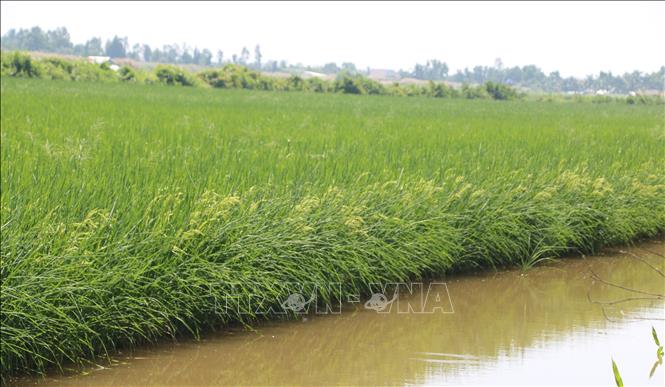
According to Pham Van Muoi, Deputy Director of the Ca Mau Department of Agriculture and Environment, the rice-shrimp farming model has been implemented since the 2000s, involving rice cultivation during the rainy season and shrimp farming during the dry season. This rotational farming system not only helps farmers increase their income per unit of cultivated land but also produces clean, environmentally friendly agricultural products. Because this farming method uses fewer chemicals, farmers are producing rice products that meet organic, VietGAP, and GlobalGAP standards, satisfying the stringent requirements of foreign export markets.
To enhance the value of rice grown in the rice-shrimp farming model, Ca Mau province is implementing solutions to develop production in an ecological and organic direction. Simultaneously, it is building product brands; promoting the issuance of planting area codes, pond codes, product traceability, and connecting with businesses to guarantee product consumption.
The province has established numerous agricultural cooperatives to act as intermediaries linking farmers with consuming businesses. Simultaneously, it has intensified the promotion and connection of "fragrant rice - clean shrimp" products through events, trade fairs, and especially on digital platforms.
Source: https://baotintuc.vn/kinh-te/ca-mau-duoc-mua-lua-tren-dat-tom-20251215110953927.htm
![[Photo] Capturing the moment the tide recedes at Yen Binh Son rapids - a million-year-old scenic spot in Quang Ngai.](https://vphoto.vietnam.vn/thumb/1200x675/vietnam/resource/IMAGE/2026/05/19/1779175463885_yen9-1199-jpg.webp)
![[Photo] National Assembly Chairman Tran Thanh Man attends the groundbreaking ceremony for the National Highway 1A spatial axis project.](https://vphoto.vietnam.vn/thumb/1200x675/vietnam/resource/IMAGE/2026/05/19/1779161360398_ndo_br_bnd-1412-jpg.webp)































![[Photo] General Secretary and President To Lam receives Indian Defense Minister Rajnath Singh](https://vphoto.vietnam.vn/thumb/402x226/vietnam/resource/IMAGE/2026/05/19/1779184046302_anh-man-hinh-2026-05-19-luc-16-46-58.png)












Comment (0)