

(Quang Ngai Newspaper) - Fire plays a vital role in human life, not only for cooking and heating but also in agriculture , preserving and storing food to sustain human life. Since ancient times, humans have created fire in many ways to serve their lives.
In the old days, before convenient fire-starting tools like matches and lighters existed, people needed tools to create fire when traveling far from home, hunting in the forest, or clearing land for farming. There were two common methods of fire-making in ancient times. The first, probably originating in "primitive" times, involved rubbing objects together to heat them, thus creating a flame. The second method involved using a tinderbox to generate sparks, which would then ignite a fire.
For the first method, the simple tool for making fire is dry bamboo. People go into the forest to find a very dry young bamboo stalk, split it into a trough. They then hollow out a hole in the middle of the trough and place it on the ground. Another bamboo stalk is split into a thin strip to draw fire from. The fire-maker uses both feet to firmly hold the ends of the bamboo trough and both hands to pull the bamboo strip through the trough. They pull back and forth continuously like playing a two-stringed instrument until the dry bamboo strip breaks, creating a fire for smoking, warming, cooking, burning fields, etc. This method of making fire is usually more effective in the dry season; it is more difficult to start a fire in the rainy season.
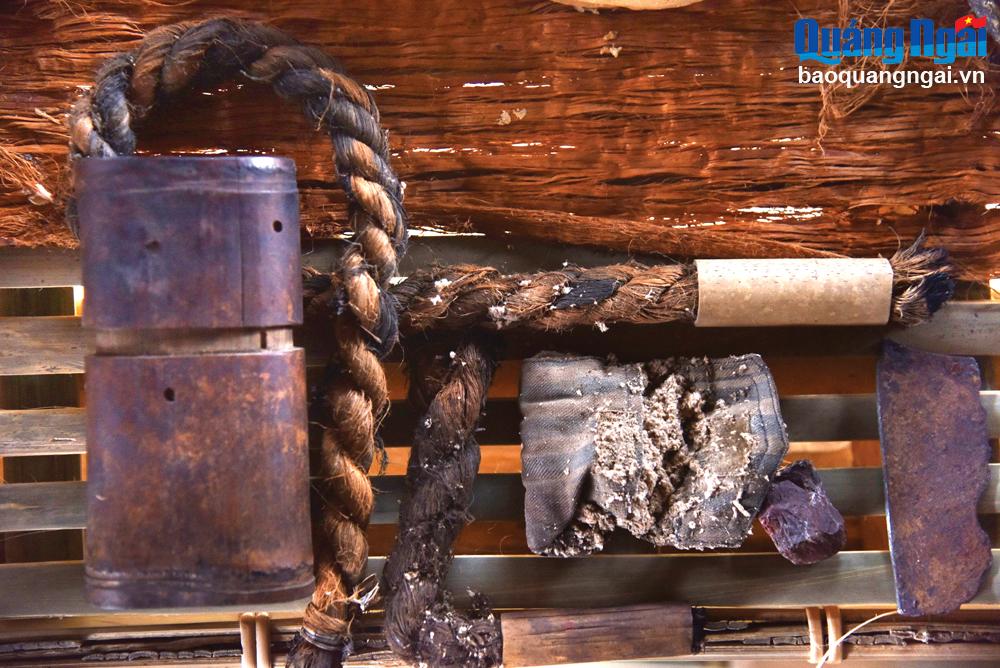 |
| Some of the tools used by people in the past to make fire included tinder, iron rods, and grate stones. |
| When hunting and gathering in the mountains and forests, with just a little rice and salt, forest dwellers, using their homemade fire-starting tools, can cook with ingredients readily available in nature. Water in bamboo or reed tubes can also be used for normal cooking, eliminating the need to fetch water from rivers or streams. Dishes cooked in bamboo tubes, called "lam" dishes (bamboo rice, bamboo soup, bamboo meat, bamboo fish), have a delicious aroma and flavor. In the past, each household had its own way of keeping a fire burning or "borrowing fire" from neighbors. Every morning, before leaving the house, people had to clean up the kitchen fire and extinguish all other fires, leaving only a large piece of firewood buried under the ashes to keep the fire going. This large piece of firewood was dry, about the size of a thigh or larger, and it was the piece of wood that kept the embers burning from night to night. |
The second method, applying physical principles, is more creative. It is quite common among many ethnic groups, even those living in the plains or midland regions. Whenever they travel far, they carry a short bamboo tube with a lid or a small pouch made of dog skin. Inside the tube or pouch are a small, flat piece of iron the size of a thumb, a piece of brownish-brown stone, and some tinder.
When they needed fire, they would take out these things, holding a stone with tinder in one hand and an iron rod in the other, striking the stone forcefully. Immediately, sparks would fly. The sparks would fall onto the tinder, igniting it. At that moment, they would add some dry leaves to start a fire. This method was called "making a tinderbox." The secret was having a well-forged iron rod and, importantly, a large, reddish-brown stone, as black or white stones produced less sparks. The tinder was made by cutting down some forest trees, scraping off the outer bark, and storing it in a bag to prevent dampness. The reddish-brown stone striking the good iron rod would ignite, and the tinder, acting as a kindling, would create a flame. This was the primitive, ancient tinderbox used by many ethnic groups.
The methods of making fire mentioned above were used by people in the past when going into the forest or traveling far from home, to desolate places where there was no place to "ask" for firewood. Wood and fire symbolized prosperity and provided life for each family. Fire itself is a sacred symbol, shaping culture and sustaining life for the ethnic minorities in the mountainous regions. Their knowledge and experience in creating, maintaining, and controlling fire, along with their rich customs, traditions, and folk beliefs, have shed light on the interesting and unique cultural aspects and practices of many ethnic groups. Many cultural heritages related to fire and hearths still hold value in life today in the villages of ethnic minorities in the highlands of Quang Nam province.
Text and photos: TAN VINH
RELATED NEWS AND ARTICLES:
Source: https://baoquangngai.vn/van-hoa/202407/cach-lam-ra-lua-cua-nguoi-xua-bf342ad/









![[Image] Exploring tourist destinations in the Central Highlands](https://vphoto.vietnam.vn/thumb/402x226/vietnam/resource/IMAGE/2026/04/03/1775188646177_anh-kham-pha-diem-_4405_1775188602.jpeg)










































































Comment (0)