

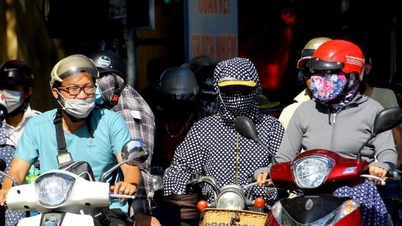
To express the scorching heat, Americans have various expressions such as "sweltering hot," "burning hot," or "blistering hot."
Mr. Quang Nguyen, an expert in English pronunciation training, introduces some common ways to talk about hot weather in English:
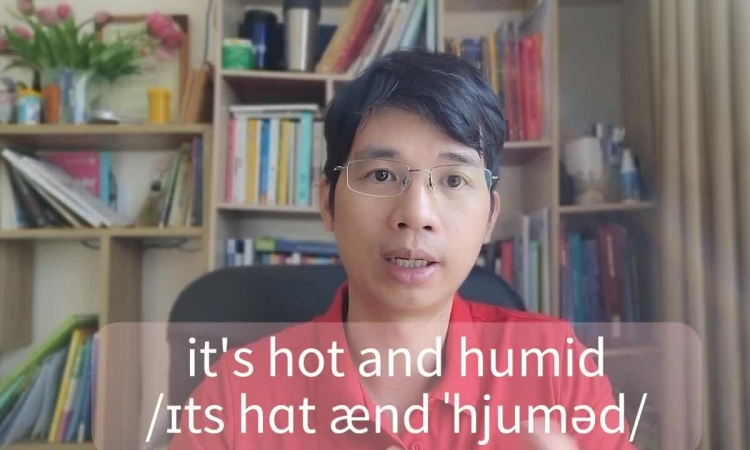
In August 2017, while I was in the US, I invited my best friend's family over. The kids ran around outside for a while before being pulled inside because of a "heatwave." That day, the weather forecast also warned, "There's a heatwave, you should keep the children indoors to avoid sunstroke." The word "sunstroke" means to get "heatstroke."
I've also noticed that Americans often use "sweltering hot" as a substitute for "very hot." The verb "swelter" expresses discomfort or stuffiness caused by heat: "The soldier swelters in their uniform" (the soldier is extremely uncomfortable because of the heat in his uniform). Another way to express this is "blistering," for example: "She ran a marathon in the blistering weather" (she ran a marathon in extremely hot weather).
The term "blistering hot" is a metaphor for the blistering that occurs when skin is burned. For example, I think if I walked barefoot on the streets of Hanoi on days when the temperature reached 45 degrees Celsius, my feet would blister immediately.

A pedestrian uses an envelope to shield themselves from the sun in London, July 2022. Photo: Hollie Adams/Bloomberg
Additionally, you may have heard the phrase "scorching hot," meaning it's so hot it feels like there's fire all around you. Or "It's sizzling hot," another way to express extreme heat, also relatively common in the US. Hearing this expression reminds me of a time in Michigan when I went to a Chinese restaurant in the freezing winter at -17°C. I went in and ordered "sizzling rice soup," a hot soup where the crispy rice crackers would bubble and make a "sizzle" sound – hot, delicious, and very tasty. The word "sizzle" is the sizzling sound you make when frying something in a hot pan, so "sizzling hot" means extremely hot.
Instead of "extremely hot," you could also say "It's burning hot" is a similar expression to "it's scorching." Another way to express it is "it's boiling." "It's roasting" immediately brings to mind a duck roasted over hot coals, also meaning incredibly hot. The verb "roast" means to turn or roast food.
Finally, we can't ignore the word "hot." I've noticed that the expression "(as) hot as hell" is relatively common – hot as hell. Similarly, "hot as a pistol" is also popular. The full expression "hot as a $2 pistol" originates from the 19th century, referring to cheap pistols whose barrels became unusually hot after firing.
Finally, not everyone knows that the English term for "summer solstice" is "the beginning of summer".
Quang Nguyen
Source link




![[Image] Close-up view of the interchange connecting the two expressways and Long Thanh Airport.](https://vphoto.vietnam.vn/thumb/1200x675/vietnam/resource/IMAGE/2026/05/25/1779703378210_ndo_br_z7863716673926-224453a31600126cce10622af6290afd-4549-jpg.webp)
![[Image] Hanoi's urban life under the challenge of a "scorching hot" environment](https://vphoto.vietnam.vn/thumb/1200x675/vietnam/resource/IMAGE/2026/05/25/1779706979265_nang-nong-t5-2026-minh-duy-7-4636-jpg.webp)

































































































Comment (0)