

Hanoi – Mrs. Thuy, 78 years old, underwent surgery for colon cancer three years ago. During a routine health checkup at Tam Anh General Hospital, a colon tumor was discovered, requiring endoscopic resection for complete eradication.
The chromoendoscopy results revealed multiple polyps, and a large, bilaterally extending lesion (5.5 x 4 cm) in the right hepatic flexure of the transverse colon. Chromoendoscopy and narrow-band imaging (NBI) techniques allowed the doctor to better observe the vascular pattern and fossa tissue (two signs of malignancy). This enabled the doctor to assess polyps and lesions with a high risk of cancerous invasion beneath the mucosa.
On March 3rd, Dr. Dao Tran Tien, Deputy Head of the Gastroenterology Department at Tam Anh General Hospital in Hanoi, stated that this was a high-grade dysplastic tumor, in the precancerous stage. Previously, for precancerous or early-stage cancerous tumors, doctors usually performed surgery to remove a segment of the colon. However, patient Thuy is elderly and had previously undergone surgery to remove half of her colon. A second surgery would easily lead to complications and a risk of losing colon function due to the complete removal, thus reducing her quality of life.
After a multidisciplinary consultation, the doctors chose the endoscopic ESD (endoscopic mucosal resection) method. The team inserted an endoscope through the anus, passing through sections of the colon to the lesion site, and used specialized instruments to cut and dissect the underlying mucosa, removing the dysplastic lesion.
According to Dr. Tien, the patient had a history of sigmoid colon cancer, having undergone surgery and chemotherapy, resulting in anatomical changes and high adhesions. The surgical team needed to handle the procedure skillfully, thoroughly removing the lesions at the base of the mucosa. Furthermore, the patient was elderly with underlying conditions of hypertension and a thin colon, requiring the doctors to be cautious in every step.
The patient underwent complete removal of the colon tumor by mucosal resection, and nine polyps scattered throughout the colon were also removed during the colonoscopy. The doctor clamped and cauterized any bleeding points, closed the wounds, and minimized the rate of local complications.
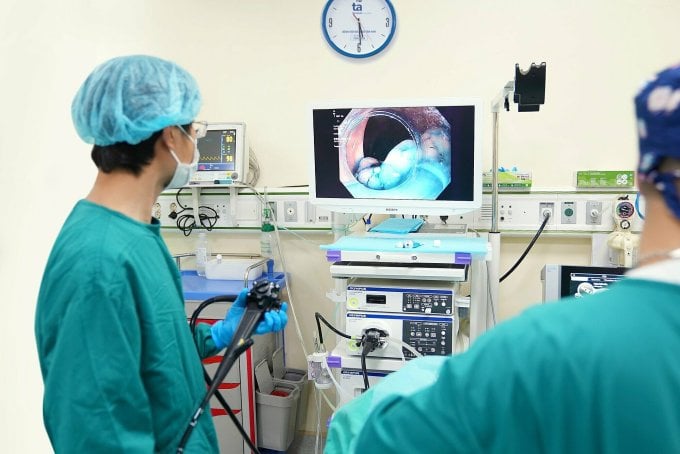
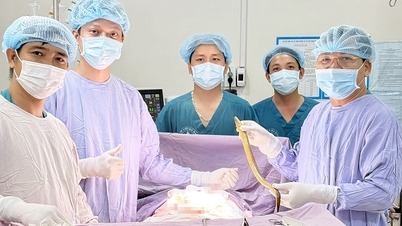
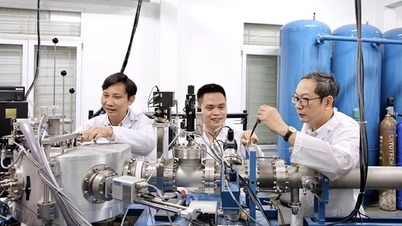
Doctor Tien (on the left) performs endoscopic removal of a lesion in Mrs. Thuy's colon. Photo: Provided by the hospital .
One day after the surgery, Mrs. Thuy started eating porridge again, her health was stable, she had no abdominal pain or bloating, and she was discharged from the hospital after three days.
Dr. Tien noted that patients who have undergone mucosal resection in the colon should eat easily digestible, soft foods such as porridge, soup, and fiber-rich foods that are pureed. They should also limit strenuous activity involving the area near the surgical site.
Colorectal cancer is quite common, with a high incidence rate in people aged 40-50. More than half of colorectal cancer cases occur in the rectum and sigmoid colon. Colorectal tumors are often asymptomatic and can easily develop into cancer. If a tumor is detected, patients should have regular check-ups every six months to promptly detect and treat any progressing lesions.
Emerald
* The patient's name has been changed.
| Readers can ask questions about digestive diseases here for doctors to answer. |
Source link


![[Image] Close-up view of the interchange connecting the two expressways and Long Thanh Airport.](https://vphoto.vietnam.vn/thumb/1200x675/vietnam/resource/IMAGE/2026/05/25/1779703378210_ndo_br_z7863716673926-224453a31600126cce10622af6290afd-4549-jpg.webp)


![[Image] Hanoi's urban life under the challenge of a "scorching hot" environment](https://vphoto.vietnam.vn/thumb/1200x675/vietnam/resource/IMAGE/2026/05/25/1779706979265_nang-nong-t5-2026-minh-duy-7-4636-jpg.webp)


















































































Comment (0)