

In an early 2024 issue of USA Today, Christopher Elliott, a popular American blogger, shared that Hoi An (Vietnam) was his biggest surprise on his 2023 round- the-world trip… Indeed, this ancient world heritage site always attracts visitors from all over the world, and it is something that the authorities and people of Hoi An always cherish and preserve.
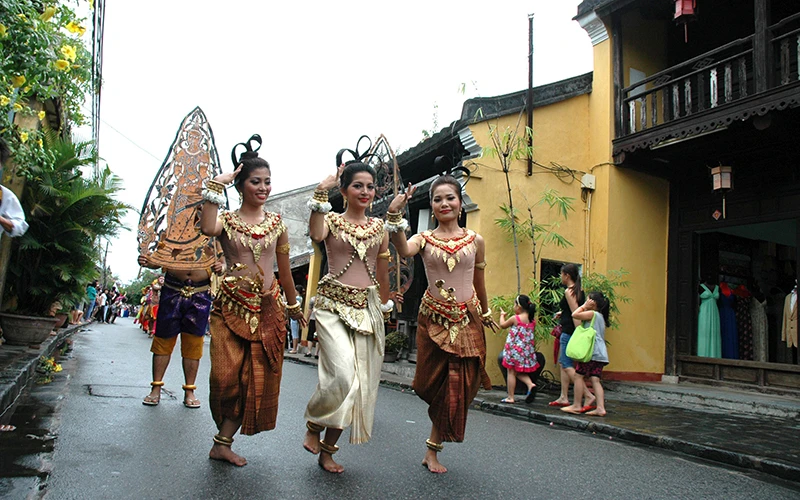 |
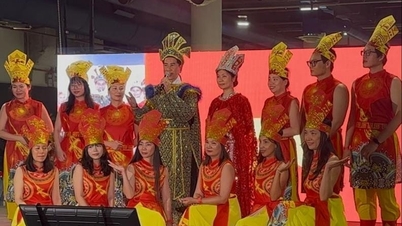
A performance by Cambodian artists at an event in Hoi An. (Photo courtesy)
Throughout his 365-day journey in 2023, C. Elliott visited numerous cities in countries such as Qatar, New Zealand, Japan, Chile, South Korea, Thailand, Cambodia, Australia, Vietnam, and Antarctica. Experiencing the ancient city of Hoi An in May 2023, the traveler shared on Elliott Confidential: “I spent a long weekend in Hoi An, central Vietnam, and I am still impressed by its natural beauty, with its lush green mountains and picturesque beaches. Hoi An is an ancient city with many temples and pagodas, boasting a rich history and influences from various cultures, including China, Japan, and Western countries. Visitors shouldn't miss the experience of going to the market and cruising along the Thu Bon River at sunset, when boats float downstream with brightly colored lanterns…” Notably, according to readers of this magazine, Hoi An ranked third, only after two cities in Mexico. Travel and Leisure commented: “Hoi An is known as a little gem. If you like shopping, you can easily order from there. For those who love food , Hoi An has many talented chefs who can satisfy all tastes. A great thing is that the old town area has limited vehicle traffic, so people can walk along the streets to the shops and markets. The city has a beautiful atmosphere, situated right next to a river.” From Travel and Leisure's account, I recall journalist Same Weuter's assessment of Hoi An in the world's leading travel magazine, Conde Nast Traveler, a few years ago: “Visitors love the colorful houses and ancient mansions; they give them the feeling of being in a movie…”. In 2023, Hoi An was also included in a Hong Kong (China) magazine's list of 9 amazing destinations. According to this magazine, the reason for choosing Hoi An is that it perfectly suits the needs of tourists, from sightseeing and shopping to relaxation and sunbathing on the beach. Traveler Christopher Elliott was surprised when he first visited Hoi An, but we are not surprised by the surveys, feelings, and positive reviews from international friends about Hoi An. Because Hoi An is an impressive name that has been etched into the memories of those who love experiences and exploration. This ancient town has, to some extent, met the needs of tourists. The people of Hoi An have built this value through a renowned tourism brand, but first and foremost, the town's history as an international trading port from hundreds of years ago, preserved in a relatively intact state, is an irresistible attraction... Looking back at history, our ancestors chose this beautifully shaped land by the Dai Chiem estuary as a place to welcome foreign winds into the tropical land on the ocean's edge from an early age. More than five centuries ago, Hoi An was already one of the most bustling trading ports in the Southern region of Vietnam. Asian and European merchant ships came and went in droves, and trade services flourished along the "Silk Road" of the trans-Asian maritime route. In 1535, Captain Antonie de Farie of the Portuguese ship Albuquenque visited this coastal area and saw: “A walled city with nearly 10,000 houses, 40 large sailing ships, two or three piers, and around it about 2,000 sailing ships of various sizes.” Antonie de Farie was not the first group of Western merchants to come to Hoi An to buy bird's nests, incense, silk, wood, cinnamon, sugar, etc., and to trade ceramics, silver ingots, sulfur, lead, zinc, felt, etc. Before that, the Dutch had a trade agreement with the Nguyen lords through the Hoi An trading port. The French and British also established offices and opened trading posts to manage foreign trade at this port. The most prominent mark on the Hoi An port city was left by Chinese and Japanese merchants. Christoforo Borri, a Jesuit missionary from Milan, Italy, arrived in Hoi An in 1618 and recorded in his book "The Southern Region in 1621": "The Nguyen Lords allowed the Chinese and Japanese to build houses in proportion to their numbers to establish a city. This city is called Faifo and it is quite large. We can say there are two cities, one Chinese and one Japanese. They live separately, have their own rulers, and follow the customs and traditions of each country." This was the result of the open policy that the Nguyen Lords applied in the port city of Hoi An. That past created Hoi An – a land of integration, interaction, and cultural transformation, incredibly unique in a country that had experienced a long history under a feudal regime with a characteristic "closed-door" policy. Indeed, the image of Hoi An today still clearly bears the mark of a time when Eastern and Western cultures met. Today, this city still bears the imprint of the Portuguese, English, French, Dutch, Chinese, and Japanese influences through its architectural structures, cultural colors, traditional crafts, and even the customs and lifestyles of its inhabitants. Within a few square kilometers of the old town, one encounters countless images of harbors, bridges, communal houses, temples, churches, assembly halls, tombs, streets, and cultural relics of Vietnam, Champa, China, Japan, and Western countries.
Previously, in 2020, Hoi An city was honored by the renowned American travel magazine Travel and Leisure as one of the 10 greatest cities in the world.
In modern times, when life is full of new and overwhelming changes, the journey back to old values, living in a nostalgic space, letting one's imagination wander to a bygone era in a place suddenly encountered, will give everyone a delightful feeling.
History has endowed Hoi An with a unique urban identity, enabling this place to confidently move forward with its familiar face and new style. Hoi An attracts tourists with its inherent tranquility, its moss-covered, melancholic atmosphere, as if harboring ancient secrets and distant messages.
Visitors will be immersed in a myriad of emotions, both familiar and unfamiliar, as they wander through the ancient town. Facing the ancient city means opening one's heart to engage in dialogue with the multifaceted expressions of ancient and modern, Eastern and Western cultures. In Hoi An, visitors are captivated by moments of humanistic values from the past, alongside the vibrant image of city dwellers actively embracing new trends with their modern and open-minded approach. The fortuitous encounter with history has given Hoi An a naturally integrated spirit. Therefore, "the older Hoi An gets, the more valuable it becomes." This was an impromptu remark from a colleague after he described his profound reflections on the moss-covered walls, imbued with the nostalgic charm characteristic of the ancient town... I have visited and experienced Hoi An countless times and have observed many unique aspects of this place. During peak tourist seasons, visiting this town feels like entering another world, characterized by the daily influx of foreign tourists on the streets. Visitors and locals interact in a friendly manner. Tourists actively and naturally participate in the cultural and daily life activities of the locals. Many have visited and returned multiple times. Some, unable to resist their love for this city on the banks of the Hoai River, have stayed to become its residents. I have had the pleasure of getting to know a French painter, an Italian businessman, and a Korean musician who live and work here. They were once tourists but have now become residents of Hoi An, participating in monthly neighborhood meetings and joining their neighbors in the annual year-end celebrations. They came and stayed to enjoy the delightful experiences of this ancient town. This shows just how attractive Hoi An is… It's noteworthy that the people of Hoi An have long recognized the value of their homeland – a world-renowned heritage city. They have also embraced the process of integration naturally, as history has shaped them over the centuries. Unlike some other places, international tourists rarely experience culture shock in Hoi An, and the locals treat visitors with natural harmony. 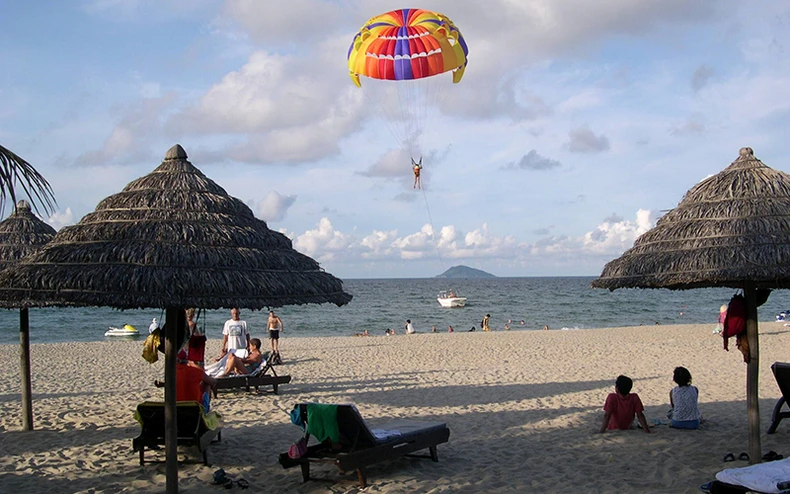 |
Cua Dai Beach, Hoi An (Quang Nam).
In Hoi An, tourists are not just passersby but benefactors, a sentiment shared by both the local government and residents. Visitors are always welcomed with genuine warmth, not in the superficial, opportunistic way often seen elsewhere. In Hoi An's tourism industry, the people are the main actors. Their interests are not in conflict but organically linked to the common good; their pride in their homeland, coupled with an increasingly improved quality of life, means the people are the primary actors in protecting their local brand. A new success: in 2023, Hoi An became one of two Vietnamese representatives (along with Da Lat) to be officially recognized by UNESCO as a member of the Global Creative Cities Network in the field of Crafts and Folk Arts. This is a fair recognition. This ancient town currently boasts five traditional craft villages with nearly 50 traditional crafts being preserved and developed, along with diverse artistic values that the local people maintain and offer to the public, such as street music and dance, folk singing, traditional folk songs and theater, traditional opera performances, art galleries, exhibitions, and art programs like the "Memories of Hoi An" live performance, "Ancient Town Night," and "Heritage Journey." The city currently has 658 small businesses and 1,710 households operating in the handicraft and folk art sectors. It is estimated that approximately 4,000 people are directly employed in these fields, earning between $3,500 and $4,000 USD annually.Becoming a full member of UNESCO's Global Innovation Network is an extremely significant event, contributing to the goal of enhancing the status and brand of Hoi An, and promoting the image of Vietnam, its people, and Hoi An-Quang Nam to friends around the world. (Mr. Nguyen Van Son, Chairman of the People's Committee of Hoi An City)The accolades and recognitions have contributed and will continue to encourage and motivate Hoi An to remain an attractive destination, a place that always captivates tourists with its accumulated values. All past and present efforts in Hoi An are aimed at preserving the best possible aspects of the ancient urban architecture, landscape, environment, traditional craft villages, beaches, and tangible and intangible cultural values; these are the foundations for developing a tourism industry deeply rooted in local cultural identity. The crucial factor is ensuring a conducive environment for development and well-being for the people, the owners of the brand. If the people abandon their sense of responsibility and show signs of pragmatism and negativity in business, then all the government's efforts will be very difficult to succeed...
![[Photo] Solemn bathing ceremony and Buddha procession in Hue](https://vphoto.vietnam.vn/thumb/1200x675/vietnam/resource/IMAGE/2026/05/31/1780228263543_1-jpg.webp)
![[Photo] Admire the coral "masterpiece" amidst the million-year-old heritage of Dak Lak province.](https://vphoto.vietnam.vn/thumb/1200x675/vietnam/resource/IMAGE/2026/05/31/1780221235105_anh-man-hinh-2026-05-31-luc-16-53-27.png)

![[Photo] The General Secretary, President and his wife begin their state visit to the Philippines.](https://vphoto.vietnam.vn/thumb/1200x675/vietnam/resource/IMAGE/2026/05/31/1780230559452_anh-man-hinh-2026-05-31-luc-19-28-11.png)






![[Video] Weather forecast for tonight and tomorrow, June 1st, 2026: Northern Vietnam experiences rising temperatures, Southern Vietnam continues to have thunderstorms.](https://vphoto.vietnam.vn/thumb/402x226/vietnam/resource/IMAGE/2026/05/31/1780232471628_thumb-toi-3105-png.webp)











![[Video] Sunset at Lap An Lagoon – Where the sun sets over the fishing nets](https://vphoto.vietnam.vn/thumb/340x192/vietnam/resource/IMAGE/2026/05/31/1780192137701_beach-landscape-sea-water-nature-grass-745871-pxhere-com.jpeg)




![[Photo] The General Secretary, President and his wife begin their state visit to the Philippines.](https://vphoto.vietnam.vn/thumb/402x226/vietnam/resource/IMAGE/2026/05/31/1780230559452_anh-man-hinh-2026-05-31-luc-19-28-11.png)





























![[Photo] Admire the coral "masterpiece" amidst the million-year-old heritage of Dak Lak province.](https://vphoto.vietnam.vn/thumb/402x226/vietnam/resource/IMAGE/2026/05/31/1780221235105_anh-man-hinh-2026-05-31-luc-16-53-27.png)




























Comment (0)