

Evidence of the May War against America
A Vuong, Tay Giang was the starting point for the Ho Chi Minh Trail, connecting Thua Thien Hue province (now Hue city) to Quang Nam province (now Da Nang city). This area also bears witness to many heroic deeds that contributed to the victory of the historic Ho Chi Minh Campaign. One of the most clearly visible surviving examples is the Bh'nơm tunnel (now located in A xoo village, Tay Giang commune), a stronghold of the Co Tu people and the 43rd Supply Depot during the resistance war against the US.
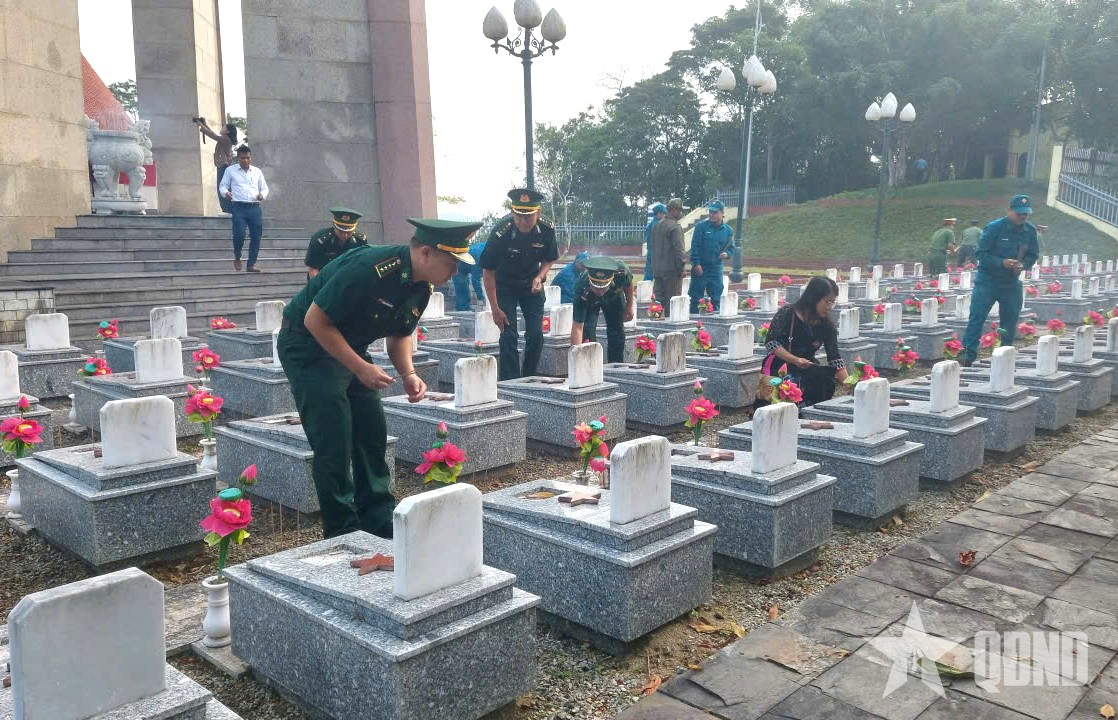 |
| Armed forces personnel, leaders, officials, and civil servants of A Vuong commune, village heads, Party branch secretaries, and village elders offered incense at Tay Giang Martyrs' Cemetery. |
In 1965, the US began intense bombing of the mountainous highlands of Quang Nam province (now Da Nang city). By 1967, the Ho Chi Minh Trail had reached this area. To ensure the safety of the liberation army and to store food and weapons transported from the North to the Southern battlefield, the 43rd Supply Depot mobilized the Co Tu people in Tay Giang to dig tunnels on Bh'nơm mountain. For a whole year, every night, the villagers and soldiers of the 43rd Supply Depot dug the tunnels, and during the day they participated in transporting weapons and food for the liberation army. The Bh'nơm tunnels were dug with more than 16,000 man-days of labor, removing more than 19,000 cubic meters of earth and rock from the mountain. The tunnels are over 70 meters long, winding deep inside the mountain, with a height of 1.8 meters and a width of 1.5 meters. The tunnel is divided into seven compartments with different functions, each measuring 5m in length and 2m in width.
During the two years of 1967-1968, the war intensified, with American B52 bombers carpet-bombing the area to cut off the Eastern Truong Son Road. Thanks to the tunnels, the 43rd Supply Depot and the surrounding people were able to avoid bombs and bullets during those fierce days of war. The Truong Son Road continued to extend. Many infantry and anti-aircraft units advanced here to prepare for the great offensive of Spring 1975. More than half a century has passed, and the Bh'nơm tunnels still stand, recognized as a historical site and becoming a significant location for educating the younger generation about national traditions.
 |
| Comrade Zơ Râm Bê, Deputy Secretary of the Standing Committee of A Vương commune, presents gifts to officers of the A Nông Border Guard Post. |
During the wars for independence, the former Tay Giang district had 138 martyrs, 51 wounded soldiers, 1,039 sick soldiers, 288 people with revolutionary merit, and 253 resistance fighters exposed to dioxin. In addition, there were 8 Heroes of the People's Armed Forces and 6 Heroic Vietnamese Mothers. The Co Tu people in A Vuong commune are always proud to have Alang Bhuoch, a Hero of the People's Armed Forces. This Co Tu man was known as the "legendary blind hero" of the Truong Son mountain range. Despite being blind in both eyes, he spent 14 years carrying weapons, ammunition, and food (a total of nearly 200 tons) to serve the resistance against the US. Now, this hero has passed away, but his story continues to be told as a source of pride for the Co Tu people in Tay Giang.
Singing the national anthem beside the border marker.
To practically celebrate the 51st anniversary of the liberation of Southern Vietnam and the reunification of the country (April 30, 1975/April 30, 2026), the A Nong Border Guard Station (Da Nang City Border Guard Command) advised the People's Committee of A Vuong Commune to organize a flag-raising ceremony at border marker 678. The ceremony was attended by leaders and officials of A Vuong Commune, village elders, influential figures, village heads, Party branch secretaries, armed forces personnel, and youth union members of the commune. This event also aimed to show each official and citizen the achievements of border demarcation and marker placement, to understand the national border and border markers, and thereby to promote their responsibility in disseminating information and mobilizing the people to strictly abide by the Party's guidelines and policies, and the laws of the State. This also aims to further strengthen the close relationship between the Party committees, local governments, organizations, and units in the area with the people, creating a combined strength to build a strong, efficient, and effective local political system.
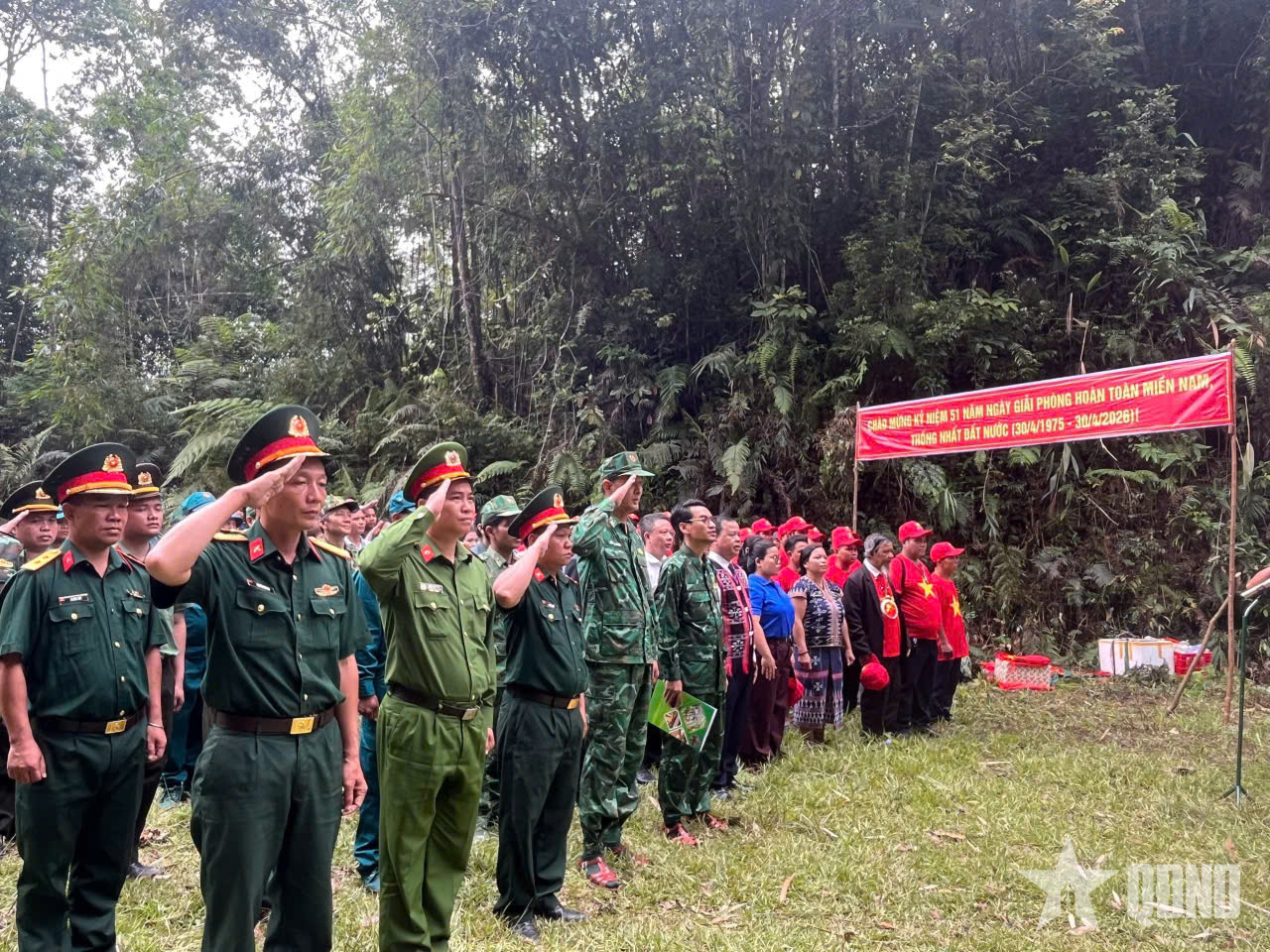 |
| Armed forces personnel, leaders, officials, civil servants, village heads, Party branch secretaries, and village elders of A Vuong commune performed a flag-raising ceremony at milestone 678. |
According to Lieutenant Colonel Le Van Nam, Political Officer of the A Nong Border Guard Post, the unit manages 21.345 km of border line with 9 border markers (from 676 to 684). The border terrain is rugged, and patrolling the border and border markers almost entirely requires walking; some markers take 3 days and 2 nights to reach. Border marker 678, erected in 2011, is the closest and easiest to access, yet it still takes 2 hours on foot. This is not only a geographical marker but also a sacred symbol of national sovereignty, embodying the spirit of unity and the will to defend the homeland of the military and people in the border region.
From early morning, leaders, officials, armed forces personnel, along with village elders, respected community leaders, Party branch secretaries, and village heads, gathered at the A Vuong Commune People's Committee headquarters to begin their journey through the treacherous mountain forest to reach Milestone 678. The delegation then visited the Tay Giang Martyrs' Cemetery to pay respects to those who fell for the independence and freedom of the Fatherland. Because the path to Milestone 678 was steep and difficult, everyone had to walk. After two hours of climbing the mountains, Milestone 678 appeared beneath the canopy of ancient trees. Made of granite, the sight of the Vietnamese national emblem affixed to the marker evoked a feeling of pride. Beside the sovereignty marker, under the national flag, everyone sang the national anthem with great reverence. So many people have fallen to achieve the peace, independence, and freedom we enjoy today, to unite our country. "Therefore, the flag-raising ceremony at milestone 678 is not only a practical activity to celebrate the reunification of the country, but also contributes to fostering patriotism and strengthening national unity," emphasized Lieutenant Colonel Le Van Nam in his speech.
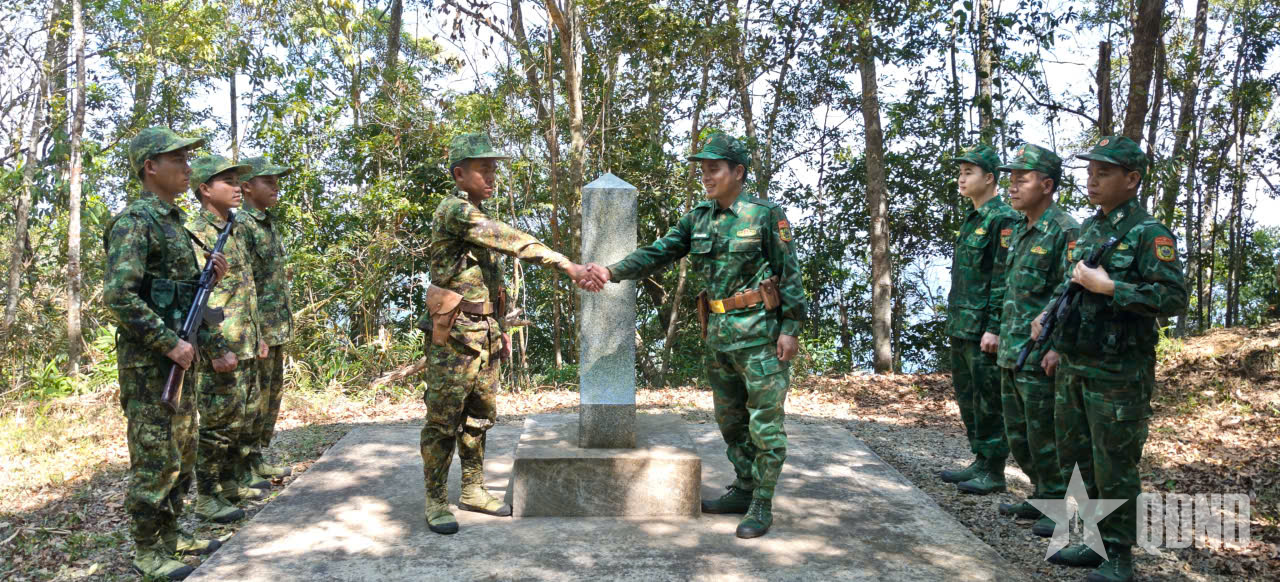 |
| The A Nong Border Guard Post and the Lao Border Guard force patrol the border line and boundary markers. |
Participating in the flag-raising ceremony at milestone 678, village elder A Lăng Nhaih (Atêếp village, A Vương commune) excitedly said: "Every time April 30th comes around, the Cơ Tu people are very happy, not only because it is a great national holiday, but also because it is an opportunity for us Cơ Tu people to remember the years we contributed to the great victory of Spring 1975. With the country at peace, the local government and the Border Guard always stand by and support us, helping to improve the lives of the people. 100% of children attend school at the appropriate age. Young people go to college or university or leave home to work. Many Cơ Tu people have become Border Guard officers, such as Major Zơ Râm Xiết, Major Zơ Râm Bên… Life today is exactly what the Cơ Tu people have always dreamed of." Fifty-one years have passed since the reunification of North and South Vietnam. Many changes have occurred, but the indomitable spirit and unwavering loyalty to the Party of the soldiers and people in the border region of A Vuong and Tay Giang remains intact.
Source: https://www.qdnd.vn/phong-su-dieu-tra/phong-su/cau-chuyen-ngay-thong-nhat-ben-cot-moc-bien-cuong-1037604

![[Photo] The heat at the fireworks display site on the opening night of the Da Nang International Fireworks Festival 2026](https://vphoto.vietnam.vn/thumb/1200x675/vietnam/resource/IMAGE/2026/05/27/1779889741485_ndo_br_z7872039145157-fecaba5112f39e8352544099d7ef4738-5140-jpg.webp)
![[Photo] The courage of new recruits of Brigade 144 on the training ground.](https://vphoto.vietnam.vn/thumb/1200x675/vietnam/resource/IMAGE/2026/05/27/1779881651341_anh-man-hinh-2026-05-27-luc-18-32-52.png)











































![[Photo] The courage of new recruits of Brigade 144 on the training ground.](https://vphoto.vietnam.vn/thumb/402x226/vietnam/resource/IMAGE/2026/05/27/1779881651341_anh-man-hinh-2026-05-27-luc-18-32-52.png)



























Comment (0)