

Tay folk songs, while rich in lyricism and passion, are often quite "level-headed," possessing a certain intellectual and scholarly quality. These are signs of the mutual influence between oral and written folk literature, and the interaction between Tay folk literature and the national literature. This interaction is not only evident in love songs but also in other genres such as folk tales and narrative poems.
The rational element in Tay folk songs of courtship is often taken to a high level. Through the lyrics, we sometimes see carefully calculated advice and vows, meticulously planned, and looking far into the future: "If we cannot marry each other in ten parts / We will go together to swear an oath / Splitting the money in half, each taking half / Keeping it carefully in our pockets / If later our hearts betray us / We will curse and swear."
The rational nature of Tay folk songs is not only reflected in the specific content of each lyric but also in the types of songs that often involve competition and intellectual challenges. This is most clearly demonstrated in riddles and stories, such as the common word riddles: "Nhân tềnh, nhất khẩu hợp pền tối/Bày cạ sloong hàng bạn túc mai..." (meaning: "The people above, one mouth unites to form a pair/Arranging two rows of friends, bamboo and plum blossoms...") (the word "hợp" is composed of the words "nhân", "nhất", and "khẩu"). Or the stories of Nhị độ mai and Phạm Tải - Ngọc Hoa, which the Tay folk authors considered their precious "treasures," borrowing stories from Vietnamese Nôm stories to create call-and-response songs between men and women: "Seeing you like the son of a lord/I am like Phạm Tải begging for alms..." Love poems (phong slư) written on cloth or silk, exchanged between lovers, in which the author uses many Sino-Vietnamese words or allusions: "Xuân thiên tiết vằn thâng bươn cẩu/Các bách điểu nộc nu vui mừng" (The spring season arrives in September/A hundred kinds of birds rejoice). The words "spring sky," "hundred birds," and "joyful" are all written in both Sino-Vietnamese in the original text. While riddle songs, narrative songs, and folk poems belong to the lyrical folk song genre, they possess a distinctly intellectual quality. The authors employ sophisticated compositional techniques, closer to scholarly literature than to folk literature, unlike other lyrical folk songs with their simpler, more innocent language.
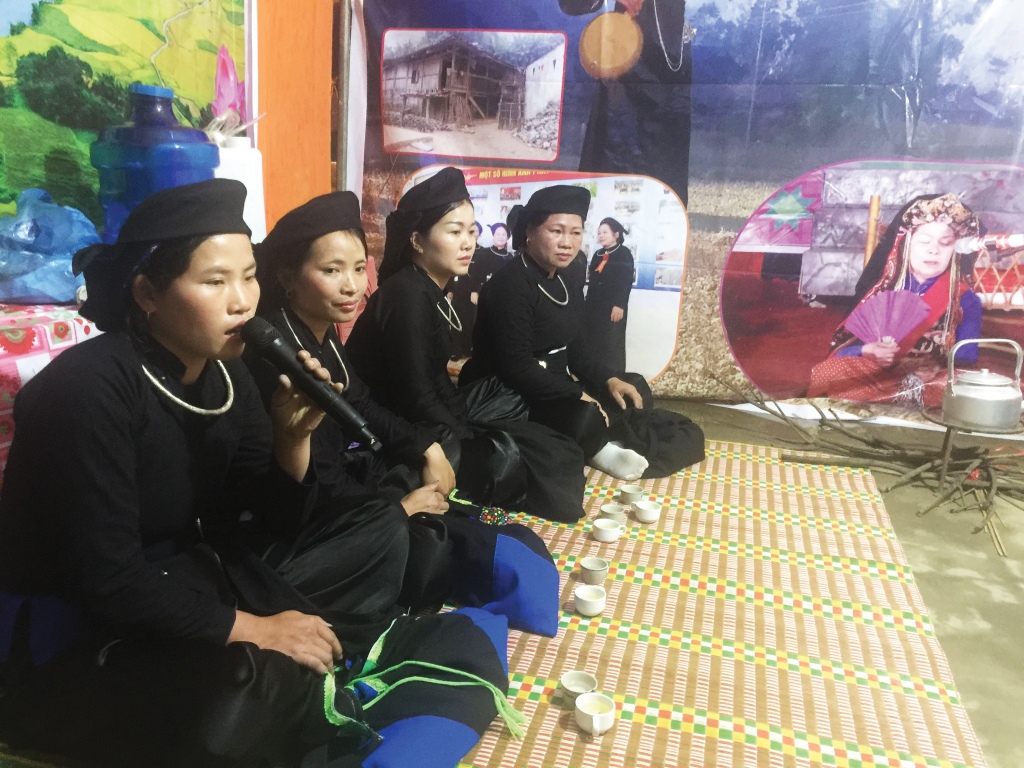
In folk songs, the language is often subtle but usually simple, unpretentious, and close to the everyday language of the people. In narrative poetry, however, alongside the simple language close to the daily speech of the people, many authors meticulously refine their writing, preferring to use formulas and allusions from classical Chinese literature, and stories borrowed from the poetry of the Jin and Tang dynasties, such as: "The fisherman is captivated by Peach Blossom Cave / The White Emperor's boat crosses the waves of Jiangling." (Tran Chau, Tay-Nung Narrative Poem).
The first line is taken from the story of "the fisherman who landed in Peach Blossom Paradise" in the poem "Peach Blossom Paradise" by the poet Tao Qian. The second line is a quote from two lines of Tang Dynasty poetry: "Farewell to the city of Bai Di in the morning amidst beautiful clouds / Return to Jiangling, a thousand miles away, in one day" (meaning: Bidding farewell to the city of Bai Di in the morning amidst beautiful clouds, returning to Jiangling, a thousand miles away, in one day).
Often, the author uses metaphors derived from Sino-Vietnamese words to express a thought or feeling. For example, to show that he, though a poor scholar, is pure and not greedy for money or possessions, the character Liu Tai uses the phrase: "A man who is greedy for wealth dies / A bird who is greedy for food far away perishes" (Liu Tai - Han Xuan, Tay-Nung Poetic Tale). Or, to show Liu Tai's humility before his lover, the author has the character borrow the story of the poet Tao Qian to speak on his behalf: "I have temporarily learned a few words of the sage's teachings / I do not long for the fisherman of Peach Blossom Paradise." Furthermore, along with the characters in the work, the author himself begins to appear in the poetic narrative through opening lines that serve as self-introduction, such as: "Holding a pen to record the story passed down / Ding Jun, the story of the ancient state of Chu..."
Typically, when discussing morality and social norms, the language of narrative poetry is formal and elaborate, employing scholarly idioms and Sino-Vietnamese formulas. For example, when discussing the husband-wife relationship, the poem in the story of Luu Dai - Han Xuan writes: "An ancient saying goes: A woman, upon marriage, follows her husband, a common custom." Or, when describing the simple and ordinary mother-child relationship within the family, the author of the narrative poem also favors this formal language: "One must be skillful in all matters; a gentleman's loyalty is of paramount importance…"
Artistically, Tay folk poetry exhibits characteristics of scholarly literature, inheriting and developing narrative and lyrical traditions while absorbing influences from scholarly culture, particularly Vietnamese scholarly literature. From these multifaceted inheritances and influences, folk artists and ethnic intellectuals have created a genre of folk literature with substantial content and a more refined and perfected artistry.
Xuan Thuong
Source


![[Photo] Prime Minister Pham Minh Chinh receives the Chinese Ambassador to Vietnam](https://vphoto.vietnam.vn/thumb/1200x675/vietnam/resource/IMAGE/2026/04/05/1775397481797_ndo_br_dsc-5512-jpg.webp)






























































Comment (0)