

After the August Revolution of 1945, in terms of broadcasting, Vietnam had the Voice of Vietnam Radio (established on September 7, 1945 in Hanoi ) and the Voice of Southern Vietnam Radio, which began broadcasting at the end of July 1946.
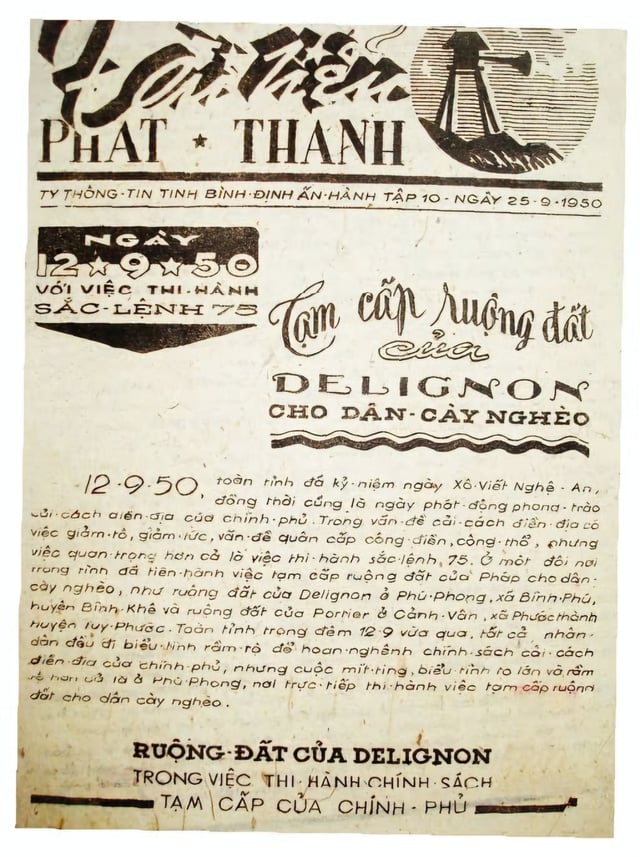
Radio broadcast material published by the Information and Propaganda Department of Binh Dinh province on September 25, 1950.
PHOTO: ARCHIVE
The Voice of Southern Vietnam Radio Station was established on the instructions of Mr. Pham Van Dong, the Central Party and Government's special envoy to Zone 5, to support the Voice of Vietnam Radio Station. Initially, the station was located at Tho Loc communal house, Ton Dinh village (now Tho Loc hamlet, Tinh Ha commune, Son Tinh district, Quang Ngai province ). In 1947, the station moved to the Nuoc Bo area, An Ninh village (now An Dung commune, An Lao district, Binh Dinh province) with the new name Voice of Southern Vietnam Radio Station, under the management of the Southern Central Vietnam Administrative Resistance Committee and the leadership of the Standing Committee of the Zone 5 Party Committee.
In late 1948, the radio station moved to Nuoc Trong, An Thanh village (now An Trung commune, An Lao district, Binh Dinh province). Initially, the station broadcast in Vietnamese, but later added French and English. The station's programs included news and music , primarily focusing on war news, domestic and international affairs, government directives, and commentary to help people understand the schemes and tactics of the French colonialists, and to call for patriotism and unity in the fight against foreign invaders.
By mid-1953, the Voice of Vietnam radio waves had become stronger, covering almost the entire country. The Southern Resistance Radio (1948) and the Saigon-Chợ Lớn Free Radio had stabilized, so according to government policy, the Voice of the South gradually reduced its operations, ceasing completely in December 1954, ending a seven-year period of accompanying the people of the South and the entire country in the fight against the invading forces.
According to the History of Journalism in Binh Dinh Province (1930 - 2020), although the Voice of the South radio station was located in Binh Dinh, the low-power transmitters had a narrow coverage area, and furthermore, the majority of officials and people did not have radios to listen to the radio; while printed newspapers, such as the Central People 's Newspaper and the National Salvation Newspaper, and newspapers published by Binh Dinh province, had very low circulation, and the majority of the population was illiterate, the dissemination of information was very limited, hardly reaching even villages, hamlets, and households.
To disseminate the Party and Government's guidelines, policies, and strategies to the grassroots level, and in compliance with the directives of the leaders of Military Region 5, the Information and Propaganda Department of Binh Dinh province and the liberated areas of the provinces in Region 5 developed "radio broadcasting towers" to update news on the resistance and national reconstruction to every village and hamlet.
In Binh Dinh province, broadcasting booths have spread to even the most remote villages. These booths are built in the style of small stilt houses, about 5-6 meters above the ground, or stand independently on four pillars, or are placed on top of tall trees. The materials used are woven mats, coconut leaves, thatch, and bamboo. The broadcasting equipment consists of loudspeakers made of sheet metal or palm leaf sheaths.
Broadcasting booths are usually erected in the center of the village, with one booth per village. Smaller communes, lacking information officers, may only have one booth in the center of the commune, where there is a large population and the commune's offices are located. Notably, some villages, such as An Thuong village in An Thanh commune, Hoai An district (Binh Dinh province), have as many as three broadcasting booths in three densely populated areas: Hoc Nghe, Phu Cu, and Dong Tron.
The broadcasting booths located in the villages of the commune are all managed by the commune's information and propaganda officers. The information broadcasts mainly rely on articles from provincial newspapers, the central newspapers Nhan Dan and Cuu Quoc , and newsletters sent down from the provincial information and propaganda departments. Each month, the Binh Dinh Provincial Information and Propaganda Department publishes 3-5 issues of broadcasting materials to support the information and propaganda work of the broadcasting booths.
Initially, provincial and district information officers went to the communes to assist commune information officers in implementing the propaganda program at the broadcasting booths. Later, due to the strong development of the broadcasting booth network, the Department of Information and Propaganda of Binh Dinh province opened training courses for grassroots information officers to organize daily broadcasts themselves.
Every day, after two shifts of work, around 7-8 pm, people would gather under the broadcasting booth to listen to the news, especially news about the war in various places. In some areas, the number of listeners could reach hundreds. Besides the news, the broadcasts from the booth also included musical performances such as revolutionary songs, resistance songs, folk songs, traditional rhymes, and theatrical performances by the local people. Although the performances were "homegrown," listeners were attentive and thoroughly enjoyed both the news broadcasts and the singing; no one left halfway through.
During periods of intensified enemy attacks, in some places, the broadcasting towers even became watchtowers for enemy aircraft and warships. When warships were lurking at sea or planes were circling overhead, the people in the broadcasting towers would repeatedly strike gongs and drums to alert the population and allow them to take precautions.
Despite the rudimentary equipment, thanks to its extensive network reaching down to the grassroots level and its continuous operation throughout the resistance war against the French, the broadcasting booths promptly informed the majority of the population about the policies and guidelines of the Party, Government, and local authorities; the situation regarding agricultural production, rear-area construction, and news of victories throughout the province, in Military Region 5, and the entire country; and encouraged and motivated all strata of the people to enthusiastically promote patriotic emulation and actively contribute to the victory of the resistance war against the French.
Thanks to the establishment of the broadcasting booth, a form of collective reading, important news articles published in newspapers, especially those explaining the Party's guidelines, policies, and strategies; news of victories, achievements in production, service to the front lines, development of education, culture, and health... were conveyed to the community, contributing to encouraging and motivating the emulation movement of resistance and national construction among all strata of the people in the province.
The radio booth can be considered the precursor to the spoken newspaper that later developed into the broadcasting industry of Binh Dinh province.
Source: https://thanhnien.vn/choi-phat-thanh-to-bao-noi-doc-dao-trong-khang-chien-185250616211941436.htm





![[Photo] General Secretary and President To Lam presides over a meeting on preparations for the review of one year of operation of the three-tiered government system.](https://vphoto.vietnam.vn/thumb/1200x675/vietnam/resource/IMAGE/2026/06/02/1780391821195_a1-bnd-4595-9717-jpg.webp)























































































Comment (0)