

Localities in the province are focusing on caring for and thinning the rice crop. To protect the rice crop and ensure its good growth and development, high yield, and quality, the agricultural sector has actively coordinated with localities to guide farmers in implementing measures to care for the crop and prevent and control pests and diseases.
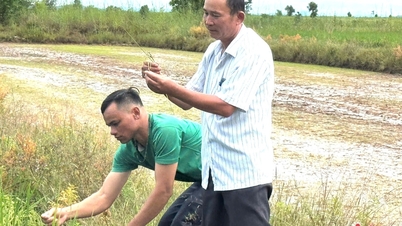
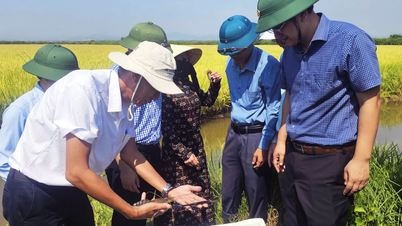
Officials from the Dong Hung District Plant Cultivation and Protection Station inspect for pests and diseases in the fields.
Currently, the early-season rice crop in Kien Xuong district is in the late tillering stage, while the main rice crop is tillering to vigorous tillering. A small number of crops affected by natural disasters have been replanted and are recovering and tillering. The weather conditions at the beginning of the season have been unfavorable, with alternating rain and sunshine, and heavy rainfall affecting rice growth and development. This also creates favorable conditions for the emergence and spread of pests and diseases such as stem borers, rats, small leaf rollers, and especially the appearance of black striped dwarf disease.
Mr. Nguyen Duc Thinh, Head of the District's Crop Cultivation and Plant Protection Station, said: The station has issued notices and guidelines on caring for and controlling pests and diseases in the rice crop. Accordingly, for early and main crop areas where the rice is growing well, it is necessary to apply topdressing fertilizer and potassium fertilizer from August 10th to 25th. Short-day varieties and fields that grow well early should be fertilized at the beginning of the schedule, while long-day varieties that are not yet growing well should be fertilized at the end of the schedule. For areas where replanting is needed, farmers should continue thinning and fertilizing, choosing high-quality fertilizers and applying the correct and sufficient amount as recommended. In addition, the station has taken samples of white-backed planthoppers for testing, and the results showed that some samples tested positive for black striped dwarf virus. The disease is appearing sporadically, and we request that cooperatives guide farmers to inspect their fields when rice plants or clumps show symptoms of stunted growth, twisted leaves, dark green color, and roots growing upwards, and to notify the local authorities or specialized agencies. When identifying diseased rice plants or clumps, it is necessary to destroy the diseased plants and simultaneously spray to prevent and control white-backed planthoppers in the affected rice area.
To date, the rice crops are generally growing and developing well. Early rice is in the panicle differentiation to heading stage, while the main rice crop is in the tillering to late tillering stage. Some areas, due to the impact of rain and flooding, have had to be replanted and thinned during the rooting and greening stage. To ensure good growth and development of the main rice crop, the agricultural sector requests that localities disseminate information and guide farmers to focus on proper care and water management. For areas where rice is being thinned or replanted and is growing slowly, it is necessary to promptly apply fertilizer and maintain shallow water on the field surface to maximize tillering; drain the water and dry the field after tillering to allow the roots to penetrate deeply and prevent lodging in the late season; for areas entering the panicle differentiation stage, it is necessary to urgently supplement with potassium fertilizer, at a rate of 2-4 kg/sao (1 sao = 360 square meters) to help the plant increase its resistance to external conditions and facilitate flower bud differentiation, contributing to increased rice yield.
It is expected that by September 5th, over 20,000 hectares of early-season rice in the province will have bloomed. Furthermore, according to forecasts from specialized agencies and field inspections, the two-spotted rice stem borer is at risk of early emergence and severe damage in the fields from the beginning of August, creating several peaks in August. In Dong Hung, the density of adult two-spotted rice stem borers (4th generation) is high in some areas, ranging from 0.1 - 0.3 individuals/ m² , with exceptional cases of 1 - 2 individuals/ m² ; egg clusters are high in some areas, ranging from 0.3 - 0.5 clusters/ m² , with exceptional cases of 1 - 2 clusters/ m² .
Ms. Vu Thi Nhue, Head of the District's Crop Cultivation and Plant Protection Station, said: The fourth generation of two-spotted rice stem borers emerged early with very high densities. If not controlled promptly, they will cause whiteheads in rice fields that flower from August to early September, causing severe stunting of panicles and tillers in areas with high pest density, such as areas near villages, near artificial lights, and near abandoned areas. Communes with high pest density this time include: Do Luong, Dong Xa, Dong Cac, Dong Xuan, Dong Duong, Ha Giang, Dong Vinh... The station has issued notices and guidance on controlling the two-spotted rice stem borer and launched a spraying campaign from September 6-9 for rice fields that flowered before September 5. Because the timing of spraying for the two-spotted stem borer this year is earlier than the average of previous years, it is recommended that localities use various forms of active communication to ensure that people understand the pest situation and focus on controlling the correct pests and diseases in the right areas as recommended by specialized agencies.
Mr. Nguyen Xuan Thanh, Deputy Head of the Department of Crop Production and Plant Protection, said: It is estimated that about 25,000 - 30,000 hectares of rice fields, concentrated in the districts of Hung Ha, Dong Hung, Quynh Phu, Thai Thuy, and Vu Thu, will need to be sprayed with pesticides to control the two-spotted rice stem borer. The Department has advised the Department of Agriculture and Rural Development to issue a directive on crop care and pest control, and at the same time requested the crop production and plant protection stations in the districts and cities to urgently identify areas with high densities of two-spotted rice stem borers and other pests that need to be controlled; and guide farmers on technical measures to prevent and control damage caused by pests and diseases.
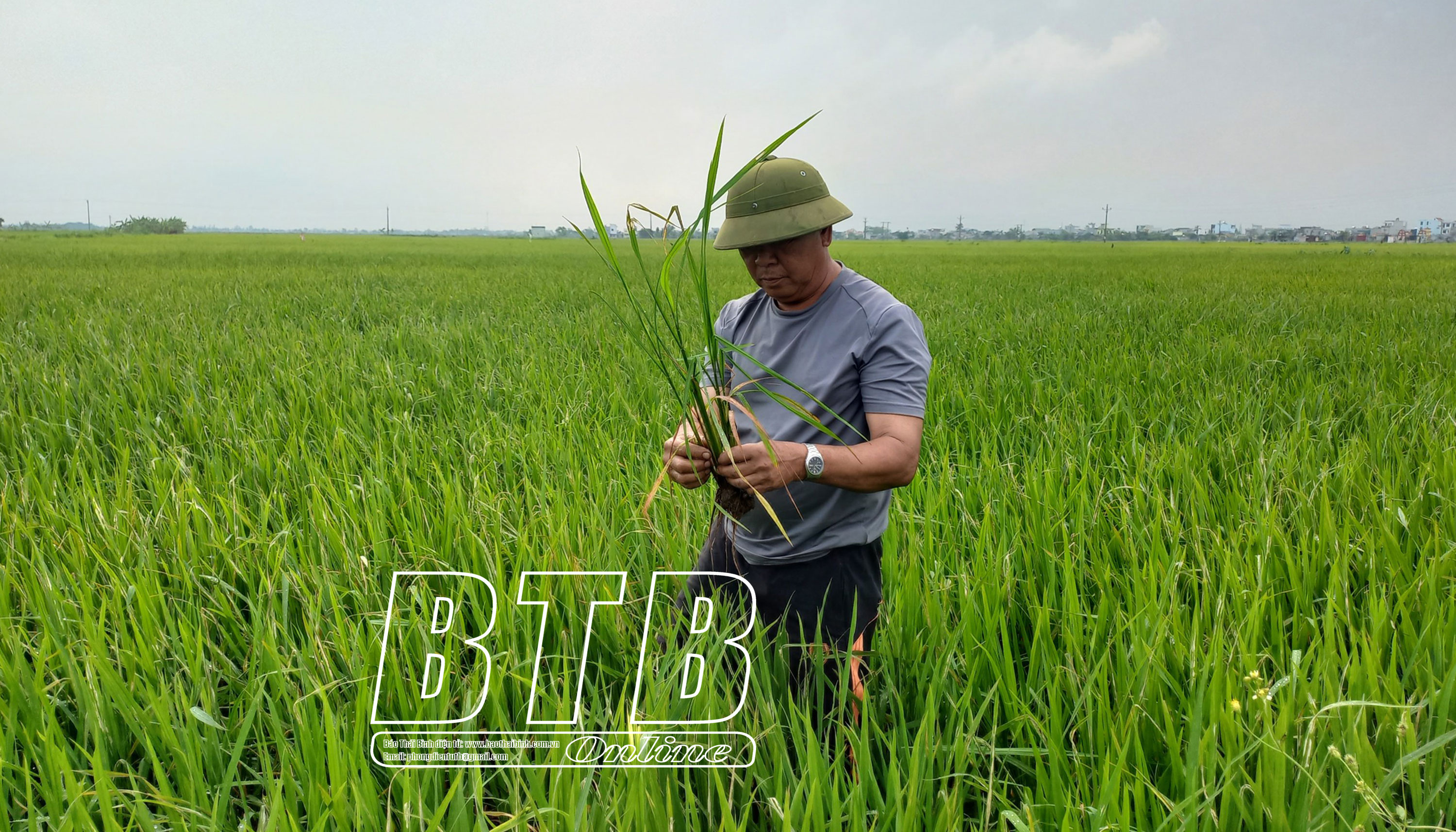
The agricultural sector advises farmers to regularly inspect their fields to promptly detect pests and diseases affecting rice crops.
Luu Ngan
Source: https://baothaibinh.com.vn/tin-tuc/4/205259/chu-dong-cham-care-protect-rice-and-crops

![[Photo] General Secretary and President To Lam presides over a meeting on assessing national development resources.](https://vphoto.vietnam.vn/thumb/1200x675/vietnam/resource/IMAGE/2026/05/20/1779253785852_a1-bnd-2943-8519-jpg.webp)














































































Comment (0)