

In anticipation of widespread and severe drought, water shortages, and saltwater intrusion, the agricultural sector and local authorities in the province are proactively implementing various solutions to ensure the safety of agricultural production and minimize damage caused by drought, water shortages, and saltwater intrusion.

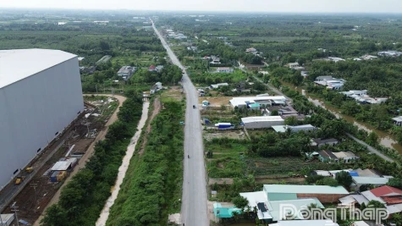
The Thuy Khe pumping station ensures irrigation water for agricultural production in Gio Linh - Photo: LA
According to statistics from the Department of Agriculture and Rural Development, the total water level in irrigation reservoirs in the province currently stands at approximately 67%, while the Quang Tri irrigation-hydroelectric reservoir is at about 72% of its designed capacity. Meanwhile, according to forecasts from the Provincial Meteorological and Hydrological Station, due to the influence of El Nino, this year's dry season will be longer and more intense than the average of previous years. Average temperatures are expected to be 0.5-1.5 degrees Celsius higher than the average of previous years. Total rainfall is expected to be 20-30% lower than the average of previous years.
In particular, the flow rate on the Ben Hai River from May to July 2024 only reached 10.1 - 17.2%, which is 82.8 - 89.9% lower than the average for the same period in previous years. According to Ho Xuan Hoe, Director of the Department of Agriculture and Rural Development, with the current water levels in reservoirs and the predicted weather trends, the summer-autumn crop season faces a high risk of water shortage, drought, and widespread saltwater intrusion throughout the province.
Providing irrigation water for agricultural production will face many difficulties, especially during the rice heading and flowering stages. Based on calculations of water balance, the area lacking water and requiring pumping support is over 3,280 hectares; of which, approximately 1,960 hectares are managed by the Irrigation Works Management and Exploitation Company Limited, and over 1,320 hectares are managed by local authorities. Approximately 738 hectares need to be converted for the summer-autumn crop season.
Mr. Ho Xuan Hoe further stated that, in order to proactively respond to the risks of drought, water shortage, and saltwater intrusion, and to serve the summer-autumn crop production, the agricultural sector has proactively implemented response solutions such as: advising farmers to increase the application of advanced and water-saving irrigation solutions for crops; in case of water shortage, prioritizing water supply for daily life, high -value crops, and other essential needs; implementing decentralized water storage on a small scale by households and groups of households to ensure the minimum needs for daily life, livestock, and dryland crops are met.
Implement irrigation solutions such as dredging water intake gates and canal systems, digging ponds and wells, building temporary dams to prevent saltwater intrusion, and installing mobile pumping stations to improve water flow and maximize the utilization of returned water resources. Arrange a suitable cropping structure, prioritizing the use of short-growing, drought-resistant, and high-economic-value crop varieties.
Develop regional and inter-regional water regulation plans, and implement rotational water supply during necessary stages of rice cultivation; ensuring sufficient irrigation water, especially during the heading and flowering stages. Coordinate with Quang Tri Hydropower Company and other hydropower reservoir owners in the area to develop and agree on a water regulation plan for downstream areas to serve agricultural production.
Review and identify areas at risk of rural water shortages, assess the availability of water for domestic use, and develop plans and implement measures to provide clean water to residents, such as establishing centralized water supply points, extending water supply pipelines, providing water storage equipment, and using mobile water transport vehicles to deliver water to residential areas.
Local authorities are urged to promptly convert 738 hectares of water-scarce rice land to dryland crops suitable to the farming characteristics and soil conditions of each region. Simultaneously, they should effectively operate irrigation systems and facilities to obtain water and proactively store water to ensure minimum irrigation needs for crops are met during water shortages, minimizing losses to production and business, especially agricultural production.
Identify areas at risk of water shortages to proactively organize and implement solutions to ensure the supply of clean water for the people, preventing any shortage. If necessary, mobilize forces and water transport vehicles to supply the people. "The agricultural sector has also proposed that the Provincial People's Committee approve a drought relief fund of over 12.7 billion VND," Mr. Hoè informed.
Le An
Source


![[Image] Central Party Office summarizes work in 2025](/_next/image?url=https%3A%2F%2Fvphoto.vietnam.vn%2Fthumb%2F1200x675%2Fvietnam%2Fresource%2FIMAGE%2F2025%2F12%2F18%2F1766065572073_vptw-hoi-nghi-tong-ket-89-1204-jpg.webp&w=3840&q=75)














































































Comment (0)