

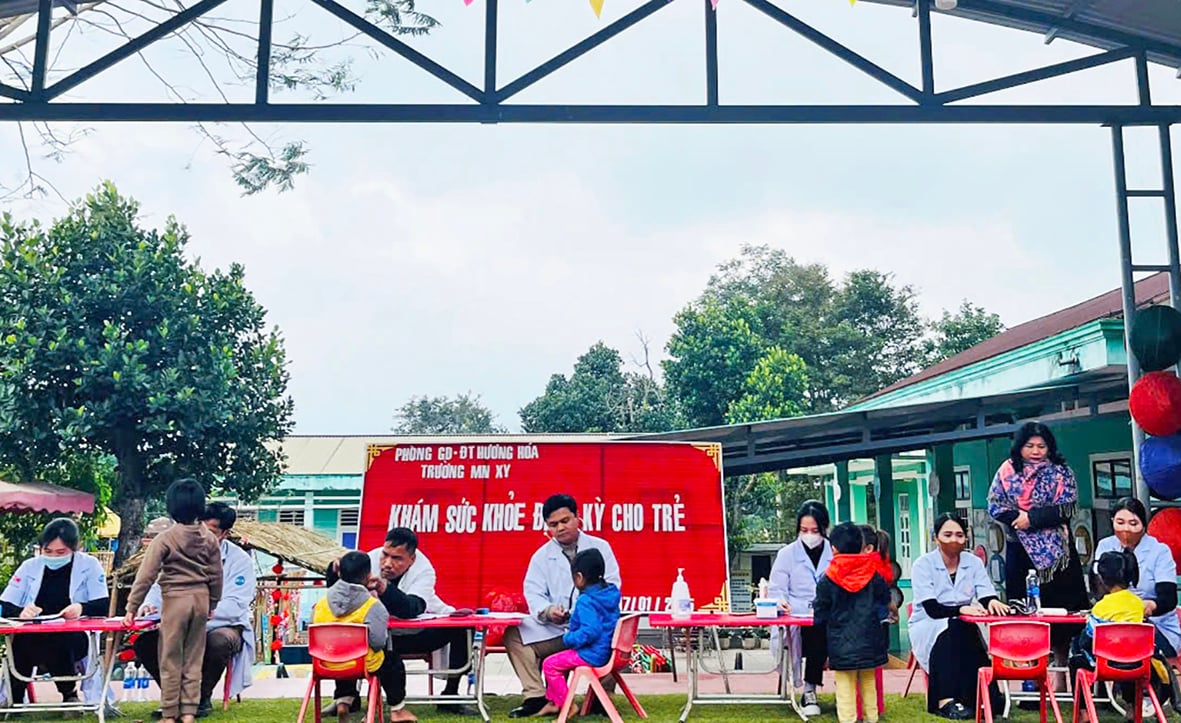
Regular health check-ups for children at Xy Kindergarten - Photo: ML
Alongside effectively nurturing and educating children, Xy Kindergarten (Huong Hoa district) always prioritizes the care and management of students' health and disease prevention within the school. In the 2024-2025 school year, the school has 9 groups/classes with 231 students. At the beginning of each school year, the school develops a school health plan.
Implement effective measures to protect and care for children's health, and establish a school health room. Regularly coordinate with the commune health station to organize activities to prevent and control various infectious diseases in schools and new outbreaks. Organize health education, care, personal hygiene, and disease prevention activities in schools.
Ensuring food safety and hygiene, preventing food poisoning incidents in the school. Coordinating with the Huong Hoa District Health Center to conduct regular health check-ups for children. This allows us to monitor the weight, physical condition, and health status of each student, providing timely advice and coordinating with families for treatment if the children fall ill.
According to Do Uyen Thien Minh, Principal of Xy Kindergarten: “The school carefully selects and prepares each meal for the children, ensuring proper nutrition. In addition, the school regularly cleans and disinfects classrooms, toys, and other supplies used in the daycare program to prevent the spread of disease.”
The school's medical facilities are adequately equipped and meet standards, including a spacious and well-ventilated infirmary with beds, medicine cabinets, first aid equipment, work desks, lights, and fans. The school has a health care steering committee that collaborates with medical staff and homeroom teachers to monitor and provide primary healthcare and manage children. This helps ensure their health and motivates them to feel that "Every day at school is a happy day."
The province currently has 177,228 children and students, distributed across 386 educational institutions from preschool to high school. School health, nutrition, disease prevention, physical fitness improvement, and psychological support activities are implemented with close coordination between the education and health sectors and other organizations and associations.
During the period 2019-2025, Quang Tri province will focus on protecting and caring for the health of children and students through the synchronized implementation of government programs and projects. District, town, and city health centers will effectively support schools in health check-ups, disease prevention, and vaccination.
Several schools have received investment for the construction and upgrading of infirmaries and healthcare equipment for students. Programs and projects allocate budgets from the central and local governments, as well as mobilize social resources and financial support for implementation. The percentage of schools with health care staff is increasing, especially in primary and secondary schools. Currently, 100% of schools have health care staff, with approximately 60% being full-time staff and 40% having part-time duties. Many staff members receive regular professional training to improve their first aid and basic healthcare skills.
Health education and awareness programs for students are regularly implemented through various forms such as direct communication and integration into extracurricular activities and class time. Parents and students are increasingly concerned about nutrition, personal hygiene, and disease prevention. During the period 2019-2025, Quang Tri province has focused on investing in and improving facilities to support student health care at educational institutions.
By 2025, approximately 72% of schools throughout the province will have separate medical rooms that meet the required area and basic equipment standards. 100% of schools will have first-aid kits, which are supplemented annually from the budget or social contributions. Some schools receive support in the form of hospital beds, first-aid kits, blood pressure monitors, and digital thermometers; however, this is still unevenly distributed across different educational levels, especially in private kindergens and secondary schools in disadvantaged areas. 98.7% of schools will have access to clean and hygienic water, which is regularly inspected. The percentage of schools with standard toilets will reach approximately 82%, an increase of 17% compared to 2019.
In addition, the province is paying attention to and gradually improving the quality of physical education and developing sports activities in schools. Many efforts have been made to improve school nutrition, ensuring food safety in organizing meals for boarding students, especially in preschools and primary schools. Coordination with local health facilities in monitoring epidemiological situations, food safety, and drinking water in schools is also being prioritized.
By 2025, over 65% of primary schools and 100% of kindergartens in the province will have boarding facilities. Nine out of ten districts, towns, and cities will have established models of school health and grassroots health coordination. The total funding mobilized for school health programs and projects in the province from 2019 to 2025 is nearly 25 billion VND. The percentage of schools receiving medical equipment support from social mobilization sources will reach 68%.
According to the Director of the Department of Education and Training, Le Thi Huong, in the coming time, the provincial education sector will continue to maintain and improve the quality of implementing the Prime Minister's programs and projects on school health and child and student health care for the period 2019 - 2025.
This includes focusing on practical content that is appropriate to the actual conditions in the locality and at each educational level. It also involves strengthening investment in school health facilities towards standardization and uniformity, ensuring that 100% of schools have a health room with minimum equipment for first aid and basic health care.
Recruit and assign sufficient dedicated or part-time school health staff as required, while also promoting training and improving the capacity and professional skills of this team. Develop a software-based system for managing student health records, connecting data between the education and health sectors, and moving towards synchronizing health information from the school level to the provincial level.
Strengthening health communication and education for students on a regular basis, innovating in form and content, with a focus on topics such as: mental health, proper nutrition, prevention of school-related diseases, non-communicable diseases, and emerging infectious diseases.
Kan Suong
Source: https://baoquangtri.vn/chu-trong-cham-care-health-students-194305.htm






![[Photo] Prime Minister Pham Minh Chinh presides over the conference announcing the establishment of the International Finance Centre in Vietnam.](/_next/image?url=https%3A%2F%2Fvphoto.vietnam.vn%2Fthumb%2F1200x675%2Fvietnam%2Fresource%2FIMAGE%2F2025%2F12%2F21%2F1766309817714_ndo_br_dsc-3400-jpg.webp&w=3840&q=75)

































































Comment (0)