

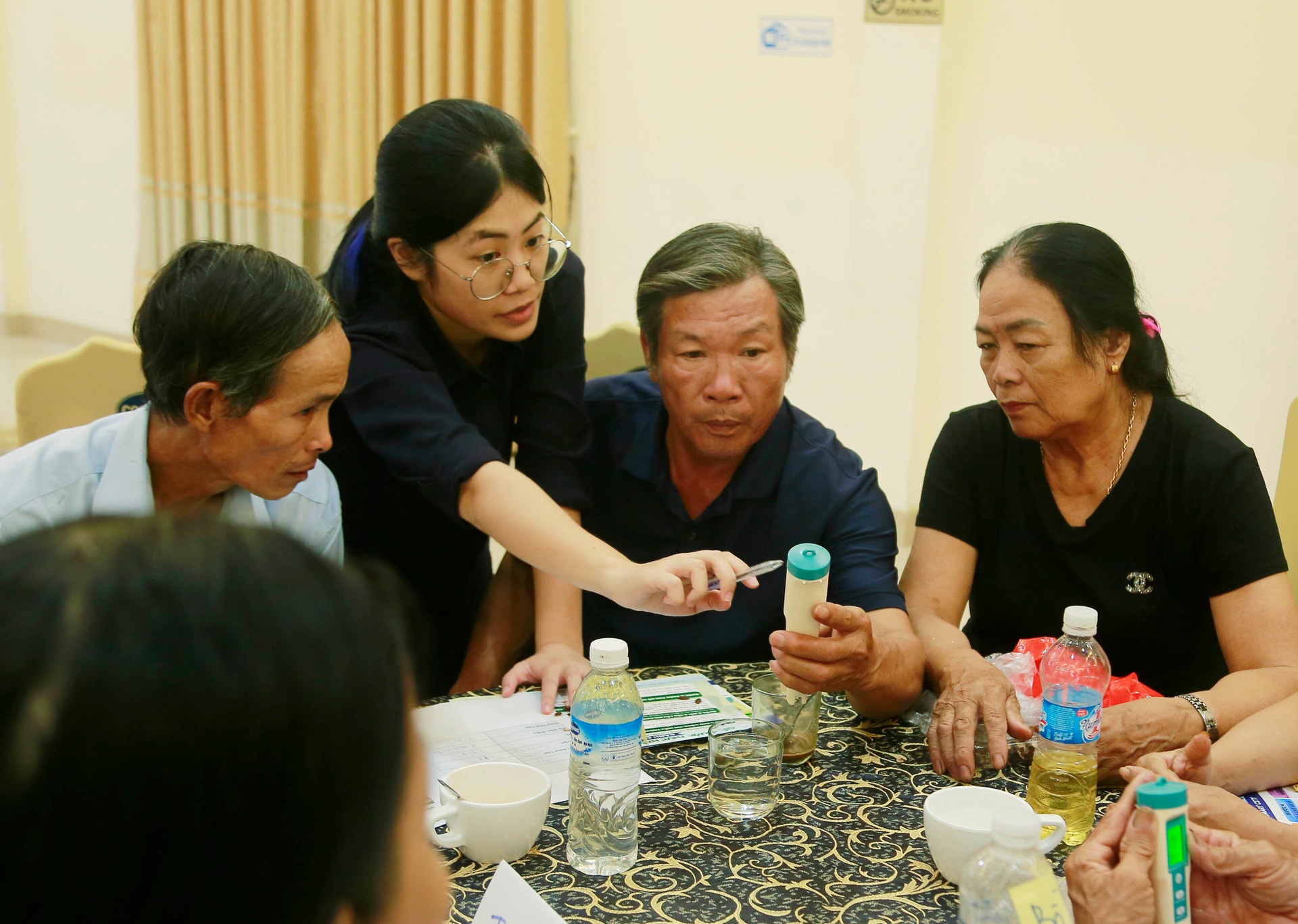
"Taking the pulse," "screening the health" of the river.
Having lived their entire lives connected to the Cu De River, it wasn't until they joined the river health monitoring team, learning both theory and practical skills, that the Co Tu people in the residential areas of Hai Van ward witnessed firsthand the scientific indicators of the river's health, originating from the Truong Son mountain range and flowing into the Nam O estuary.
After completing the training program on monitoring and using handheld water quality measuring devices, residents of Ta Lang, Gian Bi, and Nam My neighborhoods were given the opportunity to conduct a "clinical examination" of the river, stretching nearly 40km from upstream to downstream.
Their job is to observe the color of the river water, turbidity, aquatic life, sources of pollution, and activities and behaviors that harm the water source. They also personally collect river water samples and use equipment to measure water quality indicators such as pH, suspended solids, salinity, and the level of water pollution.
Over the past few days, the six members of the river health monitoring and protection team in Ta Lang residential area have been divided into two groups to monitor the Nam River area, the upstream of the Cu De River. Each person uses handheld devices to measure water quality, updating data from multiple locations and at various times to provide objective assessments.
Along with monitoring water sources, the team also conducts monthly inspections and protects fish stocks, and promptly reports any potential threats to aquatic resources in the river.
"Since we've been given the opportunity and have some knowledge, we must practice it seriously before spreading the word or encouraging others not to litter or damage the riverbanks and riverbeds. When strangers come to the streams or illegally enter the forest, we must quickly report it to the authorities," said Deputy Team Leader Ha Xuan Tau.
This unique model involves the active participation of women. Their meticulousness, responsibility, and commitment to community life have helped them become "nurses," handling the detailed aspects of routine health checkups for the Cu De ethnic group.
According to Ms. Tran Thi Phuong (Gian Bi residential group), in addition to monitoring water quality, the members also actively participate in collecting waste, and educating residents and tourists not to exploit resources in a destructive way that depletes aquatic life.
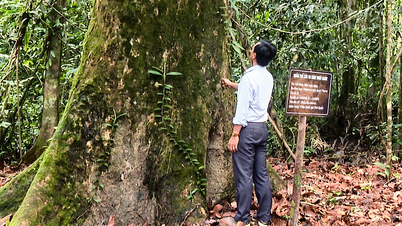
Nguyen Van Trung, head of the Ta Lang neighborhood's Fatherland Front Committee and someone deeply involved in the lives and activities of the Co Tu people, said that the Ta Lang and Gian Bi communities rely on stream and spring water for drinking and daily life, and therefore have a strong awareness of protecting water resources. When the Nam My dam was built to supply water to the Hoa Lien Water Treatment Plant, the people became even more aware of their responsibility, as everyone understood that river water is crucial to their lives, health, and livelihoods.
Since the project "Promoting effective community participation in environmental protection and sustainable water resource management in Da Nang " was implemented locally, many awareness campaigns, training sessions, and guidance programs have been organized to help people protect water resources.
“There has been a positive change in people's thinking and actions. It's no longer vague but manifested in concrete actions. People are very much hoping to receive attention from all levels of government so that they can both participate in the project and benefit from it, which is linked to sustainable livelihoods,” Mr. Trung expressed his hope.
The river health care project has also been implemented in Thai Lai village (Ba Na commune), Bac An village (Hoa Tien commune), Thach Bo and Bo Ban villages (Hoa Vang commune). Community monitoring teams also periodically "inspect" and measure water quality in Bau Trai lake, Tuy Loan river and Yen river... to protect water sources for domestic use and agricultural production. This is also the water source supplying the Cau Do Water Treatment Plant, ensuring a quality water supply for the city.
Resources are linked to livelihoods.
The project "Promoting effective community participation in environmental protection and sustainable water resource management in Da Nang City" is being implemented by the Center for Environmental and Community Research (CECR) in collaboration with various units and localities from October 2024 to October 2027, with funding from the Stichting Oxfam Novib organization.
According to Ms. Nguyen Ngoc Ly, Chairwoman of the CECR Management Board, the project is being implemented to promote community participation in environmental protection and sustainable water resource management in Da Nang.
Ms. Ly shared that the health of a river is not only reflected in its abundant water volume but also in its aquatic life, healthy ecosystem, and guaranteed water quality indicators.
standard.
Implemented in 7 villages and residential areas along the river basins of Hoa Vang, Ba Na, Hoa Tien communes and Hai Van ward, the model aims to empower local communities to become the main actors in protecting the environment and water resources, in accordance with the spirit of the Environmental Protection Law.
By connecting people with experts to transfer knowledge, providing equipment, manuals, and guidance on updating data to digital platforms, CECR has contributed to enhancing people's capacity in monitoring and protecting the health of rivers that are closely linked to their lives and livelihoods.
"Healthy rivers contribute to ensuring human health and socio-economic development," Ms. Ly said.
Accompanying the project, Mr. Nguyen Ba Son - Chairman of the Da Nang Lawyers Association - assessed that Da Nang's rivers are not only closely linked to the lives of people along the river basins but also contribute to ensuring water security for the city center. In recent times, water protection activities have focused on controlling tourism activities and wastewater discharges, ensuring compliance with technical standards, and limiting the construction of projects that impact the river flow.
Source: https://baodanang.vn/chung-tay-bao-ve-suc-khoe-dong-song-3338775.html








![Water security in the Mekong Delta: [Part 2] 'The vicious cycle of degradation' is difficult to reverse.](https://vphoto.vietnam.vn/thumb/402x226/vietnam/resource/IMAGE/2026/05/29/1780020596526_4209-han-dbscl1-094000_891.jpeg)


![Water security in the Mekong Delta: [Part 1] When the 'rice bowl' gradually loses its ability to retain people.](https://vphoto.vietnam.vn/thumb/402x226/vietnam/resource/IMAGE/2026/05/28/1779937163427_1415-image00220230718165933-17068901867521153615427-111010_61.jpeg)











![[Video] Sunset at Lap An Lagoon – Where the sun sets over the fishing nets](https://vphoto.vietnam.vn/thumb/340x192/vietnam/resource/IMAGE/2026/05/31/1780192137701_beach-landscape-sea-water-nature-grass-745871-pxhere-com.jpeg)




![[Photo] The General Secretary, President and his wife lay flowers at the Ho Chi Minh Monument in Manila.](https://vphoto.vietnam.vn/thumb/1200x675/vietnam/resource/IMAGE/2026/05/31/1780219759477_anh-man-hinh-2026-05-31-luc-16-29-07.png)
























































Comment (0)