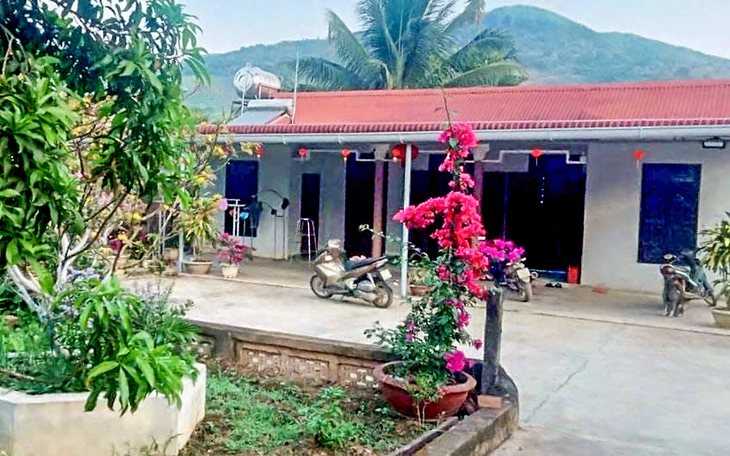
The new house is more spacious and comfortable - Photo: Provided by the owner.
Missing my hometown, my father planted a row of betel nut trees in front of the house, and the path leading to it was covered with bougainvillea flowers. By the time I was 10, the red tiled roof was covered with green moss, and the crossbeams had turned black with age.
I often spread my arms wide to embrace them, vividly remembering the cool sensation of my cheek pressed against the four old, sturdy pillars. A faint scent of wood, the smell of firewood smoke, the scent of "people," and even the earthy smell of the forest wafted through the air.
In the central room, my father placed the ancestral altar, solemn and cozy. On either side, one side held my parents' bed, and the other was the bedroom of my older brother and sister-in-law. We children, with our hair still in topknots, slept together on a wooden platform in the middle of the room.
The winter was bitterly cold, yet always warm with human presence, even as the biting wind seeped through the gaps in the wooden floor. Night after night, Mother turned up the wick of the oil lamp and diligently sewed clothes. The four children lay sprawled on the wooden platform, listening intently as Mother told stories about the village and their homeland.
After some time, my parents expanded their farm, alternating between growing tobacco and watermelons to earn money during the months waiting for the coffee harvest. These were short-term crops that provided quick income but were hard work.
My parents had to build a makeshift shelter in the garden. Only my older brother and sister-in-law were left to manage the household. We, going to school in the morning and returning home in the afternoon, would trail after my mother to the fields. By dusk, we would wait for my father to urge us on before we would drive the buffalo back home. After a quick meal, bath, and some studying, we would all gather on the wooden platform and go to sleep as soon as the chickens went to roost.
Life went on peacefully until one ordinary afternoon, just like any other. My sister-in-law had an argument with my brother and stormed out while the kitchen fire was blazing.
The fire caught the firewood and spread, engulfing the wooden walls. By the time neighbors saw the smoke and shouted for help, the flames had consumed more than half of the house.
My parents rushed back from the fields, their bare feet kicking up clouds of dust. The roof glowed red, the rafters and pillars crumbling amidst desperate screams.
My mother froze, then collapsed to the ground, her hands fumbling, trying to crawl away, but the neighbors restrained her.
My father was also speechless, his hands clenched tightly and trembling. The fire consumed everything we owned. The only things that still retained their original shape were the pots and pans and the tray, cracked and torn by the flames.
After the fire, everyone in my family went their separate ways. My older brother and sister-in-law left our hometown to find work in Ho Chi Minh City. My parents returned to their shack in the fields, dividing up a few sets of clothes that neighbors had brought us to take to our uncles' and aunts' houses.
Every time I walked past the old house on my way to school, all that remained was scorched, dry earth and black, charred ashes. The betel nut trees were charred by the fire, their shriveled, dry fruit swaying in the hot wind. The bougainvillea bushes drooped and withered. I buried my feet in the ground, gazing and sobbing uncontrollably.
The days that followed seemed endless. My parents toiled from dawn till dusk. Of the four of us, two stayed at my aunt's house, and two at my uncle's. We spent one part of the day at school, and the other part we'd meet up to herd the buffalo and go down to the fields to glean melons and strip medicinal leaves.
The melon season was marked by plummeting prices, and the tobacco season was plagued by storms. My parents were worn out and exhausted, yet they never complained, even though their hair turned gray surprisingly quickly. At their most weary, my mother would repeatedly chant, "We must rebuild the house so we can return," like a mantra. It made me understand the importance of home—not just a place to live, but also a source of faith and refuge, a place we could cling to to weather the storms of life.
It took more than three years for that seemingly distant dream to finally come true.
My parents saved up and borrowed more money to dig the foundation and build a new house. It was only fifty square meters, with brick walls painted gray, but to us it was a priceless gift. I remember vividly the day my father called us home to see the house; the wooden door had just opened, and the smell of cement was still strong and pungent. The soft morning sunlight streamed through the window in damp yellow streaks.
My mother stood on the porch, a thin smile gracing her wrinkled, sagging face. My father silently reached out and touched the wall, pretending to pry up the protruding pebbles, his eyes deep and embarrassed. We, her children, clung to her feet and wept. Not because the house was beautiful and spacious, but because after so many storms, we still had a place to return to.
How could I forget those days lying on my aunt's warm mattress, secretly crying and wiping away tears of longing for family reunion? The new house, though only a few dozen square meters for five or six people to live in, was, for me, the happiest shelter, irreplaceable. It was proof of my parents' perseverance and hard work. It was a place that compensated for the brokenness of my childhood, a childhood I thought I lacked.
On our first night in the new house, my sister and I stayed awake, listening to the wind blowing in the garden and the crickets chirping nearby, a sound so familiar and comforting. My father didn't sleep; he stayed up all night sitting in his hammock with the lamp lit. My mother also got up to soak the sticky rice and beans to make sticky rice for the housewarming ceremony the next morning, to invite relatives over to celebrate our return.
The old house may have turned to dust, but the memories of it live on, only they have receded into a deep, hidden corner of my heart.
We invite readers to participate in the writing contest.
A warm spring day
As a special treat for the Lunar New Year, Tuoi Tre newspaper , in partnership with INSEE Cement Company, continues to invite readers to participate in the "Springtime Home" writing contest to share and introduce your home – your warm and cozy haven, its features, and unforgettable memories.
The house where your grandparents, parents, and you were born and raised; the house you built yourself; the house where you celebrated your first Tet (Lunar New Year) with your small family... all can be submitted to the competition to introduce to readers nationwide.
The article "A Warm Spring Home" must not have previously entered any writing competition or been published in any media or social networks. The author is responsible for copyright, the organizing committee has the right to edit, and the author will receive royalties if the article is selected for publication in Tuoi Tre publications.
The competition will take place from December 1, 2025 to January 15, 2026, and all Vietnamese people, regardless of age or profession, are welcome to participate.
The article "A Warm Home on a Spring Day" in Vietnamese should be a maximum of 1,000 words. Including photos and videos is encouraged (photos and videos taken from social media without copyright will not be accepted). Entries will only be accepted via email; postal mail will not be accepted to avoid loss.
Entries should be sent to the email address maiamngayxuan@tuoitre.com.vn.
Authors must provide their address, phone number, email address, bank account number, and citizen identification number so that the organizers can contact them and send royalties or prizes.
Staff and employees of Tuoi Tre newspaper and their family members may participate in the "Warm Home in Spring" writing contest, but they will not be considered for prizes. The organizing committee's decision is final.

The Springtime Shelter Award Ceremony and the Launch of the Youth Spring Special Edition
The judging panel, comprising renowned journalists and cultural figures along with representatives from Tuoi Tre newspaper , will review and award prizes based on the preliminary entries.
The awards ceremony and launch of the Tuoi Tre Spring special issue are scheduled to be held at Nguyen Van Binh Book Street, Ho Chi Minh City, at the end of January 2026.
Prize:
1st prize: 10 million VND + certificate, Tuoi Tre Spring issue;
1 second prize: 7 million VND + certificate, Tuoi Tre Spring issue;
1 third prize: 5 million VND + certificate, Tuoi Tre Spring issue;
5 consolation prizes: 2 million VND each + certificate, Tuoi Tre Spring issue.
10 Readers' Choice Awards: 1 million VND each + certificate, Tuoi Tre Spring Edition.
The voting points are calculated based on interaction with the post, where 1 star = 15 points, 1 heart = 3 points, and 1 like = 2 points.
Back to the topic
HA HONG NGUYEN
Source: https://tuoitre.vn/chung-toi-chap-lai-mai-nha-20260110075937609.htm































![[Photo] Reception to welcome General Secretary and President To Lam and his wife on their State visit to the Philippines](https://vphoto.vietnam.vn/thumb/1200x675/vietnam/resource/IMAGE/2026/06/01/1780295488620_vna-potal-chieu-dai-chao-mung-tong-bi-thu-chu-tich-nuoc-to-lam-va-phu-nhan-tham-cap-nha-nuoc-toi-philippines-8798060-7855-jpg.webp)





























































Comment (0)