

OVERWHELMED DUE TO UNFAMILIARITY WITH THE NEW APPROACH TO THE PROGRAM
As a teacher who experienced both the 2006 and 2018 General Education Programs, Master Tran Van Toan, former head of the mathematics department at Marie Curie High School (District 3, Ho Chi Minh City), believes that the need for extra tutoring is not due to the new or old curriculum, but rather a long-standing need of students, especially high school students, to prepare for exams and university entrance exams. However, according to Mr. Toan, although the 2018 General Education Program has been applied at the high school level for the past three years, it feels that both teachers and students are still not accustomed to the new program, so learning remains stressful.
"The unfamiliarity and anxiety about a lack of knowledge for students to participate in upcoming exams, after a long period of being accustomed to the academic approach of the old curriculum, has led some teachers to 'mix' the old and the new together, making learning the new curriculum stressful. And when under pressure, it naturally leads to extra tutoring," Mr. Toan commented.
According to Mr. Toan, the new curriculum has less time to convey new knowledge to students. Furthermore, the practical, real-world approach in the new curriculum requires teachers to dedicate more time. This makes it difficult for teachers to transition from the old curriculum to the new one. Because they are unfamiliar with the new approach, teachers worry that removing old exercises and replacing them with real-world examples will prevent students from fully grasping the fundamental concepts.
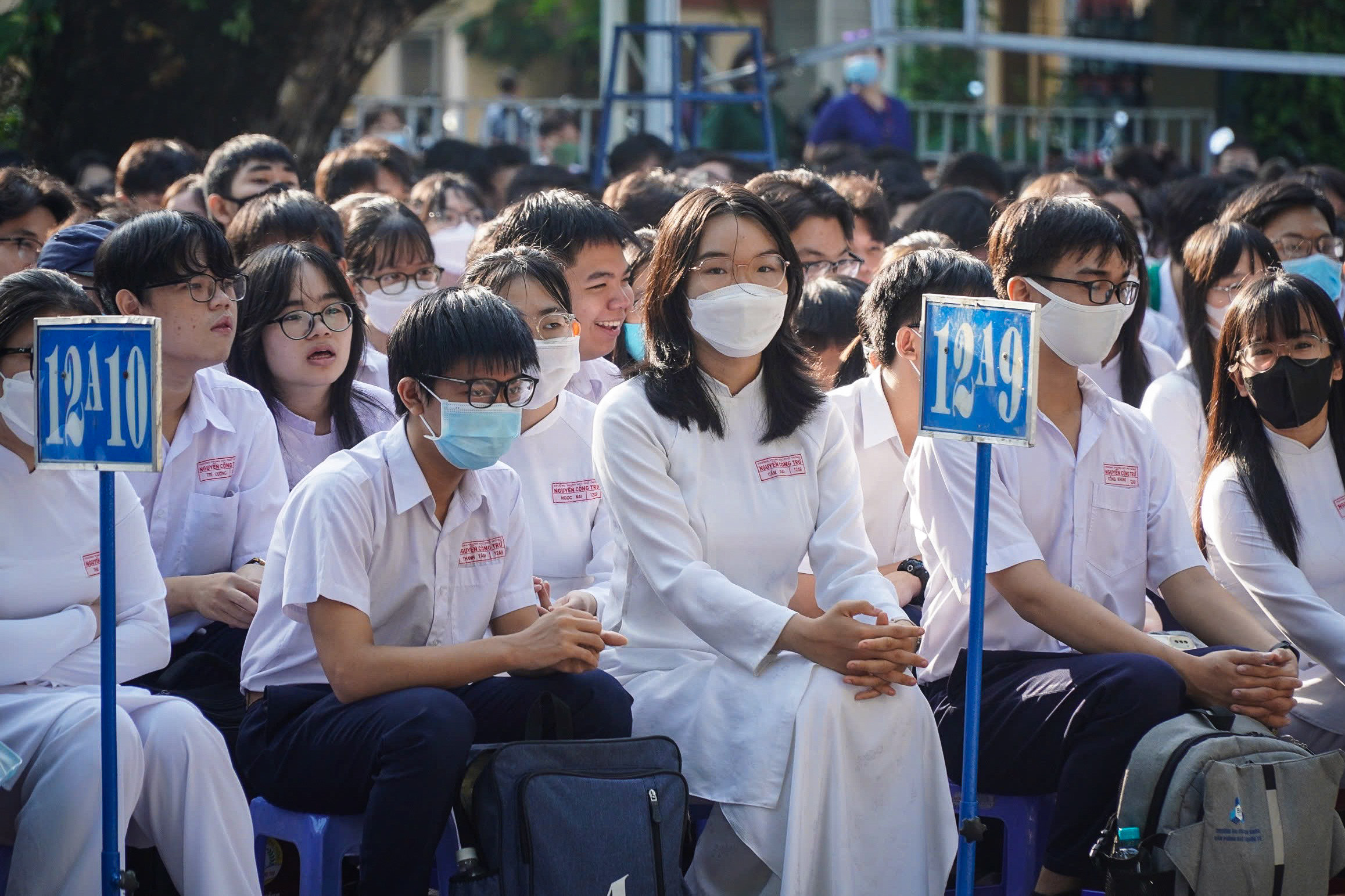
This year's 12th-grade students have had three years of exposure to the 2018 General Education Program and will take the high school graduation exam under the new curriculum.
Mr. Toan cited: "After reviewing some test papers from several schools, I noticed that a lot of knowledge from the old curriculum still lingers. The math curriculum now is no longer as academic as it used to be, nor does it delve too deeply into complex calculations. Instead, it's more closely linked to real-world situations, directly presenting mathematical concepts applicable to practice. That is, in addition to purely mathematical content, teachers have time to teach students practical problems. However, most teachers include real-world examples but are hesitant to include exercises from the old curriculum."
You have to "work hard" to meet the required standards.
Similarly, a high school literature teacher in District 7 (Ho Chi Minh City) noted that in literature class, teachers teach students reading skills by genre to answer reading comprehension questions in tests, but there isn't enough time to analyze certain passages to help students appreciate and understand them more deeply, to develop a more "literary" quality. Therefore, when asked in 12th grade if they were impressed by any characters or remembered any poems from previous grades, the majority answered no.
According to this teacher, if all 105 lessons of the curriculum are taught, both teachers and students would have to work extremely hard to meet the required learning objectives. Some schools offer extra lessons or afternoon classes, allowing teachers and students to better complete the lessons in class. If schools don't offer extra lessons, it's difficult to ensure the required standards are met. Therefore, students may seek out tutoring centers or private tutors to supplement their knowledge.
From another perspective, Mr. Huynh Thanh Phu, Principal of Bui Thi Xuan High School (District 1, Ho Chi Minh City), raised the issue that at the junior high school level, students study natural or social science subjects in an integrated approach, but at the high school level, these subjects are separated into individual subjects and become more specialized and career-oriented. Furthermore, high school students will have to participate in important exams, so extra tutoring is a necessity. "If they only study in school, using basic textbooks, how can they pass the exams? Difficult knowledge needs to be learned at an advanced level, so it's natural for students to worry and seek extra tutoring," Mr. Phu emphasized.
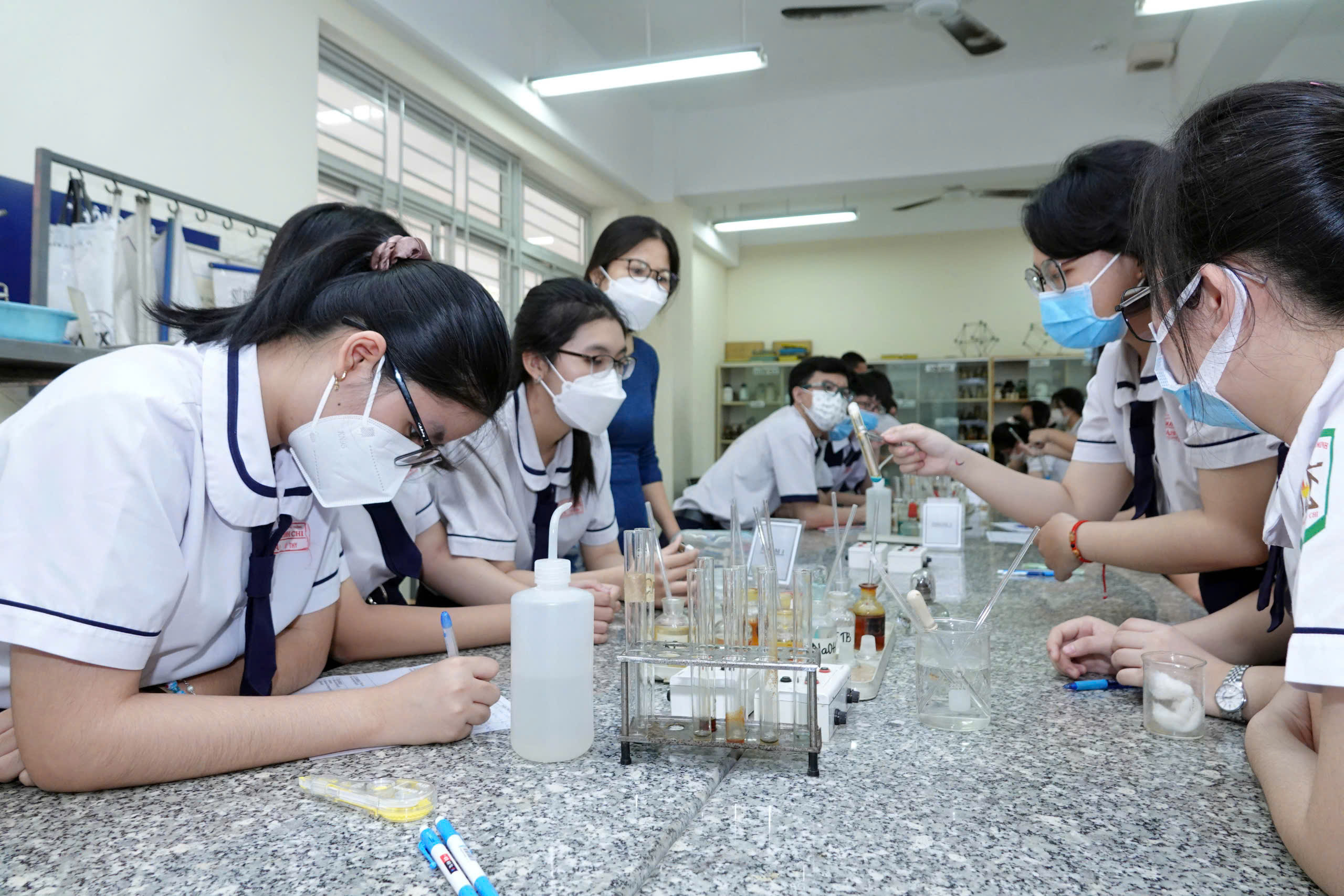
The new program focuses not only on knowledge but, more importantly, on how to combine it to develop and enhance learners' competencies.
PHOTO: DAO NGOC THACH
AVOID COOKING WITH KNOWLEDGE
Ms. Pham Le Thanh, a teacher at Nguyen Hien High School (District 11, Ho Chi Minh City), believes that the 2018 General Education Program is open-ended, with the educational goal not only being to impart knowledge but also to help students complete tasks and initially solve appropriate problems in their studies and lives by effectively and creatively applying the knowledge and skills they have learned.
"Teaching by rote memorization doesn't guarantee that students will understand and be able to apply what they've learned, let alone develop their abilities," Master Thanh commented.
According to Master Thanh, the purpose of teaching is not to equip students with a lot of knowledge or solve many difficult problems, but to help them understand the essence of phenomena and apply the knowledge and skills they have learned. In other words, the curriculum should not only focus on the materials (knowledge, skills, attitudes...), but more importantly, on how they are combined to form and develop the learners' competencies.
Lecturer Pham Le Thanh also noted that each subject in the curriculum is merely a means to develop students' abilities and qualities through learning activities, not to cram subject knowledge into their heads without equipping them with the ability to apply that knowledge to real-world problems. "Without critical thinking and creativity in solving practical situations, it contradicts the goals and perspectives of the new curriculum," Thanh concluded.
The methods of assessment and exam design need improvement.
According to Mr. Thanh, under the 2018 General Education Program, the high school graduation exam from 2025 onwards will only have 4 subjects (2 compulsory, 2 elective). Therefore, learning subjects in the general education program needs to focus on developing competencies and qualities through learning activities. When students achieve competencies, they also achieve optimal knowledge and skills. From there, they can clearly identify which subjects they excel in and choose those subjects for the high school graduation exam, accurately and scientifically orienting their career paths and reducing academic pressure.
However, Master Pham Le Thanh expressed the view that the output objectives of the 2018 General Education Program need improvement in the assessment and design of the high school graduation exam. The exam format needs to be improved to fully and comprehensively assess students' abilities; questions that only assess rote memorization and exercises lacking context and meaning should be limited, as this will prevent the development of competencies in teaching and learning from the mission set forth by the 2018 General Education Program.
The difference between teaching purely about knowledge and developing competencies.
Master Pham Le Thanh used chemistry as an example to demonstrate the difference between teaching knowledge and teaching to develop competencies. Even with the same core scientific knowledge, different teaching methods will contribute to the development of qualities and competencies in different ways.
This can be illustrated with an example of teaching about soap and detergents (Chemistry 12). If taught through lectures, students might only remember the definitions of soap and detergents and write the chemical equation for the saponification reaction. Everything remains on paper. However, when students understand the mechanism of soap's cleaning action, practice making "handmade" soap in the laboratory, measure the pH of the soap, and improve the pH to suit their skin type, scent, and color, the knowledge will be retained for a longer period. Students can be divided into groups and role-play as recruiters for cosmetic chemical engineers and job seekers. Students playing the job seekers will try to convince the recruiter to choose them for a production engineer position using their knowledge of chemistry... This is competency-based teaching.
Students are able to acquire knowledge independently, leading to deeper understanding; this can also help to develop key qualities, such as honesty in scientific research…
Source: https://thanhnien.vn/chuong-trinh-moi-co-lam-tang-nhu-cau-hoc-them-185241009230931535.htm


![[Photo] Prime Minister Pham Minh Chinh attends the Conference on the Implementation of Tasks for 2026 of the Industry and Trade Sector](/_next/image?url=https%3A%2F%2Fvphoto.vietnam.vn%2Fthumb%2F1200x675%2Fvietnam%2Fresource%2FIMAGE%2F2025%2F12%2F19%2F1766159500458_ndo_br_shared31-jpg.webp&w=3840&q=75)


























































Comment (0)