

On the morning of May 30th in Ho Chi Minh City, the Ho Chi Minh City University of Culture and the Vietnam Digital Library (ViLIB) inaugurated the workshop "Digital Transformation of Libraries: Challenges and Opportunities" to jointly identify bottlenecks and propose solutions to promote digital transformation in the library sector in the new phase.

The workshop on Digital Transformation of Libraries: Challenges and Opportunities took place in the context of digital transformation becoming a key national strategy in line with Resolution No. 57-NQ/TW of the Politburo.
Photo: QUYNH TRAN

The "hot" topic of the conference attracted considerable interest from managers, scientists , libraries, publishers, and technology companies.
Photo: QUYNH TRAN
According to the organizers, in response to the demands for accelerating national digital transformation and cultural development in the new era, as outlined in the Politburo 's resolutions, the Vietnamese library sector needs to undergo significant transformation. Innovating operational models, applying technology, and building a digital library ecosystem are considered urgent requirements to meet the need for access to knowledge in the digital age.
In this context, the Vietnam Digital Library (ViLIB) suggests an approach to building a shared digital library model, oriented towards data interoperability, resource sharing, and organizing digital knowledge infrastructure on a system scale.
Why do digital libraries need a shared knowledge infrastructure?
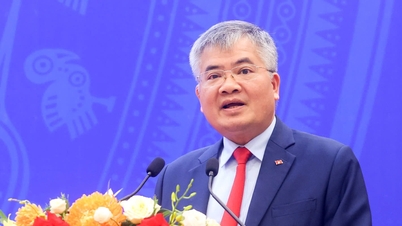
Despite numerous policies and initiatives supporting the development of digital libraries, according to Associate Professor Dr. Nguyen The Dung (Ho Chi Minh City University of Culture), the gap between direction and implementation resources remains a major challenge. This is because developing a digital library involves more than just digitizing documents; it also requires sustainable investment in technological infrastructure, software, data security, database copyright, human resource training, and system operation.

Opinions expressed at the workshop affirmed that digital transformation of libraries in the era of Industry 4.0 is an inevitable trend.
Photo: QUYNH TRAN
"The technological infrastructure of a digital library includes not only computers and the internet but also data standards, interoperability, security, data backup, system scalability, and mobile access. Without a common architecture and standards, libraries will develop their own systems, making interoperability and data sharing difficult, thereby reducing service efficiency and wasting investment resources," Nguyen The Dung analyzed.
Nguyen Anh Dung, founder and chairman of ViLIB, stated: "The biggest bottleneck in the library sector today is not a lack of resources, but rather the fragmentation of resources and the lack of an effective interoperability mechanism. If each library undergoes digital transformation in its own way, it will be very difficult to create systemic strength."
"In the digital age, libraries cannot simply be places for storing knowledge. Libraries need to become part of the national knowledge infrastructure – where knowledge is connected, organized, and served to the community on a larger scale. If Vietnam wants to build a learning society in the digital age, we need to think about a shared digital knowledge infrastructure at the national level," Mr. Nguyen Anh Dung emphasized.
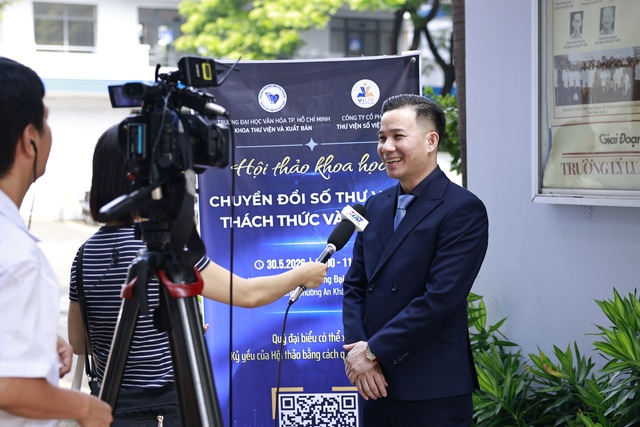
Speaking to the press, ViLIB Chairman Nguyen Anh Dung affirmed: "The shared digital library model is moving towards connecting multiple libraries, supporting the exploitation of legitimate digital resources, expanding access to knowledge, and creating conditions for publishers, authors, and copyright owners to participate together in the digital knowledge ecosystem."
Photo: QUYNH TRAN
Based on practical experience, Master Vinh Quoc Bao, Deputy Director of the Ho Chi Minh City General Science Library, shared at the workshop experiences and lessons related to the digital transformation model for the Ho Chi Minh City public library system in the new context. According to him, in order to assume the role of a central digital coordination hub for the expanded Ho Chi Minh City library system, many bottlenecks need to be addressed soon.
The current situation highlights a lack of synchronized interoperability, a system not designed for large-scale multi-platform integration, and a shortage of remote support tools for a large number of users. Furthermore, the digital resource library primarily focuses on general knowledge, failing to adequately meet the specific cultural, historical, and economic/occupational information needs of the communities in Binh Duong and Ba Ria-Vung Tau. Additionally, the issue of sustainable financial models remains a challenge that needs to be addressed.
From the discussions and exchanges at the conference, it is clear that digital transformation of libraries is not only an essential requirement but also a journey demanding a long-term vision, sustainable resources, and close coordination among libraries, publishers, technology companies, and management agencies. Only when these links are connected synchronously can the library sector effectively take advantage of the opportunities that the digital age brings.
Towards building a connected digital knowledge infrastructure.
Many opinions at the workshop indicated that the digital transformation of libraries today is not just about digitizing documents or putting books online, but rather a process of reorganizing how knowledge is stored, managed, distributed, and accessed in a digital environment. Therefore, the approach proposed by ViLIB is that publishers should not only undertake the function of publishing and distributing books but also participate in organizing manuscripts, managing copyright, and providing legal digital resources to the library system.
For its part, the Vietnam Digital Library is also gradually implementing a shared digital library model, aiming to build a digital knowledge infrastructure platform capable of synchronously connecting libraries, publishers, training institutions, resource owners, and readers within the same ecosystem with modern equipment.
Source: https://thanhnien.vn/chuyen-doi-so-thu-vien-nhieu-diem-nghen-can-thao-go-185260530123337743.htm


![[Image] Nearly 125,000 Hanoi students completed the Literature exam for the 10th grade entrance exam.](https://vphoto.vietnam.vn/thumb/1200x675/vietnam/resource/IMAGE/2026/05/30/1780117233041_ndo_br_thiet-ke-chua-co-ten-2-png.webp)



















































































Comment (0)