

Taking place from October 14 to 18 in Milan, Italy, the International Aerospace Conference (IAC) attracted significant public attention amidst the intense competition in the space race between global powers and the private sector.
Founded and held annually since 1950, the IAC is a special event for all space professionals organized by the International Aerospace Federation (IAF). The IAC not only helps attendees stay up-to-date on the latest space information and technologies, but also serves as a global networking platform, opening up numerous opportunities for collaboration and development.
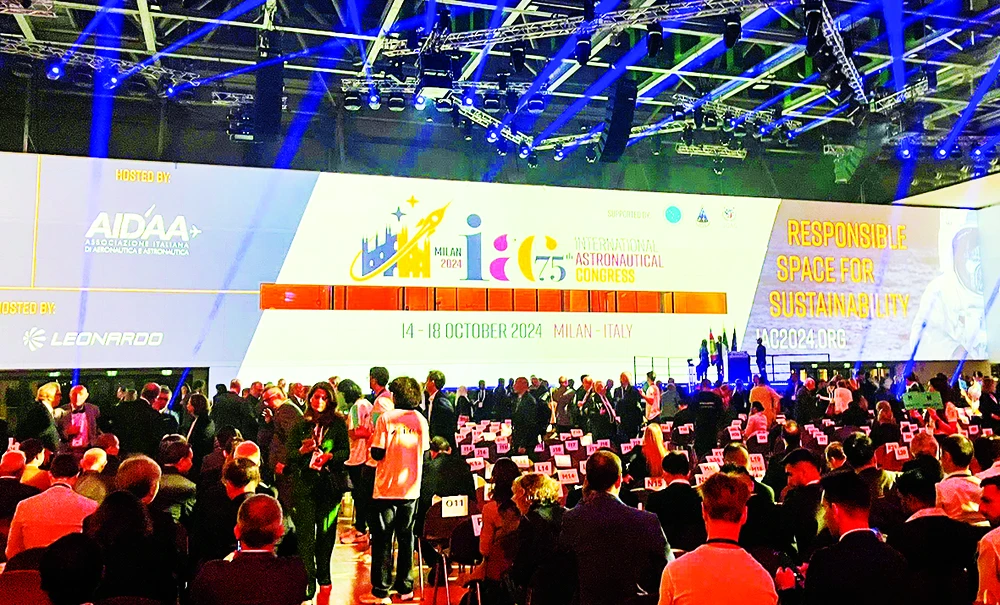
With the participation of almost all 77 member states of the IAF, and gathering around 8,000 guests, the conference focused on hot topics such as lunar exploration and Europe's need for space autonomy. According to IAF President Clay Mowry, this year's conference recorded a record 7,197 technical reports, 37% of which were presented by students and young professionals – a sign of a dynamic and innovative new generation in the industry. This year, despite increased geopolitical tensions, the IAC still brought together two major rivals: the United States and China. The presence of these two countries shows that despite their rivalry, cooperation is still possible. However, the absence of Russia highlighted the cracks in the space sector.
Currently, the US and China are not only competing in low Earth orbit but are also racing to return humans to the Moon, aiming for completion before 2030. This competition is not only about asserting technological dominance but also about winning international partners and shaping the future of space programs in many smaller nations. Meanwhile, the rapid development of breakthrough technologies and competition from the private sector has forced Europe to adjust its priorities, focusing on rocket and satellite development. While SpaceX's Falcon 9 rocket dominates the satellite launch sector, Europe is encouraging startups to develop cheaper launch solutions to reduce its dependence on the US.
After a period of interruption, Europe has restored its satellite launch capabilities with the Ariane 6 rocket test flight in July. However, the termination of cooperation with Russia following the special military operation in conflict-ridden Ukraine has left a significant void, as Russian Soyuz rockets previously played a crucial role in European space missions.
Europe's satellite manufacturing industry is also facing significant pressure from new competitors. Previously, large geostationary satellites were Europe's strength, but the rise of low-orbit satellite constellations like Starlink has completely changed the landscape. NASA is also strengthening its cooperation with European partners to develop commercial space stations to replace the ISS. NASA Administrator Bill Nelson plans to push forward a strategy seeking international support to replace the International Space Station (ISS) when it ceases operations in 2030.
THANH HANG
Source: https://www.sggp.org.vn/chuyen-dong-trong-cuoc-dua-chinh-phuc-vu-tru-post763837.html
![[Image] Pleasant weather helps students enter the 10th grade entrance exam with confidence.](https://vphoto.vietnam.vn/thumb/1200x675/vietnam/resource/IMAGE/2026/05/29/1780034401612_ngay-1-thi-lop-10-minh-duy-8-5009-jpg.webp)

![[Photo] Ba Lang An Lighthouse - the "eye of the sea" amidst the "rock museum" of Quang Ngai province.](https://vphoto.vietnam.vn/thumb/1200x675/vietnam/resource/IMAGE/2026/05/29/1780038698840_anh-man-hinh-2026-05-29-luc-14-10-42.png)







































































Comment (0)