

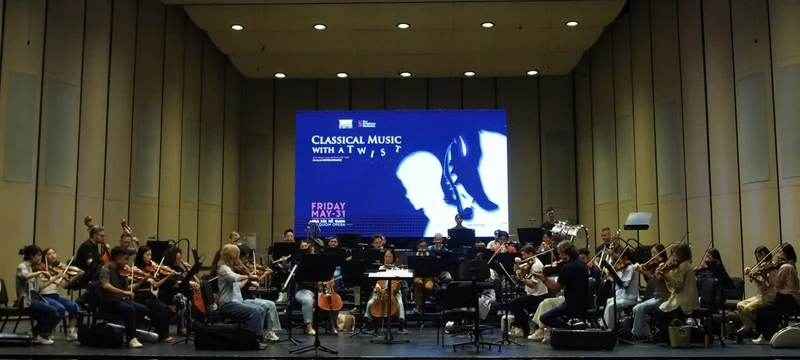
The orchestra performs the piece "The Cow on the Roof".
Classical music isn't always presented in a "classic," "academic," or "elegant and serious" guise. Sometimes it's imbued with humor, sometimes it boldly breaks the mold with boundless creative experimentation, and sometimes it patiently leads the audience to unexpected twists that leave them utterly thrilled. This is the message that the Sun Symphony Orchestra aimed to convey through its unique concert, held on the evening of May 31st at the Ho Guom Opera House, with the intriguing title "Classical Music with a Twist."
In just two hours, Music Director and Conductor Olivier Ochanine has packed a substantial repertoire, including a symphony by the genius composer FJ Haydn, the musical score for a short ballet by Darius Milhaud, and a musical story particularly beloved by children by the Russian composer S. Prokofiev. Three composers – three different eras – three completely different genres, yet they all share a common point: they all left their first and only mark – in their groundbreaking and innovative explorations at the time of their creation.
The biggest surprise came in the final movement of the opening piece. On stage was a modest orchestra, probably around 20 musicians including strings, oboe, bassoon, and two horns. The lighting was dimmed, leaving only the flickering candles on the orchestra stands. The musicians left their seats one by one, silently extinguishing their candles before departing. The conductor, after a futile attempt to persuade the members to stay, finally decided to give up.
After four movements, only the last two violinists remained on stage, patiently performing the final notes of the score, the melancholic melody fading and then dying out.
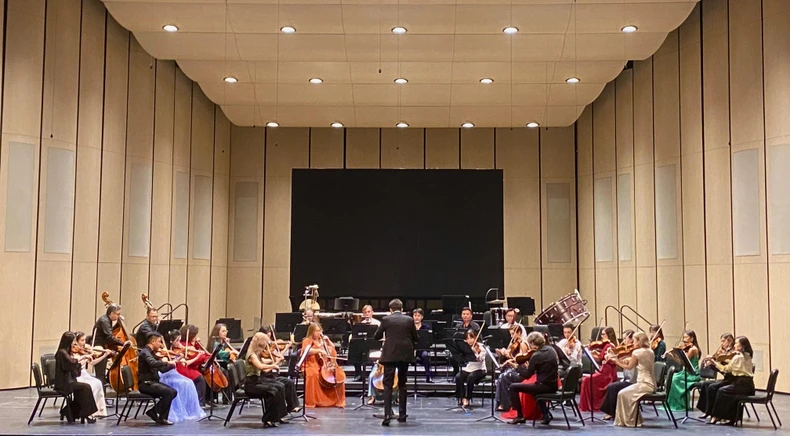
The musicians perform the symphony "Farewell".
From its first performance in 1772, the Farewell Symphony (Symphony No. 45) was considered a work imbued with a melancholic and somber atmosphere. The "Popular Music" newspaper in Leipzig, in 1799, wrote: "As the musicians began to extinguish their candles and quietly depart, everyone felt a pang in their hearts… And finally, when the sound of the last violin faded completely, everyone went home on their own accord, silently and deeply moved."
Composed in response to Prince Nikolaus Esterház's request for the musicians to return home, Haydn's "Farewell" symphony ends in an unusual way, in "the most unique way of 18th-century classical music." Not only is it the only symphony in F-sharp minor in the vast repertoire of symphonies produced throughout the 18th century, "Farewell" is also the first symphony in the history of world music to end with a slow movement - an adagio.
By selecting such a unique work from the vast repertoire of 104 symphonies that the composer created over 36 years (from 1759 to 1795), the SSO has helped music lovers understand Pitzchaikovsky's statement that "Haydn is an extremely solid and important link in the history of classical music. Without Haydn, there would be no Mozart and Beethoven."
Le Boeuf sur le Toit (The Cow on the Roof) is the first performance of Darius Milhaud's work in Vietnam. Initially composed as background music for a silent film by Charlie Chaplin, it later achieved success as part of the ballet of the same name. The composer demonstrated his boundless creativity by allowing the music to travel through various vocal ranges, utilizing material from over 14 composers and 20 famous Brazilian melodies, with many witty solos and cheerful tunes.
Sometimes music is performed simultaneously in two different voices, giving the impression of two orchestras playing at the same time. This presents a challenge for the orchestra members while also providing a novel experience for the audience.
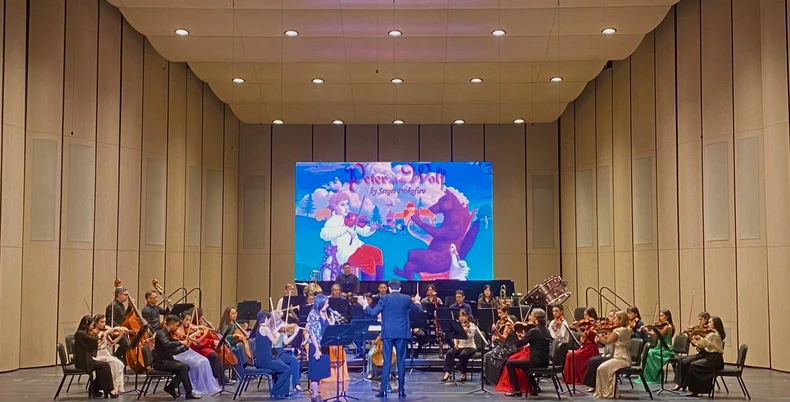
The story of "Peter and the Wolf" is retold through the impressive musical language of composer Prokofiev.
The cow on the roof also marked the first time the French conductor didn't stand on a podium, not waving his familiar baton. Olivier Ochanine held a flute, sat in the center of the orchestra, and relived his youthful, vibrant days with the sound of the flute. He created variations and dissonances full of transformations, breaking all strict rules and causing the audience in the hall to involuntarily smile.
The final piece of the program, *Peter and the Wolf*, is a gift from the SSO to young audiences on International Children's Day. It's a rare story told through the language of music, where each character is described in an easily understandable way using their own distinctive characteristics (also known as leitmotifs). The clear, melodious flute is dedicated to the sound of birds, the resonant drums resemble the rifles of brave hunters, the oboe recreates the quacking of the yellow duck, the clarinet takes on the cat's role, the bassoon speaks for the grandfather, and the wolf's menacing words are conveyed through the trio of horns…
The piece consists of three parts, structured almost like a sonata, but the themes develop very naturally, with the harmony guided and hinted at by the actions of the characters in the story. Harmoniously and smoothly, it begins and ends in C minor, but contains many abrupt transitions, which is one of the distinctive features that make up Prokofiev's unique compositional style.
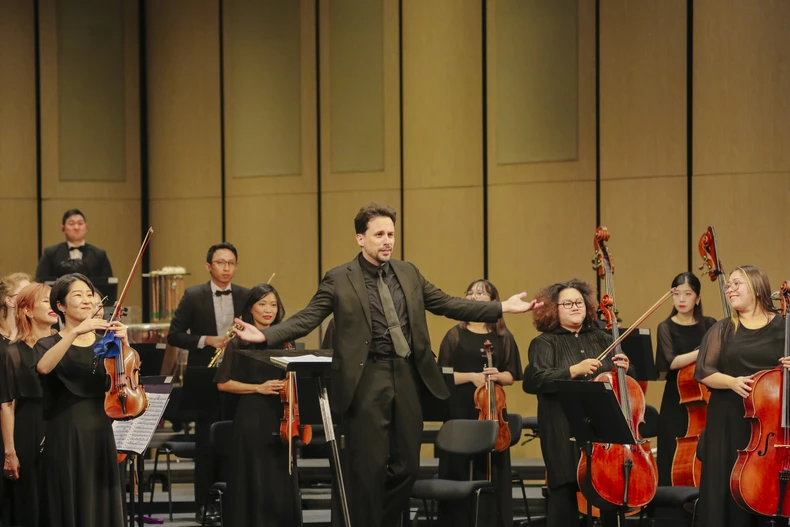
Conductor Olivier Ochanine and the artists of the Sun Symphony Orchestra. (Photo: SSO)
Listening to the music accompany and support the narrative, one will understand why Peter and the Wolf is always a favorite among children worldwide, holding a position at number 3/10 on Classic FM's list of classic works specifically for children. The vibrant colors of nature in the forest, with its lively and whimsical animals and the brave little scout Peter, are a gift that the composer enthusiastically created with the hope that children can become acquainted with classical music, which is as pure as a child's soul.
It can be said that Classical Music with a Twist has brought a breath of fresh air to classical music, recreating an atmosphere that is both elegant and yet fun, relaxed, and captivatingly new. Classical music, it turns out, also has the ability to surprise, to be transformative and spontaneous, to be youthful and to contain very modern forms and melodies.
With this concert, the SSO artists once again affirmed their talent, profound musical taste, and subtle touches, building a bridge to bring works making their debut to the Vietnamese public in a convincing way, through diverse and colorful experiences.
Get ready for some exciting twists from the upcoming SSO repertoire!
ARTICLE AND PHOTOS: BAO NGOC/ NHAN DAN NEWSPAPER
Source




![[Image] Hanoi's urban life under the challenge of a "scorching hot" environment](https://vphoto.vietnam.vn/thumb/1200x675/vietnam/resource/IMAGE/2026/05/25/1779706979265_nang-nong-t5-2026-minh-duy-7-4636-jpg.webp)



















































































Comment (0)