

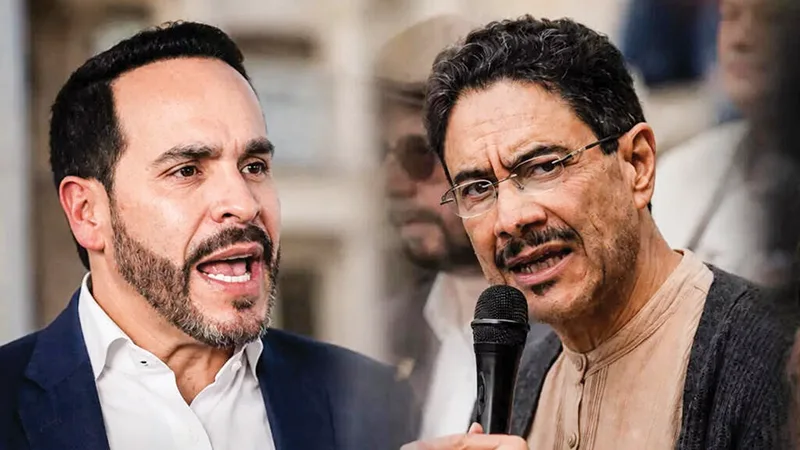
The two candidates, de la Espriella (left) and Cepeda, will face off directly in the second round of the presidential election. Photo: France 24
In the first round of voting, Senator Iván Cepeda – an ally of outgoing President Gustavo Petro – won 41% of the vote, while his opponent, lawyer and businessman Aberaldo de la Espriella, received 44%. Since no candidate surpassed the 50% threshold, the two candidates with the highest number of votes will face off directly on June 21st.
However, the fact that far-right candidate de la Espriella won more votes than Senator Cepeda was a major surprise. In the final weeks before the election, Cepeda consistently led in opinion polls. Therefore, both Cepeda and President Petro expressed doubts about the results, claiming that hundreds of thousands of votes had been manipulated and that foreign powers had interfered in the election. Cepeda stated that he was waiting for the electoral authorities to thoroughly review the results before accepting them.
Cepeda is a prominent figure in Colombian politics, having served as a member of the House of Representatives representing the capital Bogota and becoming a senator in 2014. His father was also a senator before being assassinated in 1994, an event widely considered an act of political violence. Cepeda has strongly criticized previous right-wing governments that focused solely on resolving domestic conflicts through military force. Therefore, he allied himself with President Petro, the first left-wing figure elected to the country's highest office in 2022. A former rebel fighter, President Petro has promoted what he calls a "comprehensive peace" policy, actively seeking negotiated solutions to the domestic conflict.
Despite critics questioning the effectiveness of the “comprehensive peace” policy and pointing to the recent surge in violence in Colombia, Cepeda remains committed to continuing the initiative as a representative of Petro Petro’s left-wing Historic Accords party. He acknowledges Colombia faces significant challenges from the rise of armed groups and drug cartels, but rejects overly military solutions and US intervention.
Conversely, his opponent, de la Espriella, was considered an outsider in Colombian politics, having never held any elected office. His campaign relied heavily on fears of crime, pledging to use force against drug cartels and build 10 more massive prisons – similar to El Salvador's war on drugs, which reduced crime rates but was accused of human rights violations. De la Espriella himself sought to portray himself as a supporter of U.S. President Donald Trump, who advocated the use of military force against regional drug cartels.
The Colombian election is taking place against the backdrop of the Trump administration playing a more assertive role in Latin America than any U.S. government in decades, putting increasing pressure on regional nations to crack down on crime.
De la Espriella's potential victory would be a continuation of the right-wing trend in the region of Latin America. Last year alone, left-wing governments in Chile, Honduras, and Bolivia were all replaced by right-wing figures.
DUC TRUNG
Source: https://baocantho.com.vn/colombia-dung-truc-hai-con-duong-trai-nguoc-a206080.html














































































![[Photo] Hanoi residents on the first day after the official cessation of E5 RON 95 gasoline sales.](https://vphoto.vietnam.vn/thumb/402x226/vietnam/resource/IMAGE/2026/06/02/1780370815909_666523_thumb_1780357660_06474202.jpeg)




![[Infographic] Market starts June 2026 with negative sentiment, VN-Index drops nearly 19 points.](https://vphoto.vietnam.vn/thumb/402x226/vietnam/resource/IMAGE/2026/06/02/1780370839687_666534_thumb_1780357795_06495602.jpeg)







Comment (0)