

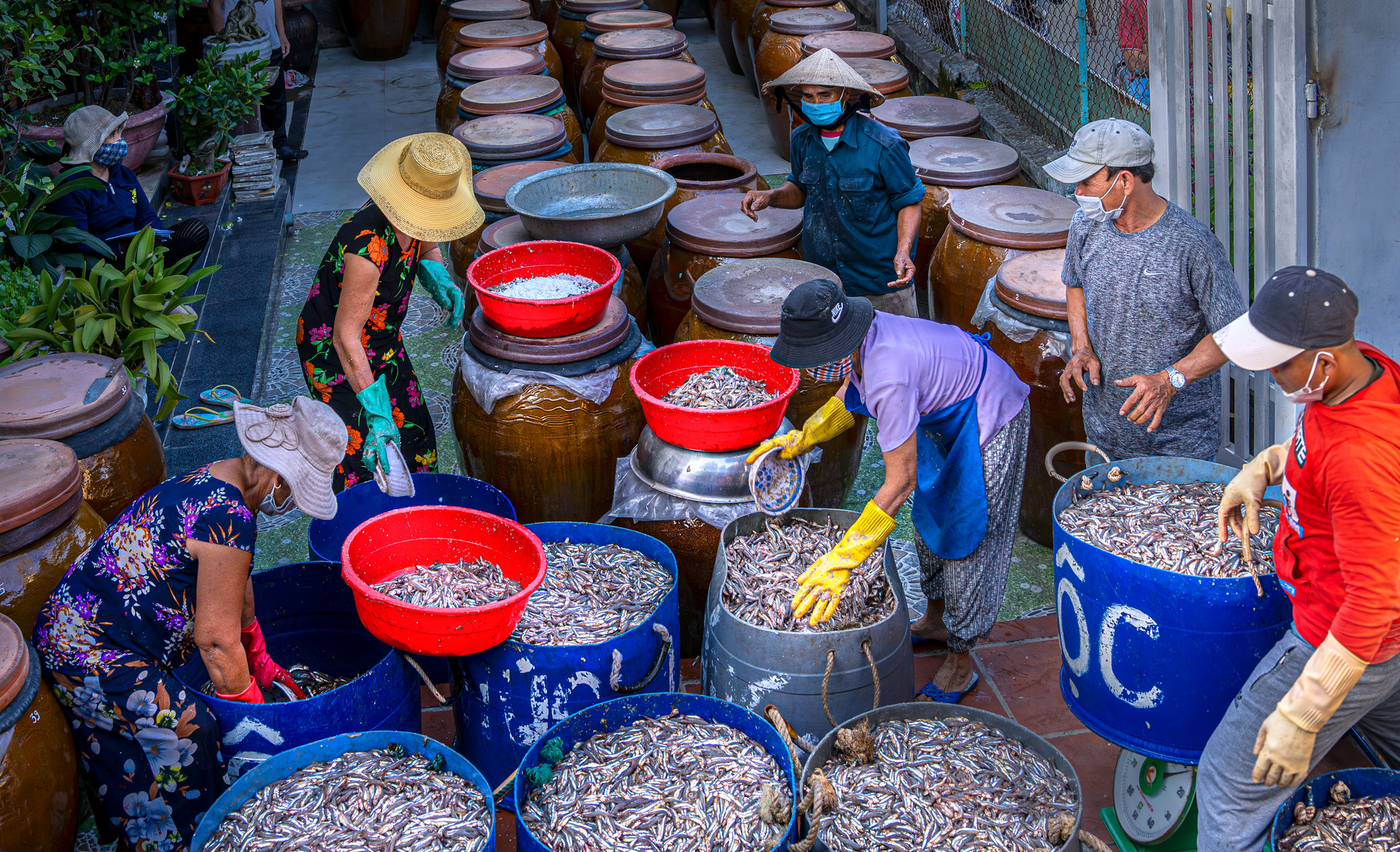
"The 'fish sauce route' exists from the fishing villages at the water's edge to the kitchens inland; from the old fishing boats that sailed up and down the central coast to the fish sauce vendors who followed the people of Quang Nam through countless journeys of life, migration, and displacement, only to return again."
Quang Nam province faces the East Sea with a long coastline stretching from Nam O, Xuan Thieu, Cua Dai, Cua Khe, Binh Minh, Tam Thanh, to Tam Tien, Ban Than... Fish sauce originated in this land of intersection, where the sea provides fish and salt, and the land provides rice and vegetables.
In the past, when living conditions were difficult, fish sauce was primarily a survival solution: fermenting fish with salt to preserve it for a long time, to eat gradually, and to get through lean seasons and rainy seasons. But then, beyond the need for survival, fish sauce became a flavor, a habit, and a deeply ingrained cultural layer in life.
There are things that were born to fight against poverty, but they remain there for a long time, becoming an integral part of the land's soul, like fish sauce.
The reputation of fish sauce villages
Along the coast of Quang Nam - Da Nang , fish sauce villages often develop naturally alongside fishing villages. Many families and small-scale establishments in Hoi An, Binh Minh, and Tam Thanh still maintain the traditional method of making fish sauce: anchovies, sardines, and herring are mixed with salt according to experienced ratios, fermented in earthenware jars and pots, and left to dry in the sun for many months, awaiting natural fermentation.
Nam O is the name of the most prominent fish sauce village, known to most people in Quang Nam province, with the saying, "The vermicelli from Chua Market is delicious, and the fish sauce from Nam O is fragrant and delicious." Nam O fish sauce, especially anchovy fish sauce, has long transcended the boundaries of the fishing village to become a brand.
Many researchers consider Nam O a "key point" in the central region's fish sauce landscape – a place that possesses all three elements for delicious fish sauce: suitable fish sources, sea salt, and time-honored fermentation techniques. There, fish sauce is not just a product, but a folk knowledge accumulated through the sun, wind, and patient experience of generations.
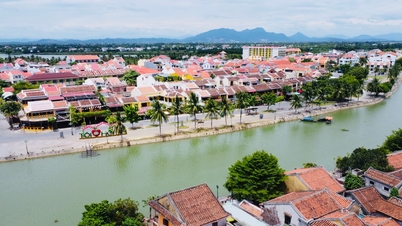
Heading south to the coastal areas of Dien Ban and Hoi An, fish sauce is not only present in meals but also a commodity. Documents about the Hoi An trading port in the 17th and 18th centuries show that dried fish, fish sauce, and salt were familiar goods on local boats, following coastal trade routes. Fish sauce quietly accompanied the merchant ships, contributing to the vitality of a once bustling port city.
Further south are the fish sauce villages of Cua Khe - Binh Duong, Ha Binh - Binh Minh, Tam Ap - Tam Thanh… the craft of fish sauce making is closely linked to these poor but resilient fishing villages. The fish sauce, shrimp paste, anchovy fish sauce, and mackerel fish sauce from this area have a deep salty taste with a sweet aftertaste, making them very appetizing with rice. While not flashy with branding, the fish sauce has established connections and specific orders, creating a quiet, sustainable brand with low profit margins and a strong Quang Nam character.
The fish sauce villages are like grains of salt scattered along the coast—small, unassuming, but without them, the salty flavor of this land would be incomplete.
The taste of fish sauce permeates… books and newspapers.
The writer Vo Phien (1925-2015), when writing about life and cuisine in Central Vietnam, once considered fish sauce to be "the spice of memory." He recounted scenes of his family carefully tasting and smelling the fish sauce; in that moment, personal life and memories of his village seemed to converge.
For people from the countryside, tasting fish sauce with both noses and mouth is natural, almost a cultural reflex.
"Fish sauce isn't just for pouring over rice; it's for smelling, tasting, and remembering. There are certain scents and flavors that, once you're familiar with them, can evoke memories of your homeland with just a fleeting whiff."
Vo Phien
Researcher Ho Trung Tu has put considerable effort into identifying the "fish sauce route." In his article "There Is a Fish Sauce Route," Ho Trung Tu cites ancient documents such as Phu Bien Tap Luc, Gia Dinh Thanh Thong Chi, and Dai Nam Nhat Thong Chi to demonstrate that fish sauce was produced and traded in Vietnam from a very early period, considered an important local product of many localities in Dang Trong from the 10th to the 18th centuries.
According to Ho Trung Tu, humanity has a maritime trade route for fish sauce – where fermented fish products followed fleets of ships, spreading across coastal cultures. Connecting this to garum – the ancient Roman style of fish sauce – shows that fish sauce is a common product of maritime civilizations, born from the needs of survival and creativity.
Besides the Silk Road, humanity also had another route: the route of fish and salt. This was the route of maritime civilizations, where people devised ways to ferment fish and salt to sustain themselves over time.
Ho Trung Tu
Viewed from that perspective, fish sauce transcends the cramped confines of the kitchen to stand within the vast expanse of socio -economic history and the boundless ocean.
The fish sauce road today
Today, the path of Quang Nam's fish sauce has taken a different direction. Fish sauce has found its way into restaurants, experiential tourism, and the stories of culinary heritage.
At the same time, there are challenges with the dominance of industrial fish sauce and quick-digestive sweet fish sauce on the market. However, some traditional craft villages have initially created OCOP products and built brands such as Nam O, Cua Khe, Ngoc Lan, and Ha Quang fish sauce…
Many fishing villages and fish sauce villages are now also associated with community tourism. Preserving the traditional fish sauce making craft is not just about preserving a product, but about preserving folk knowledge from the way fish are selected, salted, sun-dried, and fermented. This is something that cannot be rushed, cannot be completely industrialized, and serves as a foundation for experiential tourism.
Perhaps, we should view fish sauce as a culinary cultural heritage; it belongs not only to meals, but also to the history of the sea, to community memory, and to the identity of the land.
As long as there are fishing villages waking up to the smell of fish, and as long as there are kitchens with open jars of fish sauce at every meal, the savory taste of fish sauce will remain in the heart of Quang Nam province.
Source: https://baodanang.vn/con-duong-mam-qua-xu-quang-3321523.html





























































































Comment (0)