

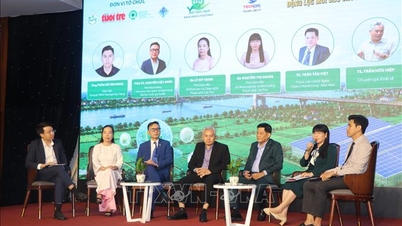
Ms. Van Thi Bach Tuyet, Deputy Secretary of the Ho Chi Minh City Party Committee, stated: Resolution No. 80-NQ/TW of the Politburo clearly established the role of culture as the spiritual foundation, intrinsic strength, and important "regulatory system" for the rapid and sustainable development of the country. In the context of digital transformation and the strong development of artificial intelligence, Ho Chi Minh City has adopted the motto: "The deeper the integration, the stronger the identity; the stronger the digitalization, the higher the humanistic values."
Journalist Nguyen Duc Loi, Permanent Vice President of the Vietnam Journalists Association, affirmed that culture is increasingly playing a central role in development strategies, directly contributing to building national soft power; the press is a core force in spreading values and creating a digital cultural space.
Ms. Dinh Thi Thanh Thuy, Deputy Head of the Propaganda and Mass Mobilization Department of the Ho Chi Minh City Party Committee, emphasized the requirement to place culture at the center of all the city's development strategies. This includes defining cultural development as being on par with economic, political, and social development; and simultaneously linking it to building a "cultural security posture" and protecting cultural sovereignty in cyberspace.
Ho Chi Minh City aims to build a cultural environment of "unity in diversity," harmoniously combining tradition and modernity; promoting the development of the cultural industry, forming a creative ecosystem, and fostering digital transformation to widely disseminate cultural values.
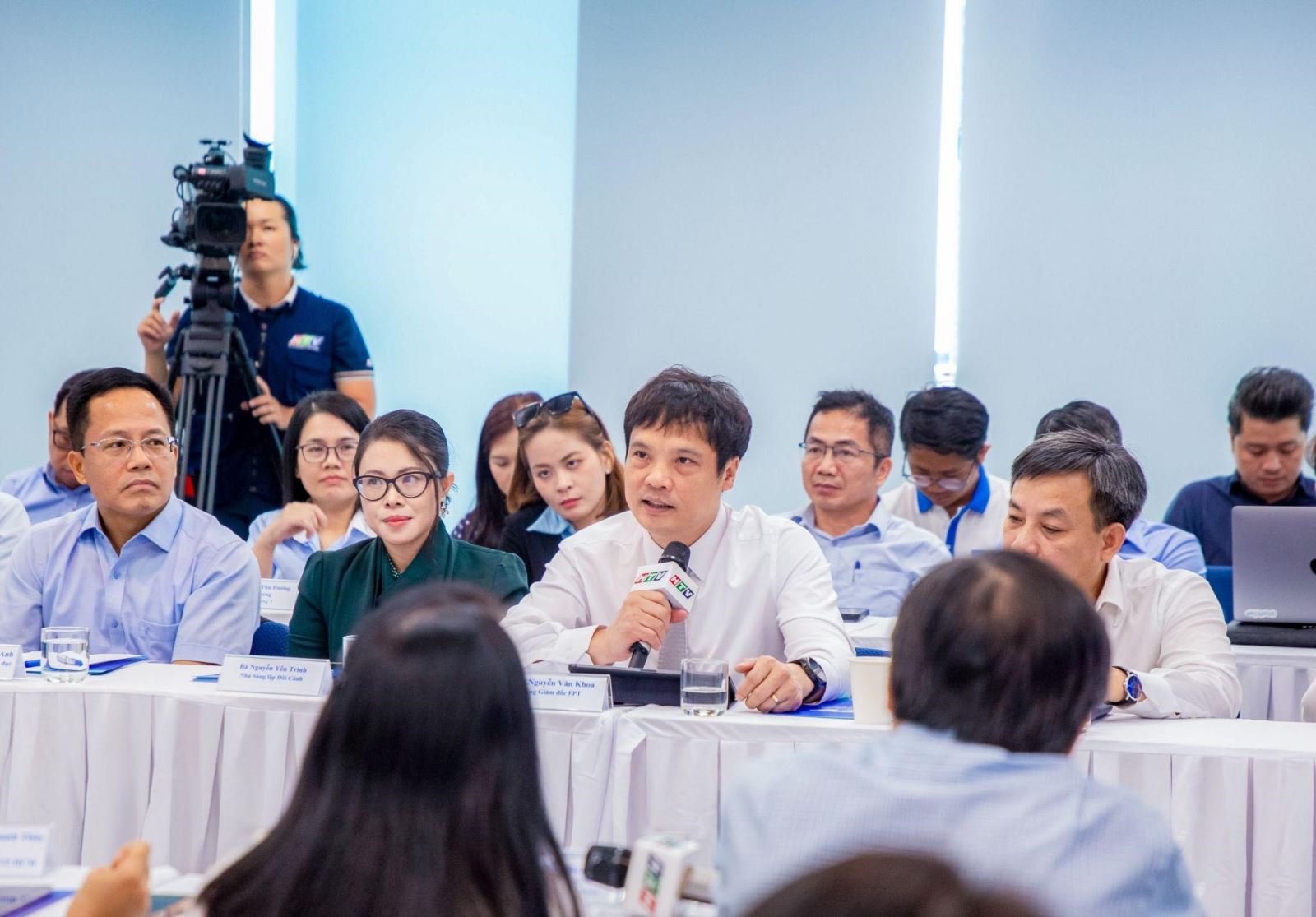
From the perspective of a technology company, Mr. Nguyen Van Khoa, General Director of FPT, believes that in the digital age, technology does not replace culture, but rather determines how culture is disseminated. The biggest bottleneck today is not a lack of content, but rather the digital distribution process – where it is determined whether the content reaches the right audience.
Citing real-world examples, he mentioned the film "Peach, Pho, and Piano," a work that didn't receive formal media investment but still grossed tens of billions of dong thanks to its natural spread on digital platforms. "Investing in production is only half the story. The other half – digital distribution – we're neglecting. Technology doesn't create content, technology creates distribution," Mr. Khoa stated.
In fact, many localities have initially succeeded in "productizing" their heritage. According to tourism industry data, Vietnam's total tourism revenue exceeded 1 trillion VND in recent years, with destinations that effectively exploit cultural and experiential elements recording high growth rates.
Models such as light shows, nighttime cultural spaces, or digital festivals not only attract visitors but also create a strong ripple effect on social media.
"Technology doesn't destroy identity. On the contrary, technology helps identity live longer and reach further," Mr. Khoa stated.
Accordingly, culture is no longer just a "soft value" of a spiritual nature, but is becoming a soft economic infrastructure that can generate revenue and contribute directly to growth.
Another noteworthy point is the impact of artificial intelligence (AI) on journalism and content creation. According to Mr. Nguyen Van Khoa, AI primarily automates intermediate stages such as translation, summarization, basic editing, and distribution. This aligns with global trends, as many newsrooms have already adopted AI to optimize their content production processes.
However, the core value – original content, perspective, real-life experience – still belongs to humans. "AI doesn't diminish the value of journalism, but rather raises its standards," Mr. Khoa said.
This means that content that is merely a compilation will gradually lose its advantage, while content with depth and originality will become increasingly valued.
In relation to the development of the cultural industry, FPT leaders believe that one should not expect a few products to be globally groundbreaking. International experience shows that soft power is built on a solid foundation of the domestic market and long-term investment, rather than depending on a single "phenomenon".
In the context of AI systems increasingly influencing how information is accessed, the lack of high-quality Vietnamese-language data could lead to misconceptions about Vietnam.
Here, the press plays a particularly important role as it possesses a highly reliable data repository. Digitizing and effectively utilizing this data not only serves readers but also contributes to shaping how Vietnam is "understood" in the digital space.
The CEO of FPT believes that Vietnamese audiences, especially the younger generation, are ready to embrace and spread domestic cultural products. The remaining issue lies on the supply side: product quality and the approach in the digital environment.
Source: https://baotintuc.vn/thuc-hien-nghi-quyet-57/cong-nghe-gop-phan-lan-toa-van-hoa-trong-ky-nguyen-so-20260422142525178.htm
![[Image] Pleasant weather helps students enter the 10th grade entrance exam with confidence.](https://vphoto.vietnam.vn/thumb/1200x675/vietnam/resource/IMAGE/2026/05/29/1780034401612_ngay-1-thi-lop-10-minh-duy-8-5009-jpg.webp)
![[Photo] Ba Lang An Lighthouse - the "eye of the sea" amidst the "rock museum" of Quang Ngai province.](https://vphoto.vietnam.vn/thumb/1200x675/vietnam/resource/IMAGE/2026/05/29/1780038698840_anh-man-hinh-2026-05-29-luc-14-10-42.png)






































































Comment (0)