

Benefits of learning AI: Early access to keep up with the times.
Nguyen Thuy An, a 9th-grade student (residing in Tan Hung Ward, Ho Chi Minh City), said that every summer she usually spends time traveling with her family instead of attending skills classes. However, this summer, An is dedicating some time to learning how to apply artificial intelligence (AI) and exploring learning support software to prepare for 10th grade.
Sharing the same view, Le Quang Thanh, a 9th-grade student at Huynh Tan Phat Secondary School (Tan Thuan Ward, Ho Chi Minh City), believes that learning AI is very important now because it is a trend for future development.
"I myself have used ChatGPT and AI tools to quickly summarize information and expand my knowledge, although the accuracy of AI still needs to be verified," Thanh shared.
Meanwhile, Tran Dang Nguyen, an 8th-grade student (residing in Tan My Ward, Ho Chi Minh City), shared that the skill he most wants to learn this summer is swimming because it helps prevent drowning.
"Even so, I'm still spending this summer exploring technology tools and software because it helps with my studies, like solving difficult assignments," Nguyen said.
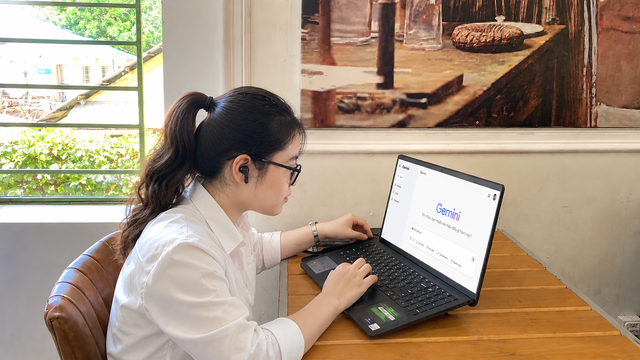
Young people's early exposure to AI is an inevitable trend.
PHOTO: MAI CAT
From a parent's perspective, Mr. Le Van Doan (50 years old, residing in Tan Thuan Ward, Ho Chi Minh City) said that during the summer, if possible, children should be exposed to AI and technology from an early age because this is a rapidly developing field and will be beneficial for their future.
"I have two children in grades 5 and 9, and I might also introduce them to AI tools early on to make their learning faster and more effective with its support," Mr. Doan said.
Ms. Nguyen Thi Thu Thao (48 years old, residing in Phu Thuan Ward, Ho Chi Minh City), whose child is in 8th grade, said that learning AI and technology early is a positive thing for young people to keep up with the trends of the times. "With smart software to support them, children learn faster and more effectively, and parents also have an easier time teaching their children," Ms. Thao said.
The pros and cons of children learning AI from an early age.
Operating in the field of digital transformation in education and developing technological solutions for teaching and learning, and applying AI in education, Mr. Huynh Quoc Thang, Chairman of Bach Khoa Science and Technology Group (Xuan Hoa Ward, Ho Chi Minh City), believes that artificial intelligence is gradually becoming a familiar part of learning, work, and daily life. Students can access AI through search engines, language learning software, image creation tools, presentation design, or content writing support.
"The important issue now is no longer 'should we introduce AI to students early or not,' but rather how to teach them to understand and use AI correctly and effectively," Mr. Thang said.
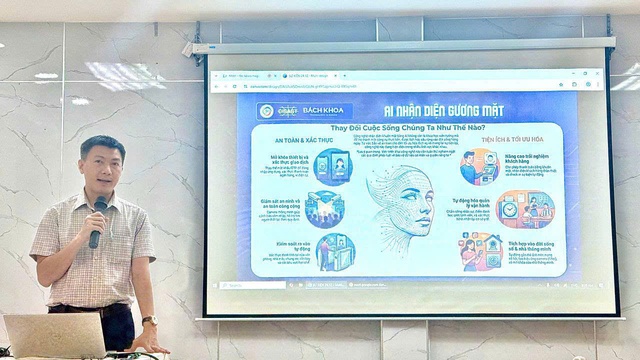
Mr. Thang gave a presentation on AI.
PHOTO: PROVIDED BY THE SUBJECT
According to Mr. Thang, if properly guided, AI can help children develop logical thinking, problem-solving skills, increase creativity, form proactive learning skills, cultivate critical thinking, and prepare them for future careers. Not only does it support the rapid and diverse search and processing of information, but AI also helps students adapt to the new technological trends of the digital age.
Besides the benefits, there are concerns that children may become dependent on technology if they lack proper guidance. Mr. Thang argues that if schools, teachers, and parents do not establish clear usage guidelines, students could easily view AI as a "shortcut" to getting answers instead of reading, thinking, and practicing independently. The overuse of AI could reduce students' ability to conduct independent research, causing them to skip the process of researching materials and systematizing knowledge.
"Students also easily develop the habit of relying on pre-prepared answers, accepting the final result without understanding the thought process behind it," Mr. Thang analyzed.
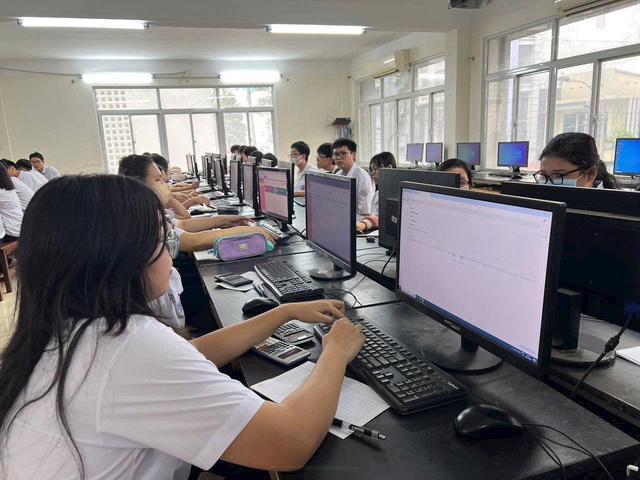
Technology plays a major role in supporting learning.
PHOTO: QUOC THANG
Furthermore, according to him, AI also poses a risk to integrity, as students may mechanically copy AI-generated content without truly understanding the material or being able to defend their own viewpoints. Another risk is that students may have difficulty distinguishing right from wrong because AI sometimes provides inaccurate or inappropriate information for the curriculum. If AI is overused for writing assignments, students may also lose their ability to express themselves, develop less reasoning skills, express emotions, and build their own style. In addition, the input of personal information, images, or the use of copyrighted content on AI platforms also carries risks regarding personal data and digital ethics.
"The important thing now is to help students learn how to use technology responsibly. When guided correctly, AI will become a tool to support students in learning more deeply, proactively, and creatively, instead of becoming a cause of declining self-learning ability and independent thinking," Mr. Thang said.
According to Associate Professor Pham Hong Long, Chairman of the Training Council of the Faculty of Tourism Studies, University of Social Sciences and Humanities (Vietnam National University, Hanoi), in the context of the strong development of AI and its presence in learning and life, students should first recognize AI as a powerful "assistant" in learning, research, and work, instead of viewing it as a "threat." The worrying thing is not AI itself, but the fact that people don't know how to use it effectively. Therefore, young people need to be proactive, knowing how to utilize AI to support themselves, but not becoming dependent on it or letting technology "control" them.
"The development of AI is making information change rapidly, become more multifaceted and complex, so young people need to cultivate a proactive learning spirit, continuously updating their knowledge from various sources, including AI. Besides being able to use technology early, young people need to avoid a dependent mindset and always maintain a role of control and direction in how AI is used," Mr. Long said.
Mr. Long believes that to balance leveraging AI while avoiding over-reliance on technology, schools need to encourage students to enhance their practical experiences, participate in social activities, internships, teamwork, and real-world communication. This is instead of spending all day in front of computers, which can easily lead to being "led astray" by AI.
"We must always maintain a positive attitude, regularly checking and cross-referencing the information provided by AI to avoid inaccuracies and over-reliance on the technology," Mr. Long emphasized.
Source: https://thanhnien.vn/tre-hoc-cong-nghe-tiep-can-ai-som-co-loi-gi-185260528210301713.htm


![[Image] Nearly 125,000 Hanoi students completed the Literature exam for the 10th grade entrance exam.](https://vphoto.vietnam.vn/thumb/1200x675/vietnam/resource/IMAGE/2026/05/30/1780117233041_ndo_br_thiet-ke-chua-co-ten-2-png.webp)
































![[Photo] Admire the coral "masterpiece" amidst the million-year-old heritage of Dak Lak province.](https://vphoto.vietnam.vn/thumb/1200x675/vietnam/resource/IMAGE/2026/05/30/1780107638639_y25-jpg.webp)
























































Comment (0)