

Phan Đinh Tùng has shaken the Vietnamese music market with his latest social media post, publicly stating that he and his partner (network) are in dispute over the rights to "Birthday Song" and several other tracks from his five albums.
Consequently, due to the copyright dispute in particular and intellectual property rights in general, a large portion of the revenue from " Birthday Song " is being withheld by international platforms (YouTube, Spotify, Apple Music, etc.). After a long period of unsuccessful attempts to resolve the issue, Phan Dinh Tung has considered the last resort: seeking legal intervention.
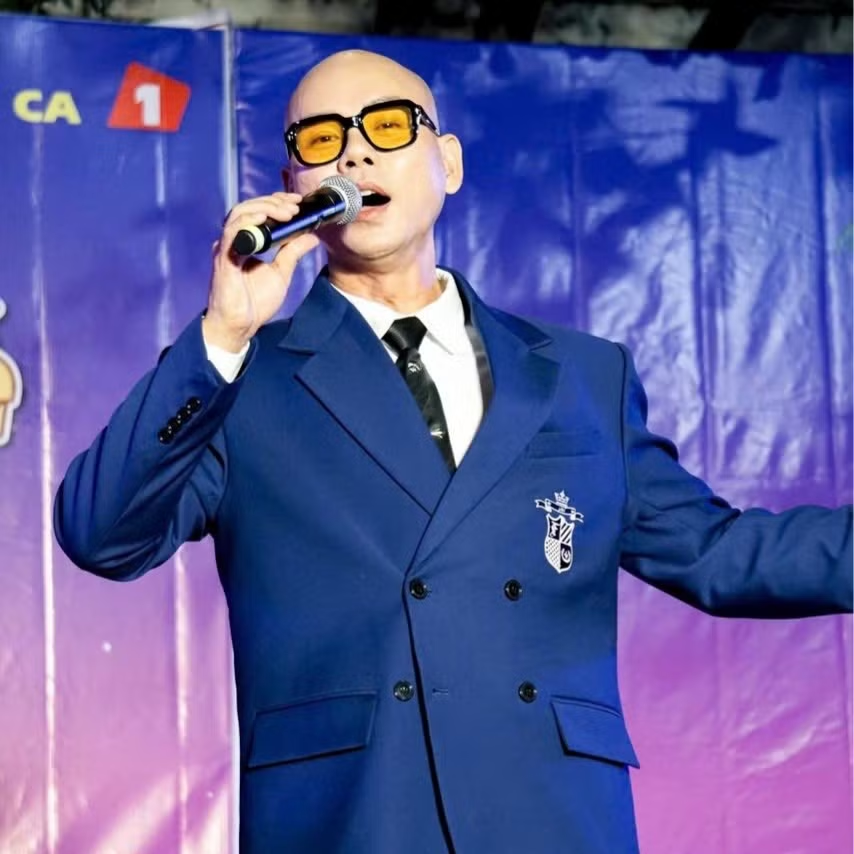

The Happy Birthday Song craze
The singer, born in 1975, released "Birthday Song" in 2004. To date, "Birthday Song" is the biggest hit of Phan Dinh Tung's career. On YouTube alone, the music video has garnered over 300 million views. Combining the achievements in digital music and related products, "Birthday Song " could surpass the "billion views" mark.
"Happy Birthday Song" quickly became a national anthem for birthdays. This is the biggest factor that helped Phan Dinh Tung's hit song deeply penetrate the audience's consciousness and endure over time. Later, many singers tried their hand at releasing products on the theme of birthdays, but "Happy Birthday Song" remained an immortal hit. A series of singers also tried to cover it, but none surpassed Phan Dinh Tung's voice.
Audiences often jokingly say, "Just one song has made Phan Dinh Tung's fortune, enough to live comfortably for a lifetime." Indeed, with the widespread popularity of "Birthday Song ," this product generated enormous revenue. However, the male singer revealed that the revenue from this hit song, along with a series of songs from his five albums, is currently being withheld by the platform due to a dispute.
The revenue from "Happy Birthday Song" came primarily from the YouTube platform. With 300 million views, the artist could earn billions of VND from advertising revenue. Currently, music videos lasting 2-4 minutes on YouTube generate an average revenue of about 10 million VND per million views. "Happy Birthday Song" was released in 2004, when YouTube revenue was significantly different from now, and the calculation method would be different. But one thing is certain: with just the original version alone reaching 300 million views, Phan Dinh Tung pocketed a substantial amount of money.
Behind the original "Happy Birthday Song" is a series of derivative versions that have attracted millions of views. For example, the nearly 50-minute-long remix of "Happy Birthday Song" has garnered almost 7 million views. The number of derivative songs of this hit on YouTube that have over a million views is countless.
Phan Dinh Tung declared that he still retains copyright for "Birthday Song ," meaning that the majority of revenue from derivative products will be claimed by the original author, and this revenue is no less than the 300 million views of the original song. Phan Dinh Tung has authorized his partner to enable Content ID to claim the revenue.
There is a dispute between Phan Dinh Tung and his publishing partner, possibly regarding copyright or derivative music rights. Therefore, the platform will temporarily withhold revenue, and the singer does not know the exact amount. Alternatively, the partner may have received revenue but has not yet completed a proper reconciliation process or coordinated with Phan Dinh Tung to fully pay for the digital music.

The case is complicated.
Phan Dinh Tung's social media post is merely one-sided information from the singer's perspective. The truth of the matter, and who is right and who is wrong, must be based on clear legal evidence, according to each clause Phan Dinh Tung signed with the authorized digital music exploitation unit.
The hit song "Happy Birthday" was released in 2004, a time when the digital music market in Vietnam had not yet formed, YouTube had not been created, and Spotify or Apple Music were still unfamiliar concepts. Music contracts at that time were usually very simple, mainly revolving around the release of physical CDs or the business of ringtones and caller tunes.
Many artists at the time, due to a lack of legal experience or a failure to foresee the future potential for monetization on digital platforms, may inadvertently sign very broad clauses, such as "Party B has the right to exploit the work on all platforms now and in the future." With the explosion of the internet, these loosely worded clauses immediately became major loopholes, blurring the lines between "temporary authorization for release" and "permanent transfer of music rights."
Audiences and professionals alike need credible answers to these core questions:
The original contract stipulates whether Phan Dinh Tung sold the entire property or merely authorized its exploitation.
What is the agreed-upon profit-sharing ratio between the two parties?
And most importantly, have the terms of the old agreements actually expired?
The fact that international platforms are proactively "locking" revenue at this time is in compliance with basic principles to protect cash flow before Phan Dinh Tung and his Network partner find common ground.
Many Vietnamese singers of the same generation as Phan Dinh Tung, who were very active between 2000 and 2010, found themselves in similar situations. They primarily relied on sales of physical CDs and DVDs and stage performances to sustain their careers. Digital music remained an unknown market, making it easy for many artists to sign contracts granting full control over their recordings to record companies or intermediaries at almost "dirt cheap" prices and with a "buy-and-sell" arrangement.
Years later, as the internet ecosystem boomed, networks acquired these old music libraries and made a fortune thanks to automated scanning algorithms (Content ID). Numerous singers had to watch helplessly as their "brainchild" generated enormous revenue on various platforms, but the money ended up in someone else's pocket. Meanwhile, attempts to sue for their rights were met with countless obstacles stemming from the very loosely worded agreements they had signed years earlier.
Source: https://tienphong.vn/cu-dau-voi-ban-hit-an-ca-doi-khong-het-cua-phan-dinh-tung-post1845403.tpo

![[Image] Close-up view of the interchange connecting the two expressways and Long Thanh Airport.](https://vphoto.vietnam.vn/thumb/1200x675/vietnam/resource/IMAGE/2026/05/25/1779703378210_ndo_br_z7863716673926-224453a31600126cce10622af6290afd-4549-jpg.webp)


![[Image] Hanoi's urban life under the challenge of a "scorching hot" environment](https://vphoto.vietnam.vn/thumb/1200x675/vietnam/resource/IMAGE/2026/05/25/1779706979265_nang-nong-t5-2026-minh-duy-7-4636-jpg.webp)



















































































Comment (0)