

 |
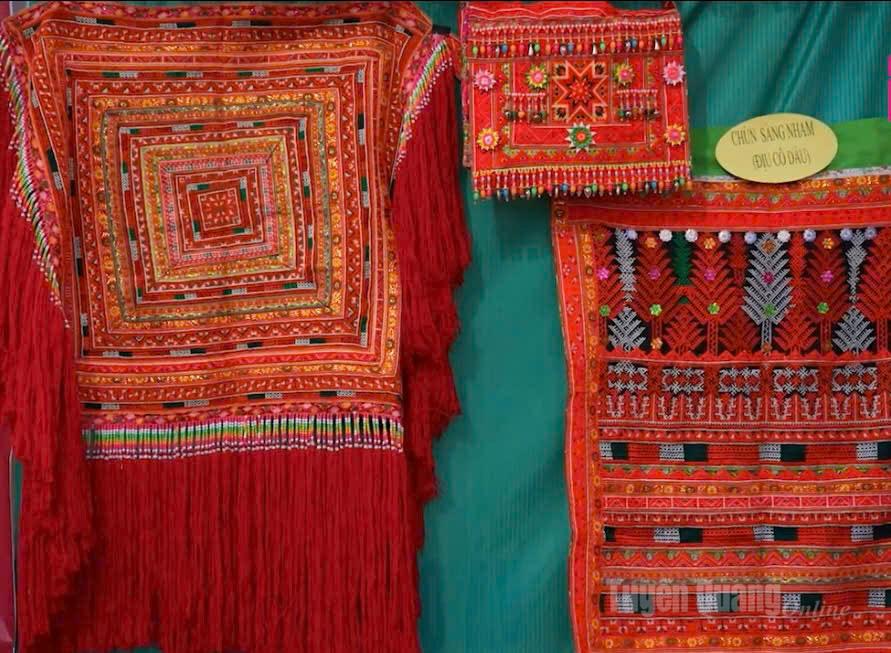
| Distinctive patterns on the clothing of the Red Dao people. |
The Dao people in Tuyen Quang province comprise many different groups, such as the Red Dao, Coin Dao, Long-robed Dao, Lo Gang Dao, Thanh Y, Cooc Ngang, White-clothed Dao, and Tight-clothed Dao. Among them, the decorative patterns on the clothing of the Red Dao people have many outstanding features: The traditional clothing of Red Dao women includes a long dress, bodice, trousers, headscarf, belt, and other accompanying jewelry; each outfit has five colors: red, blue, white, yellow, and black, with red being the dominant color because the Dao people believe red is the color of luck and happiness. A distinctive feature of the Red Dao clothing is the decorative patterns. These patterns are diverse and rich, signifying a harmonious relationship between people and nature. Wool is attached to the hem of the dress, the bride's hat, and necklaces… made of three-colored wool, creating tassels with red wool as the main color; The tassels feature swastikas, zigzags, pine tree shapes, and other motifs. The embroidered patterns on the fabric harmonize with the rows of silver flowers attached to the collar and bodice. The flowers on the collar have eight petals, and the large rectangular silver buttons on the bodice are decorated with geometric patterns.
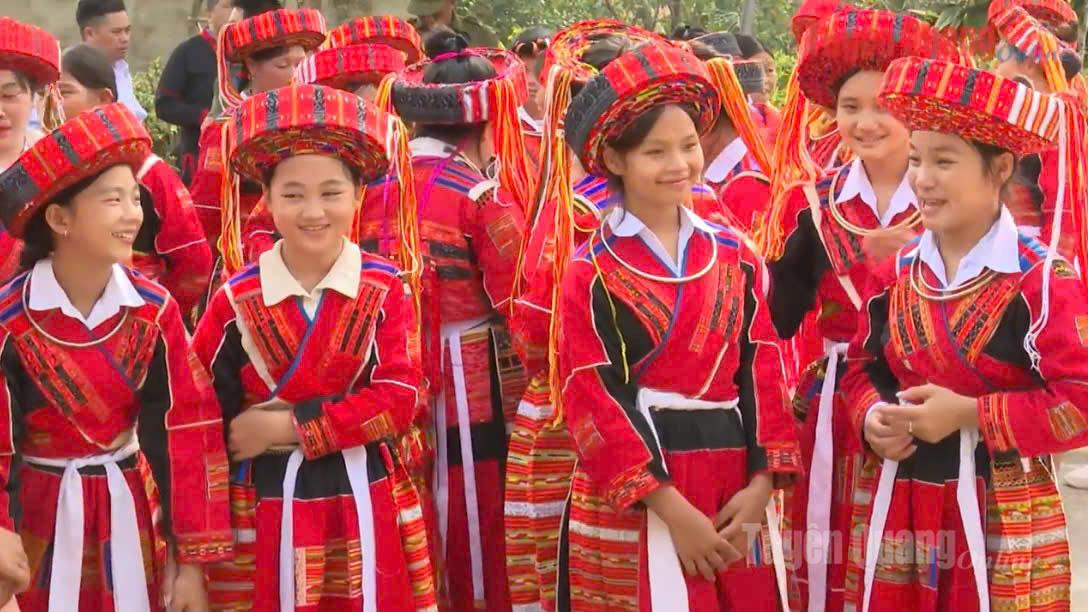 |
| The traditional clothing of Pà Thẻn women is primarily in vibrant red, striking against the green backdrop of the mountains and forests. |
The decorative patterns on the áo dài (traditional Vietnamese dress) are concentrated on the chest placket, the hem, and the sleeve ends, featuring motifs such as tiger footprints, sawtooth patterns, rhombus shapes, and crosses. These patterns not only beautify the dress but also express the Red Dao people's wish for a prosperous life, a happy and healthy family. On the waistband, the decorative patterns are concentrated at both ends, including swastikas, tiger footprints, pine trees, crosses, and figures of people wearing skirts. However, the most elaborate and meticulous are the patterns on the trousers. The patterns on the lower half of the trouser legs are embroidered square and rectangular motifs in red, yellow, and white, pine trees, and swastikas. The headscarf is decorated with various motifs such as triangles and rhombus shapes depicting the Dao people's water-powered rice mortar, symbolizing a bountiful harvest and abundant rice. When worn on the head, the patterns are displayed, enhancing the beauty of the scarf. The art of decorating the traditional costumes of the Red Dao people was recognized as a National Intangible Cultural Heritage by the Ministry of Culture, Sports and Tourism in 2019.
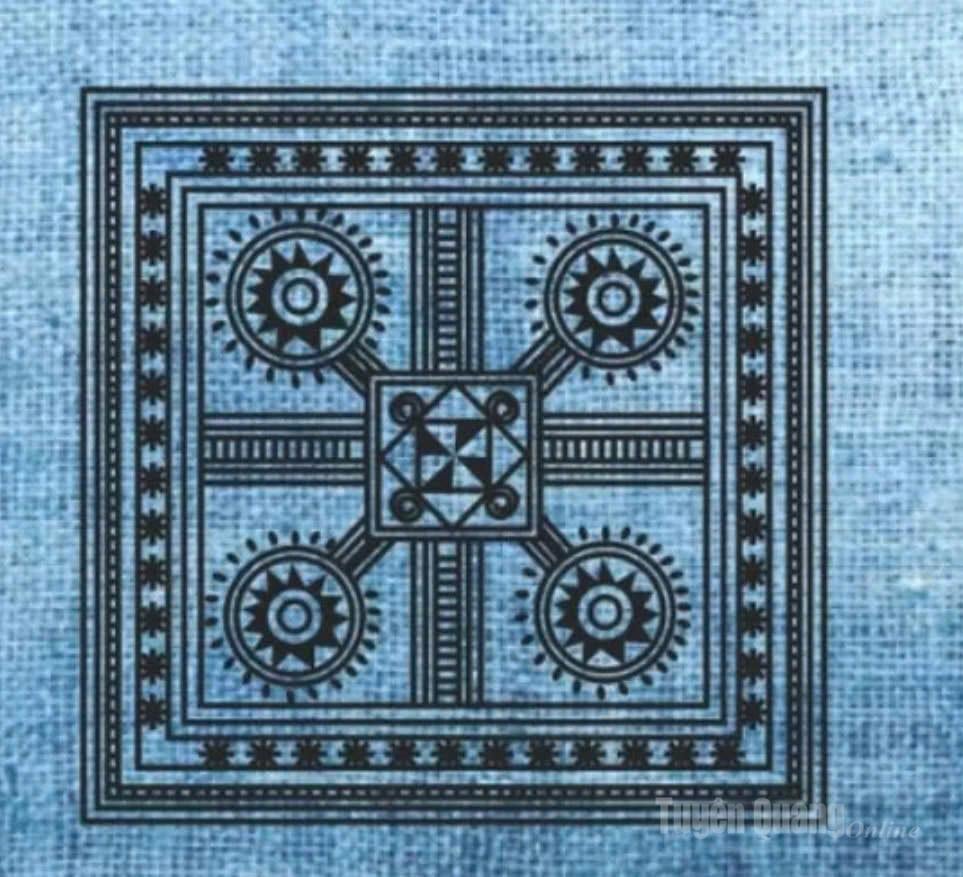 |
| One of the distinctive patterns on the skirts of Hmong women. |
The Hmong people in Tuyen Quang are divided into several groups: White Hmong, Flower Hmong, and Black Hmong, each with different colors and patterns on their clothing. Among these, the patterns on the clothing of the Flower Hmong are particularly distinctive and representative. The attire of Flower Hmong women includes a headscarf, blouse, skirt, a cloth covering the front of the skirt, a belt, and leg wraps, with the main colors being red, pink, yellow, orange, and white. The patterns on the clothing of the Flower Hmong are created using techniques such as beeswax drawing, embroidery, patchwork, and color mixing. The motifs are also very diverse, including flower shapes, diagonal lines, rectangles, squares, and crosses, but the most frequently used are rectangles interspersed with large embroidered floral patterns and zigzag embroidery depicting hills and mountains.
The decorative art on the Hmong Hoa people's clothing determines the value of the garment and is an indispensable element in their clothing culture and, more broadly, in their ethnic culture. The patterns on the clothing vividly depict the natural scenery of the mountainous region. Each pattern carries a different meaning, but ultimately they all express the desire and aspiration for a happy family and a bountiful harvest.
A traditional Pà Thẻn women's outfit consists of a headscarf, blouse, belt, skirt, and bodice. Overall, the traditional Pà Thẻn women's attire is a vibrant, striking red against the green backdrop of the mountains and forests. The structure of the garment's components is relatively simple, but the layers of fabric and the stitching are quite complex. The shapes, colors, and decorative patterns of the clothing have their own unique characteristics. Each part of the Pà Thẻn outfit features numerous decorative motifs with various shapes. The rich patterns created by Pà Thẻn women on their looms have been preserved and passed down from generation to generation. These include geometric patterns, A-shaped motifs, mountain shapes, star shapes, crab-eye flower shapes, dog-head flower shapes, bridge shapes, house shapes, and rhombus shapes… Among them, the dog-head flower is the most beautiful and prominent motif on the outfit. This is the most time-consuming and labor-intensive detail for the embroiderer, requiring meticulousness and perseverance to ensure aesthetic appeal. The patterns are distributed in horizontal bands across the scarf, chest, waist, hem, elbows, and skirt. Complex motifs such as human figures, dog paws, crab eyes, calves, and buffalo horns are used as accents on the chest, waist, and sides of the skirt. Additionally, pine tree, grass, and some familiar medicinal herbs are unique elements that enhance the beauty of the outfit. On the red fabric of the bodice, sleeves, and hem, geometric patterns, mountain shapes, and stars are skillfully incorporated into the color scheme. Each pattern has its own meaning: the dog symbolizes mutual support and protection; the bridge represents love; the house represents happiness and sacrifice; and the rhombus represents a wish for a positive life. The traditional costume of the Pà Thẻn ethnic group showcases harmonious fabric patchwork and embroidery techniques. Interspersed among the hand-embroidered patterns are woven patterns in a variety of vibrant colors. This is what makes the traditional costume of Pà Thẻn women unique and distinctive.
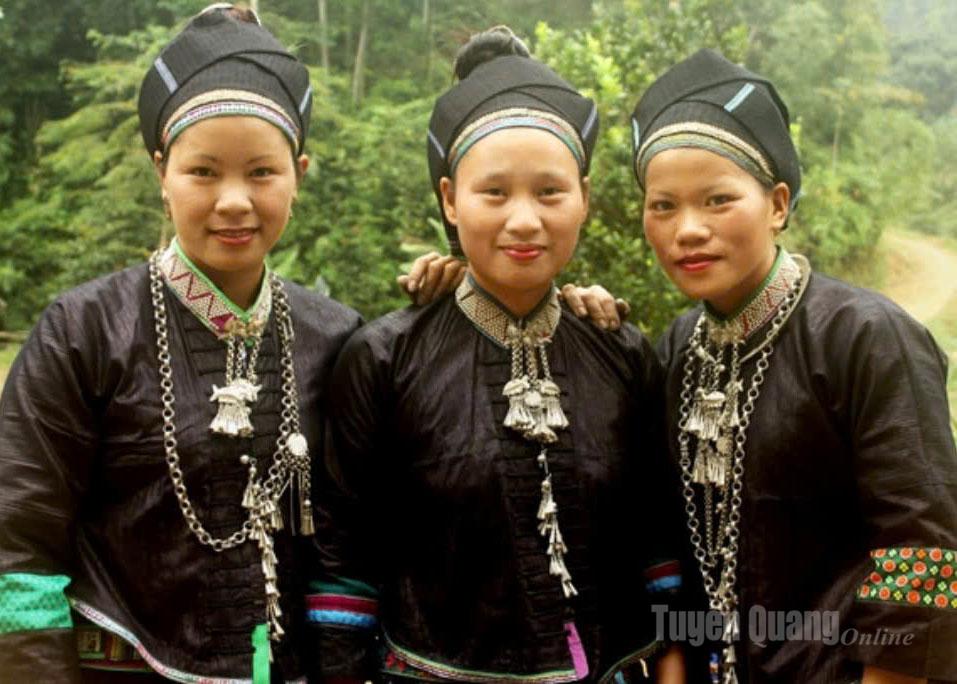 |
| The traditional clothing of Nung ethnic women is predominantly indigo in color, simple, with minimal embroidery or decoration, yet still showcases uniqueness and sophistication. |
Nung women's traditional clothing is predominantly indigo in color, simple, and minimally embroidered, yet it still showcases the unique and refined cultural identity of the Nung people, distinct from other ethnic groups. Each outfit of the Nung groups in different localities is fundamentally similar, differing only in the color combinations on the collar, sleeves, or the choice of fabric. The attire includes a blouse, skirt, belt, headpiece, embroidered cloth bag, and silver jewelry.
The patterns are mainly decorated on the headdress, collar, placket, and sleeves. The patterns include circular motifs, symmetrical arrangements, sun and star motifs in vibrant colors, square and rhombus shapes arranged in adjacent triangles… Most unique are the silver butterfly-shaped patterns on the collar buttons, adorned with triangular tassels. This symbolizes the Nung women's wish for happiness. All the patterns on Nung clothing are hand-sewn and embroidered by the women themselves.
Besides the costumes of the aforementioned ethnic groups, Tuyen Quang also has several other minority ethnic groups with costumes featuring unique patterns and designs, strongly reflecting their ethnic identity, such as the Lo Lo, Cao Lan, Giay, and San Chay people. Clothing is a material product created by humans, serving daily life in various forms. Preserving the cultural aspects of clothing contributes to the preservation and promotion of the traditional cultural values of the ethnic groups in the province.
H.Anh (Compiled)
Source: https://baotuyenquang.com.vn/van-hoa/du-lich/202510/dac-sac-hoa-van-tren-trang-phuc-truyen-thong-cua-cac-dan-toc-thieu-so-b09490f/

![[Photo] General Secretary and President To Lam presides over a meeting on preparations for the review of one year of operation of the three-tiered government system.](https://vphoto.vietnam.vn/thumb/1200x675/vietnam/resource/IMAGE/2026/06/02/1780391821195_a1-bnd-4595-9717-jpg.webp)











































Comment (0)