

The Milky Way, also known as the Milky Way, is the largest galaxy containing our Solar System. It reached its current size over its approximately 13 billion years of existence by "swallowing" smaller galaxies around it.
In a newly published study, astronomers say they have found a group of stars with unusual characteristics, likely the remnants of a dwarf galaxy that was "swallowed" by the Milky Way about 10 billion years ago.
That dwarf galaxy has been named Loki—after a cunning god in Norse mythology. The new discovery could change our understanding of the Milky Way's evolution in the distant past.
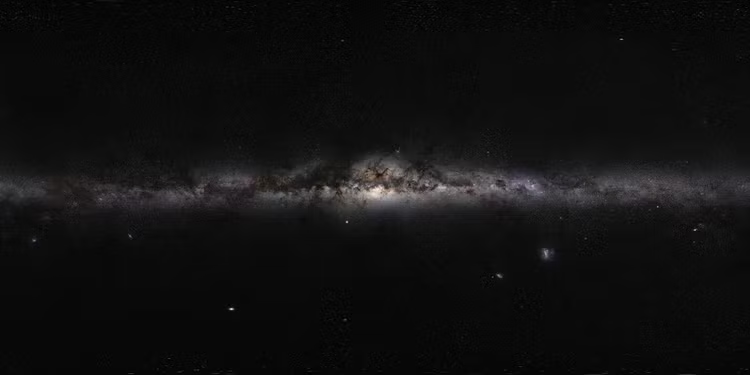
The U.S. National Aeronautics and Space Administration (NASA) estimates that the Milky Way galaxy spans approximately 100,000 light-years and contains between 100 and 400 billion stars. A light-year is the distance light travels in one year, or 9.46 trillion kilometers.
According to the researchers' hypothesis, Loki was once a separate dwarf galaxy with billions of individual stars before being completely absorbed by the Milky Way approximately 10 billion years ago.
Accordingly, within the Milky Way galaxy, there may exist remnants of another galaxy, like nested Russian nesting dolls on a cosmic scale.
The original size and mass of the Milky Way remain a major question, prompting scientists to search for evidence of how it "swallowed" smaller galaxies around it and gradually increased in size.
Scientists believe that, in the early stages of the universe, large galaxies like the Milky Way did not reach their current enormous size. They gradually grew through collisions and mergers with smaller galaxies.
To find traces of the Loki galaxy, astronomers focused their observations on a group of 20 metal-poor stars located unusually close to the galactic disk. The galactic disk is a vast, rotating region of space containing most of the stars of the Milky Way.
Meanwhile, metal-poor stars formed in the very early stages of the universe. Their chemical composition has been preserved almost intact for billions of years. When researchers analyzed the orbits and composition of these stars, they found that they differed significantly from other metal-poor stars in the Milky Way. This suggests that they may not have been born here.
The discovery of a cluster of metal-poor stars near the galactic disk suggests that the Milky Way once "swallowed" a Loki galaxy. The discovery of the Loki galaxy not only helps researchers decipher the formation history of the Milky Way but also provides further evidence for modern galactic evolution models.
Source: https://khoahocdoisong.vn/dai-ngan-ha-tung-nuot-gon-mot-thien-ha-khac-post2149101918.html
![[Image] Nearly 125,000 Hanoi students completed the Literature exam for the 10th grade entrance exam.](https://vphoto.vietnam.vn/thumb/1200x675/vietnam/resource/IMAGE/2026/05/30/1780117233041_ndo_br_thiet-ke-chua-co-ten-2-png.webp)
























![[GALLERY] Vietnamese people spend 302 billion VND watching 60-second films; Netflix is worried.](https://vphoto.vietnam.vn/thumb/402x226/vietnam/resource/IMAGE/2026/05/29/1780031393099_ve-5-png.webp)












































































Comment (0)