

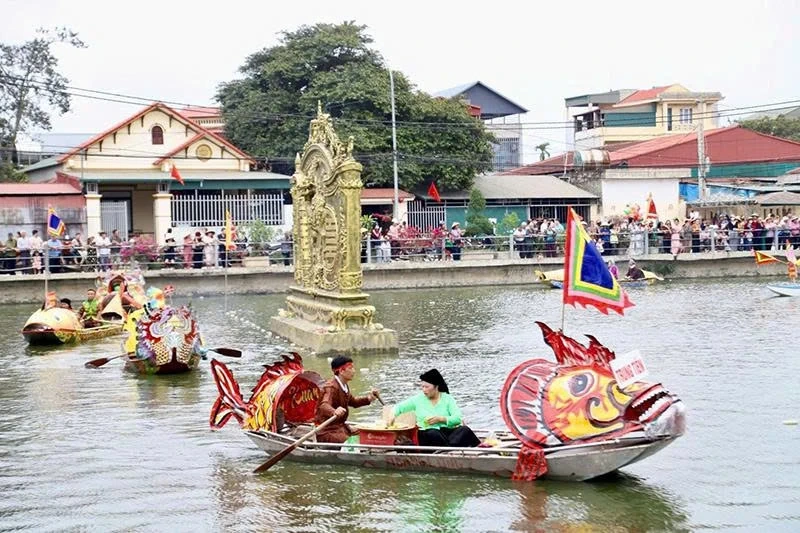
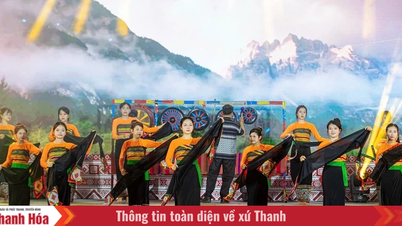
Quỳ Chữ Village Festival. Photo: Thùy Linh
Returning to Hoang Giang today, anyone can clearly feel the new vitality emanating from this region rich in cultural and historical traditions. Roads have been widened and improved, the rural landscape is constantly changing, and people's lives are steadily improving. But what creates the unique character of this land lies not only in the changes in infrastructure or the economy , but also in the way the locality preserves and revives traditional cultural values in its development journey.
It's no coincidence that many people refer to Hoang Giang as a "cultural heritage site." Over generations, it has preserved a rich system of historical and cultural relics, along with many unique folk cultural values. Currently, the commune has 3 national-level historical and cultural relics, 17 provincial-level historical and cultural relics, along with many attractive destinations and 13 traditional festivals maintained annually. Each relic and each festival not only reflects the rich history of the land along the Ma River but also preserves the unique cultural values, beliefs, and customs of the local community.
Standing out amidst the unique spiritual and cultural landscape of Hoang Giang is the Phu Vang spiritual site. For a long time, this place has been a familiar destination for locals and tourists alike. Nestled against Chua Mountain, surrounded by the peaceful scenery of Vang village along the Ma River, it possesses a serene, sacred atmosphere and holds many layers of cultural heritage from this land rich in tradition.
According to historical documents and folk legends, Phu Vang (Golden Palace) was built in the 18th century and is a place of worship for the First Holy Mother Lieu Hanh - one of the "Four Immortals" of Vietnamese folk beliefs. Having weathered many historical ups and downs, Phu Vang today has been renovated and restored to a magnificent state, while still retaining its traditional architecture and solemn spiritual atmosphere.
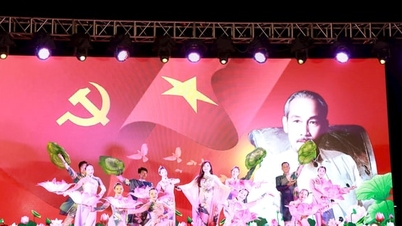
Phu Vang is also associated with a traditional festival held annually in the third lunar month. Each festival season, people from many places flock to offer incense, worship, and immerse themselves in the community's cultural atmosphere. Alongside the solemn traditional rituals are many unique folk cultural activities such as Cheo singing, folk performances, and demonstrations of traditional crafts, contributing to the recreation of the cultural life of the people living along the Ma River through many generations.
The unique appeal of the Phu Vang festival lies not only in its spiritual elements but also in its community spirit and the rustic charm of its rural culture, which has been preserved quite intact. In recent years, Phu Vang has gradually become a highlight in the cultural and spiritual tourism route along the Ma River, connecting with many famous destinations such as Co Bo Temple, Han Son Temple, and Ba Trieu Temple, contributing to the development of tourism associated with the preservation and promotion of traditional cultural values.
Moreover, Hoang Giang also preserves many traditional festivals such as the Quy Chu village festival, the Dong Khe village festival, the Phuong Mao village festival... These are "open spaces" of rural memories, where beliefs, customs, and community life blend into a unified whole. What makes Hoang Giang's festivals so attractive is that many traditional cultural values are still relatively well-preserved. Within the festival space, solemn rituals are interwoven with folk games and performances, creating an atmosphere that is both lively and vibrant, yet intimate and deeply communal. It's not just a festival, but also an opportunity for the community to "relive" the cultural memories of their ancestors.
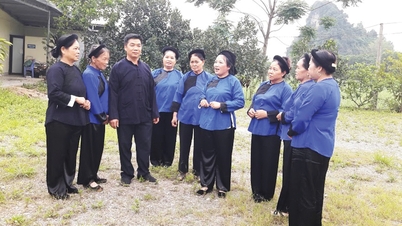
Along with festivals, folk art forms such as Cheo singing, Cheo Can singing, Cheo Chai singing, Xam singing, Tu Huan singing, etc., are preserved and promoted as an enduring cultural source. These melodies and performances are not only present during festivals but are also maintained by the people in their daily community life.
The traditional incense-making craft in the commune is also maintained by many households as a way to preserve an ancient profession. In particular, incense making is also showcased and introduced at local festivals, becoming a cultural experience that attracts locals and tourists, gradually becoming a cultural product linked to community tourism development.
According to Nguyen Quang Khanh, Vice Chairman of the People's Committee of Hoang Giang commune, "With approximately 20,000 people attending the festival and cultural activities each year, Hoang Giang is gradually affirming its attractiveness as a rural area within the cultural space along the Ma River. In the future, the commune plans to develop cultural and spiritual tourism associated with community-based and experiential tourism; promote the digitization of historical sites and tourism maps; and apply digital transformation in destination promotion. At the same time, we will diversify tourism products, focus on preserving the original character of heritage, and build the image of a rural area that is 'rich in culture, friendly, and worth experiencing,' so that culture truly becomes an endogenous resource for sustainable development."
Thuy Linh
Source: https://baothanhhoa.vn/danh-thuc-suc-manh-mem-288107.htm



![[QUIZ] Under what circumstances was Trịnh Công Sơn's passion for music "awakened"?](https://vphoto.vietnam.vn/thumb/402x226/vietnam/resource/IMAGE/2026/05/20/1779228580019_fb_thiet-ke-chua-co-ten-5072-jpg.webp)







![[Photo] Capturing the moment the tide recedes at Yen Binh Son rapids - a million-year-old scenic spot in Quang Ngai.](https://vphoto.vietnam.vn/thumb/1200x675/vietnam/resource/IMAGE/2026/05/19/1779175463885_yen9-1199-jpg.webp)
![[Photo] National Assembly Chairman Tran Thanh Man attends the groundbreaking ceremony for the National Highway 1A spatial axis project.](https://vphoto.vietnam.vn/thumb/1200x675/vietnam/resource/IMAGE/2026/05/19/1779161360398_ndo_br_bnd-1412-jpg.webp)


































Comment (0)