For the Vietnamese people, our Party, and President Ho Chi Minh have always been shining symbols of revolutionary morality, exemplary sacrifices, and lifelong dedication to the revolutionary cause of the Party and the nation; wholeheartedly and tirelessly serving the Fatherland and the people.
He left behind for present and future generations an invaluable spiritual legacy: the Ho Chi Minh era, Ho Chi Minh thought, Ho Chi Minh style, and especially Ho Chi Minh morality.
Ho Chi Minh's thought on revolutionary ethics
During his lifetime, President Ho Chi Minh always emphasized and paid attention to the issue of morality, especially revolutionary morality. He affirmed: "Just as a river needs a source to have water, without a source the river dries up. A tree must have roots, without roots the tree withers. A revolutionary must have morality; without morality, no matter how talented they are, they cannot lead the people."
President Ho Chi Minh's ethical viewpoint encompasses the fundamental relationships of human beings in society, first and foremost with the country and the people – "Loyalty to the country, filial piety to the people."
In his speeches and writings, President Ho Chi Minh summarized the essence of revolutionary ethics as: “Clearly discerning right from wrong. Maintaining a firm stance. Utmost loyalty to the country. Utmost devotion to the people”; “Absolute loyalty to the Party, to the Fatherland, and to the people.”
This is the core of revolutionary ethics. "Loyalty to the nation" means boundless loyalty to the cause of nation-building and national defense, the struggle for national independence, and making the country increasingly prosperous and strong. "Filial piety towards the people" means that all cadres must be "loyal servants of the people," "all power belongs to the people," "all benefits are for the people"; they must be closely connected with the people, trust the people, rely on the people, and consider the people as the foundation. They must understand the people's situation, grasp their sentiments, care about improving their living standards, raise their intellectual level, and make them understand their responsibilities and rights as masters of the country.
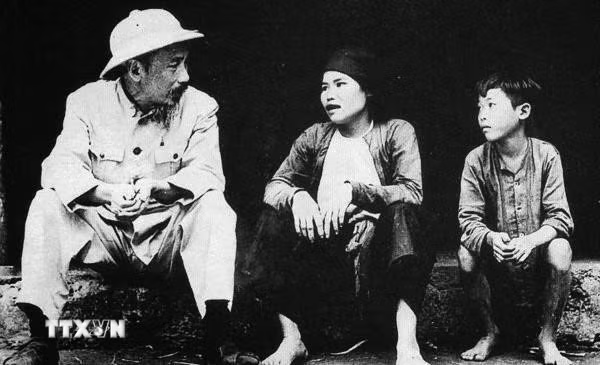
President Ho Chi Minh converses with villagers in Lam Xuyen, Bac Giang province, after the 1955 Land Reform movement. (Photo: Archival material/VNA)
Secondly, in President Ho Chi Minh's ethical thought, it is about humanity, or more precisely, "loving humanity." Loving humanity means doing everything for humanity; daring to sacrifice, daring to dedicate oneself to the struggle for human liberation. Loving humanity means believing in humanity. Be strict with yourself; be tolerant and forgiving towards others, even those who have gone astray, made mistakes, or have shortcomings. Loving humanity requires sincere self-criticism and criticism, helping each other correct shortcomings, and helping each person to become better and more progressive.
Next, for me, it is essential to truly practice "Diligence, Frugality, Integrity, Righteousness, and Selflessness." President Ho Chi Minh believed that diligence, frugality, integrity, and righteousness are four essential virtues of a person, a natural order, like the four seasons of the sky and the four directions of the earth. He wrote, "Diligence means being industrious, hardworking, and persistent," "A diligent person makes rapid progress. A diligent family will surely be prosperous. A diligent village will thrive. A diligent nation will be strong and wealthy"; Frugality "is saving, not being extravagant, wasteful, or reckless. Diligence and frugality must go hand in hand, like the two legs of a person"; "Integrity means being clean and not greedy."
He clearly stated: "Greed for money, position, fame, fine food, and a comfortable life are all forms of dishonesty..." and "Officials must practice integrity first, to set an example for the people"; and "Righteousness means being honest and upright. Anything that is not honest and upright is evil." Diligence, frugality, and integrity are the roots of righteousness. But a tree needs not only roots, but also branches, leaves, flowers, and fruit to be complete. A person must be diligent, frugal, and honest, but also upright to be a complete person."
According to him, "Diligence, frugality, integrity, and righteousness" are closely related to each other and to selflessness. "Diligence, frugality, integrity, and righteousness" will lead to selflessness. Conversely, if one is selfless and wholeheartedly devoted to the country, the people, and the Party, then one will certainly be able to practice "diligence, frugality, integrity, and righteousness."
President Ho Chi Minh - a shining example of revolutionary morality.
President Ho Chi Minh's life was the most beautiful, wonderful, and complete embodiment of revolutionary moral qualities. He always reminded cadres and Party members to constantly cultivate and refine themselves, because: "Revolutionary morality does not fall from the sky. It develops and strengthens through daily struggle and persistent training. Just as a gem becomes brighter the more it is polished, and gold becomes purer the more it is refined."
Throughout his life, he constantly cultivated and refined his moral character, becoming an exemplary figure of "a leader and a loyal servant of the people," possessing not only a powerful appeal and influence on the entire nation but also a profound impact on the world .
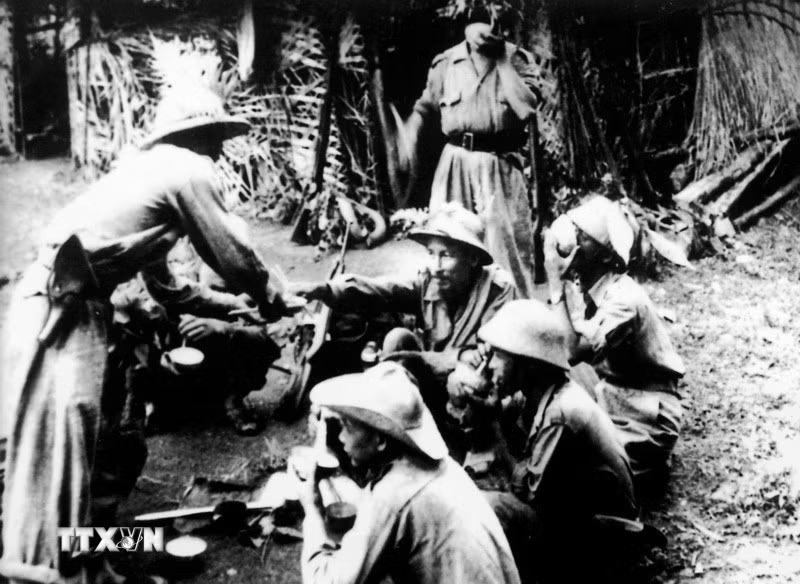
A simple meal shared by President Ho Chi Minh and his soldiers on their way to work in Viet Bac. (Photo: Archival material/VNA)
The ethics that he upheld were ethics of action, vividly demonstrated in his lifestyle and in every daily deed. These included diligence, frugality, integrity, righteousness, and selfless dedication; a spirit of altruism; and a simple, down-to-earth lifestyle, blending in with the people.
Regarding "diligence," Uncle Ho worked, studied, and researched tirelessly to find the path to national salvation; together with the Party, he organized and led the people to successfully carry out the revolution.
Regarding "frugality," Uncle Ho was a prime example of simplicity and integrity. Despite being the leader of an entire nation, he was always extremely simple, from his food (braised fish, pickled vegetables, salted eggplant); his clothing (a worn-out traditional Vietnamese outfit with rubber sandals or a yellow khaki suit with canvas shoes); to his housing (in the resistance zone, he lived with cadres and staff; in Hanoi , he lived in the house of an electrician; later, in a simple stilt house with only the most essential personal belongings). Even in his work, Uncle Ho highly valued frugality, stating, "When it shouldn't be spent, not a single penny should be spent."
Regarding integrity, his honesty was clearly demonstrated in every word and action. Not only did he never harbor any thoughts of personal gain, but he also constantly pondered how to improve the lives of his people, how to ensure that "everyone has food and clothing, and everyone has access to education."
In terms of "righteousness," he was always humble, respectful of elders and considerate of juniors, loving and caring for all social classes, especially the poor and suffering. Most importantly, he disregarded personal happiness and always placed the interests of the nation first, sacrificing his entire life to bring independence to the nation and freedom to the people.
Alongside cultivating and refining revolutionary ethics, it is essential to combat manifestations of individualism, bureaucracy, corruption, arrogance, and abuse of power.
He called individualism an "internal enemy," the most dangerous disease for revolutionary cadres. He emphasized: "A nation, a party, and each individual, no matter how great and attractive they were yesterday, will not necessarily be loved and praised by everyone today and tomorrow if their hearts are no longer pure, if they fall into individualism." That warning remains just as relevant today.
And in his sacred Last Testament, what he pondered until the end of his life was "to care for the lives of the people," to "cultivate revolutionary ethics for future generations," and to keep our Party "truly clean, worthy of being the leader and the truly loyal servant of the people." These instructions not only express the final wishes of a leader but also serve as a shining example of boundless dedication, love, and self-sacrifice.
Learning from and following Uncle Ho's example in cultivating revolutionary ethics.
Imbued with Ho Chi Minh's ideology, in the process of leading the revolution, our Party has continuously enhanced its leadership role and prestige through its courage, wisdom, exemplary revolutionary ethics, and the moral cultivation and training of its cadres and members.
Particularly during the period of national renewal, building the Party on ethical foundations has always been a priority for the Party, and has been supplemented and developed with many contents, viewpoints, and solutions appropriate to the requirements of each stage of the revolution. Thanks to this, the Party has become increasingly strong and steadfast in leading the Vietnamese revolution from one victory to another.
Resolution No. 4 of the 11th Central Committee focuses on Party building and rectification, identifying manifestations of ideological and political degradation, moral decay, and lifestyle deviations among cadres and Party members. The resolution emphasizes the need for self-criticism and criticism, raising awareness of responsibility, and setting a moral example for cadres and Party members.
At the 12th National Congress of the Party (2016), for the first time, the Party placed the building of the Party in terms of ethics on par with the building of the Party in terms of politics, ideology, and organization, affirming the goal: "Building a clean and strong Party in terms of politics, ideology, organization, and ethics."
At the 13th National Congress of the Party (2021), building the Party on ethical foundations was reaffirmed as one of the five important aspects of Party building and rectification. The Party demanded: "In the coming years, special attention must be paid to and further strengthened in the comprehensive building and rectification of the Party in terms of politics, ideology, ethics, organization, and personnel."
The 14th National Congress of the Party (in 2026) continues to emphasize: Strengthening building, rectification, and self-renewal so that our Party truly embodies morality and civilization; elevating and enhancing the effectiveness and efficiency of the Party's leadership, governance, and fighting capacity.
In addition, numerous directives and resolutions have been issued to promote the study and emulation of Ho Chi Minh's ideology, ethics, and style.
Since 2016, when the Politburo issued Directive No. 05-CT/TW on promoting the study and emulation of Ho Chi Minh's thought, morality, and style, the study and emulation of Uncle Ho has continued to be promoted as a regular task, closely linked to the political tasks of each locality, agency, and unit, aiming to build our Party into an increasingly clean and strong organization, prevent ideological and political degradation, moral decay, and lifestyle deviations, and build a comprehensively developed Vietnamese person.

After nearly 10 years of implementing Directive No. 05-CT/TW, along with Conclusion No. 01-KL/TW dated May 18, 2021, of the Politburo on continuing to implement Directive No. 05-CT/TW, significant changes have been made in both awareness and action, contributing to building a clean and strong Party and political system, and consolidating the people's trust.
Next, on May 9, 2024, the Politburo issued Regulation No. 144-QD/TW on the revolutionary ethical standards of cadres and Party members in the new period, marking an important theoretical development in building the Party's ethics.
The regulations define five principles of revolutionary ethics that cadres and Party members must adhere to in the new era: absolute loyalty to the Party, the Fatherland, and the people; exemplary conduct and lifestyle; proactively combating manifestations of degradation; dedication and responsibility to work; and upholding the spirit of unity and discipline, along with 19 criteria for evaluating the implementation of these standards.
Over the years, our Party has achieved many positive results in Party building work regarding ethics. The education and training of revolutionary ethics have been carried out regularly, linked with promoting the study and emulation of Ho Chi Minh's thought, morality, and style.
The highlights of the shift from studying to following Uncle Ho's example and setting a good example are clearly evident: Party building work on ethics has been strengthened, harmoniously combining "construction" and "combat"; the fight against corruption and negative phenomena has been intensified in the spirit of "no forbidden zones, no exceptions"; and the timely and persuasive recognition, dissemination, and replication of exemplary models and examples in studying and following Uncle Ho's example are commendable.
Cadres and Party members actively uphold the spirit of exemplary self-reflection and self-correction according to the ethical standards set by President Ho Chi Minh, from small matters to large ones, emphasizing the spirit of "diligence, thrift, integrity, and righteousness" and a sense of service to the people. Party committees and organizations at all levels have actively commended advanced models, resolutely fought against deviant behaviors, and strictly dealt with acts violating ethics and lifestyles.
The majority of Party committees and leaders of localities, agencies, and units have seriously directed and organized the implementation of the Party's regulations on building a contingent of cadres and Party members; regulations on the responsibility of setting an example, self-criticism, and criticism.
In this new era of development, as the country enters a higher stage of progress, the requirement is not only to build a "clean and strong" Party, but also to strive towards a "moral and civilized" ruling Party, capable of leading in a context where the entire nation is undergoing transformation.
Therefore, the Party's 14th Congress Document continues to emphasize: Further enhance the awareness of Party committees, Party organizations, cadres, and Party members about the particularly important role and urgent nature of Party building work in terms of ethics… Focus on leading and directing the serious, decisive, and effective implementation of regulations and directives on revolutionary ethical standards for cadres and Party members; strengthen the Party's leadership over the work of educating and practicing diligence, thrift, integrity, impartiality, and selflessness, as well as the things that Party members are not allowed to do, the responsibility of setting an example, and self-criticism and criticism within the Party in accordance with the spirit of Central Resolution 4 of the 11th and 12th Party Congresses, and Central Conclusion 4 of the 13th Party Congress on Party building and rectification; resolutely prevent, repel, and strictly handle cadres and Party members who have degenerated in political ideology, ethics, and lifestyle, and who show signs of "self-evolution" and "self-transformation"; Combining "construction" and "combat," with "construction" as the fundamental task and long-term strategy, and "combat" as an important and urgent ongoing task; creating strong changes in the performance of public duties, enhancing the ethics, culture of integrity, and professionalism of cadres, Party members, civil servants, and public employees; prioritizing the building of Party culture; resolutely fighting to eliminate opportunistic elements and those with moral and lifestyle degradation from the apparatus of Party and State agencies and the political system.
Continue to promote the study and emulation of Ho Chi Minh's ideology, ethics, and style through concrete daily actions and the exemplary conduct of cadres, Party members, association members, and union members, creating a widespread and positive impact within the Party and throughout society.
It can be seen that Ho Chi Minh's ethics are a brilliant embodiment of lofty patriotism and humanism. It is an invaluable spiritual asset that the Party, the State, and the people of Vietnam are committed to studying and following throughout their lives, serving as a guiding light for the sustainable development of the country. As General Secretary and President To Lam affirmed in his article "The Light of Ho Chi Minh Guides Our Path": "The 136th anniversary of President Ho Chi Minh's birth in the current context is not only an occasion to remember and express gratitude for his immense contributions. It is also an opportunity for the entire Party, the entire people, and the entire army to reflect on themselves in light of his thoughts, ethics, and style; to strengthen faith in the chosen path; to enhance responsibility to the Fatherland and the People; and to transform Ho Chi Minh's thought into concrete revolutionary actions in each agency, each locality, each cadre, Party member, and each citizen... Studying and following Ho Chi Minh's thought, ethics, and style today cannot stop at correct words, catchy slogans, or formal movements. More importantly, it must be transformed into public service ethics, discipline in implementation, a culture of integrity, a spirit of innovation and creativity, responsibility to serve the People, organizational capacity, and concrete results in life. Each leader..." Correct policies must be put into practice. Every policy must reach the people. Every official must use the satisfaction, trust, and happiness of the people as the measure of their work.
(VNA/Vietnam+)
Source: https://www.vietnamplus.vn/dao-duc-ho-chi-minh-bieu-tuong-van-hoa-sang-ngoi-post1110995.vnp














































































Comment (0)