

High accuracy
In early March 2025, the Provincial General Hospital put into operation the state-of-the-art Olympus EVIS X1 CV1500 endoscopic system, currently one of the most advanced in the world . With its outstanding advantage of increasing the visibility of blood vessels and mucosal structures in detail, even for tiny lesions just a few millimeters in size, the Olympus EVIS X1 CV1500 endoscopic system is also equipped with an accompanying artificial intelligence system to support the rapid identification of suspicious lesions, especially cancer and precancerous conditions. This helps doctors detect microscopic abnormalities, accurately and early locate lesions, inflammation, ulcers, polyps, and tumors in the digestive tract, detect cancer early, and support the accurate diagnosis of complex diseases…
The medical team at the Endoscopy Unit of the Provincial General Hospital is performing endoscopy on patients using the Olympus EVIS X1 CV1500 endoscopy system with integrated AI. |
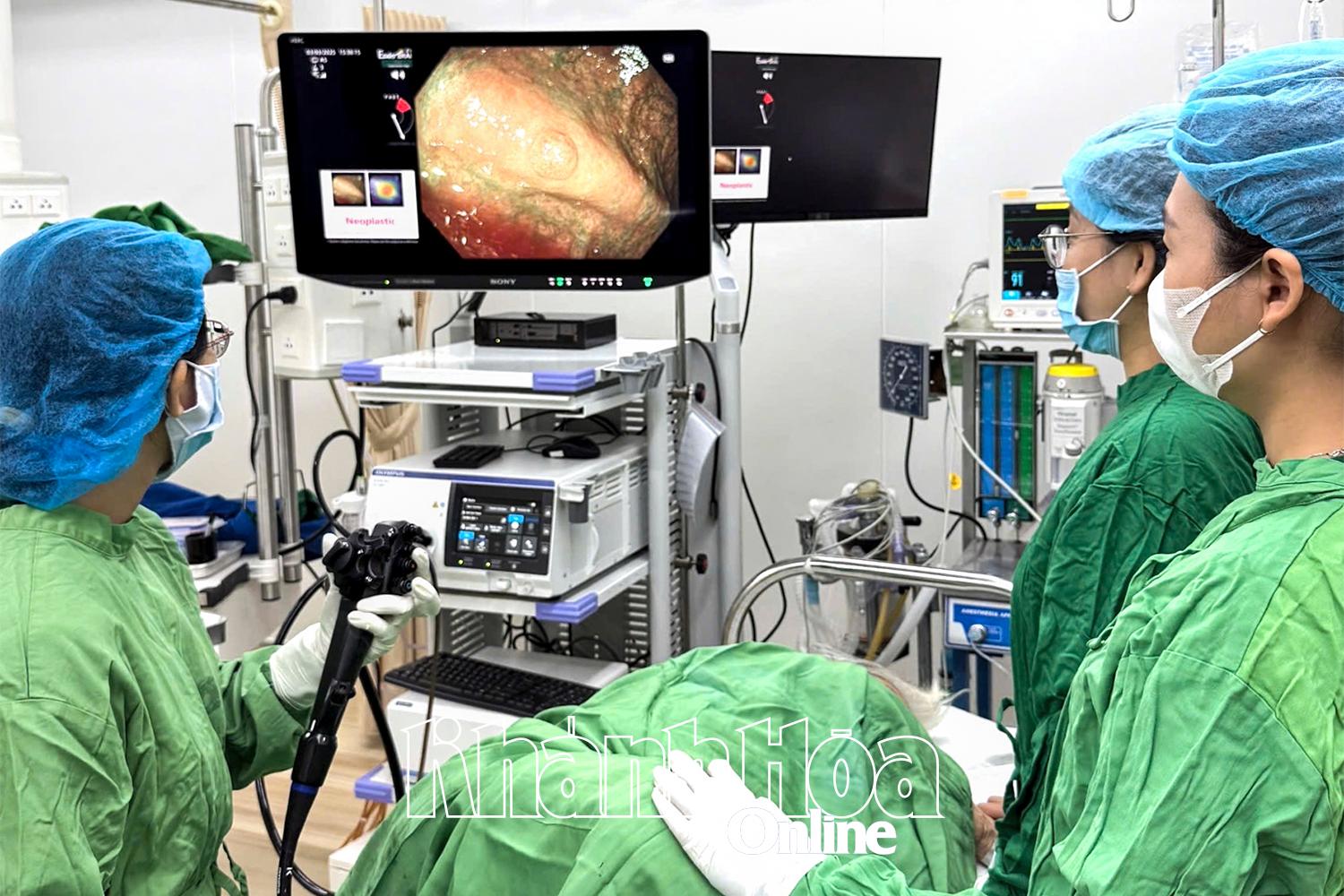
Suffering from persistent bloating, abdominal pain, and indigestion, Mr. NTT (45 years old, Nha Trang City) thought it was due to his habit of frequently skipping meals and irregular eating habits, so he neglected to seek medical attention. At the end of March, experiencing severe abdominal pain, Mr. T. went to the Provincial General Hospital for examination and was prescribed a gastroscopy. At the Endoscopy Unit, Mr. T. underwent endoscopy using the Olympus EVIS X1 CV1500 system. During the endoscopy, with the assistance of AI technology, the doctor discovered a small lesion in the antrum – easily overlooked with older generation endoscopic systems. Electronic staining and magnification technology helped the doctor see the mucosal abnormalities more clearly. Mr. T. was prescribed a biopsy, and the biopsy results confirmed it was early-stage gastric cancer. Mr. T. was treated with ESD – endoscopic submucosal dissection of the stomach, completely removing the tumor without surgery.
According to Dr. Cap Thi Thanh Thuy, a specialist in Gastrointestinal Endoscopy at the Provincial General Hospital, before putting the machine into operation, the unit's medical team received continuous training through workshops and scientific conferences on the application of AI in endoscopy. Compared to previous generations of endoscopes, the Olympus EVIS X1 CV1500 system, with the support of AI, helps doctors identify abnormal changes in the mucosa and suspicious areas. Simultaneously, AI helps assess the characteristics of lesions, classifying them as benign or malignant based on data from millions of endoscopic images. This provides doctors with a clear scientific basis for making accurate treatment decisions. The AI device can also assess and warn about areas that have not been thoroughly examined to ensure comprehensive endoscopy effectiveness.
In early 2025, the 22-12 Hospital invested in an Olympus EVIS X1 CV1500 endoscopy system with integrated AI automation for its Gastrointestinal Endoscopy Center. Dr. Cao Nguyen Dinh, Deputy Director of the 22-12 Hospital, stated: “The Olympus EVIS X1 CV-1500 endoscopy system with integrated AI helps doctors observe any abnormalities in the digestive tract, thereby providing accurate diagnoses of the nature of the lesions, improving treatment outcomes, and offering hope to patients, especially those with gastrointestinal cancers.”
Towards applying AI in many fields.
Currently, the demand for screening, diagnosis, and treatment is increasing; along with the development of MRI (magnetic resonance imaging) and CT scan systems, which provide images with very high resolution and detail, the scale of image data processing in clinical diagnosis is enormous. Doctors and technicians have to spend a lot of time analyzing images and drawing conclusions. Meanwhile, optimizing workflows and minimizing diagnostic errors is a crucial factor. With its ability to analyze details and recognize complex patterns, AI can help doctors shorten processing time, speed up the delivery of diagnoses with more accurate findings, especially for very small lesions or pathological signs hidden deep within the body's structure, difficult to detect with the naked eye.
Dr. Phan Huu Chinh, Director of the Provincial General Hospital, affirmed: “Following the trend of scientific and technological development, AI will be strongly applied in the medical field in the near future. Along with the orientation of developing specialized expertise, the Provincial General Hospital is aiming to become a regional hospital in the South Central Coast. Therefore, in addition to investing in the Olympus EVIS X1 CV1500 endoscopy system equipped with AI, this year, the Provincial General Hospital will organize a tender to purchase software for basic AI-based diagnostic imaging in endoscopy and X-ray for diseases of the brain, liver, spine, lungs, etc.” According to Dr. Cao Nguyen Dinh, in the future, the 22-12 Hospital will move towards applying AI in CT scans, X-rays, and in patient triage, helping to shorten patient waiting times.
Considered a valuable "assistant" to doctors, the application of AI in diagnosis and treatment in some hospitals has marked a major step forward in improving the quality of medical care. At the same time, it affirms the hospitals' goal of providing high-quality medical services and serving patients in the best possible way.
C.DAN
Source: https://baokhanhhoa.vn/xa-hoi/202504/day-manh-ung-dung-ai-trong-chan-doan-va-dieu-tri-benh-ee55fae/


![[Live] 2025 Community Action Awards Gala](/_next/image?url=https%3A%2F%2Fvphoto.vietnam.vn%2Fthumb%2F1200x675%2Fvietnam%2Fresource%2FIMAGE%2F2025%2F12%2F16%2F1765899631650_ndo_tr_z7334013144784-9f9fe10a6d63584c85aff40f2957c250-jpg.webp&w=3840&q=75)
![[Photo] Prime Minister Pham Minh Chinh receives the Governor of Tochigi Province (Japan)](/_next/image?url=https%3A%2F%2Fvphoto.vietnam.vn%2Fthumb%2F1200x675%2Fvietnam%2Fresource%2FIMAGE%2F2025%2F12%2F16%2F1765892133176_dsc-8082-6425-jpg.webp&w=3840&q=75)
![[Image] The tenacious fighting spirit of Vietnamese women's football](/_next/image?url=https%3A%2F%2Fvphoto.vietnam.vn%2Fthumb%2F1200x675%2Fvietnam%2Fresource%2FIMAGE%2F2025%2F12%2F17%2F1765990260956_ndo_br_4224760955870434771-copy-jpg.webp&w=3840&q=75)














































































Comment (0)