

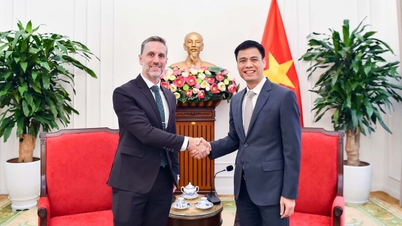
Florian Feyerabend, Resident Representative of the Konrad Adenauer Stiftung (KAS) in Vietnam, gave an interview to the World and Vietnam Newspaper ahead of the ASEAN Future Forum 2025.
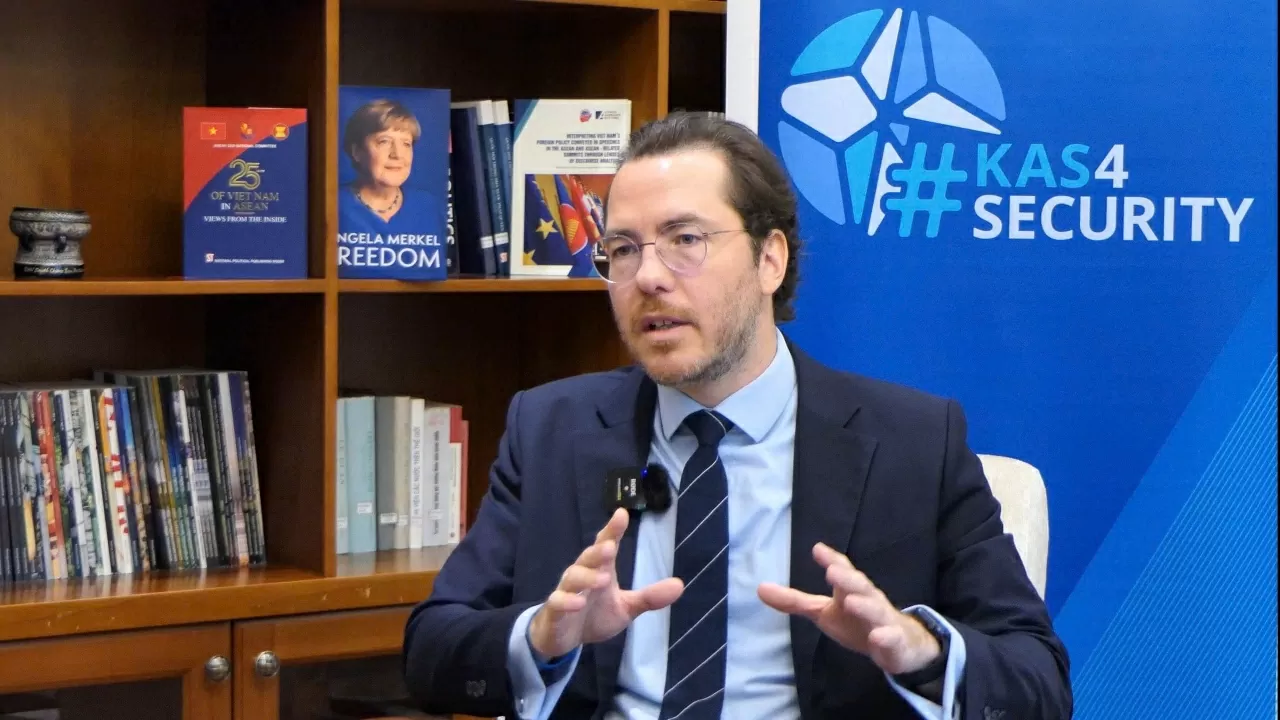 |
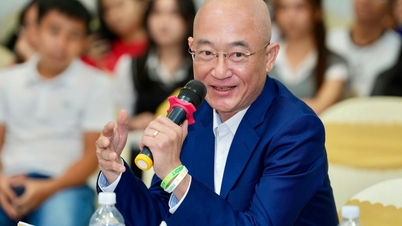
| Florian Feyerabend, Resident Representative of the Konrad Adenauer Stiftung (KAS) in Vietnam. (Photo: Thanh Long) |
The ASEAN Future Forum 2025 will be held in Hanoi from February 26-26 with the theme "Building a united, inclusive and resilient ASEAN in a changing world". Could you please share more about the significance of the ASEAN Future Forum 2025, as well as this theme?
First of all, I would like to congratulate the Diplomatic Academy, and more broadly the Ministry of Foreign Affairs, for having such a practical and meaningful initiative. This is the second time the ASEAN Future Forum has been held.
In 2024, the Forum was held for the first time and received great acclaim, even being mentioned in the joint statement of ASEAN Foreign Ministers, becoming part of the ASEAN dialogue.
This year, the ASEAN Future Forum saw greater participation from partners outside ASEAN, reflecting three key aspects: solidarity, inclusiveness, and resilience. All three are extremely important today as we stand at a historical turning point and witness the fragmentation of the international landscape. The rules-based international order is changing; we don't know what tomorrow will bring, but we can be certain that the world has been and continues to change.
Regarding solidarity, as someone from KAS – a consultative organization on issues related to Germany's foreign security policy – I believe that we need to unite to become strong, to have our voices heard, and to achieve a certain level of strategic autonomy. Therefore, this is an ambitious goal for ASEAN, and we hope to contribute to this aspect of solidarity through this Forum.
In terms of inclusiveness, it means that all ASEAN member states can have a voice, regardless of size, and all need to be heard. However, this is not limited to the ASEAN framework. Looking at the participants in this year's forum and other dialogue mechanisms of the bloc, it is clear that ASEAN always prioritizes inviting external partners to participate. This is also an important aspect of inclusiveness: ensuring that all member states are heard, while also including non-ASEAN countries in the dialogue. Furthermore, within ASEAN, not only the voice of the government (channel 1) but also other stakeholders (channel 1.5) need to be respected and listened to. With channel 1.5 dialogue, the ASEAN Future Forum is truly a good platform to meet these standards.
Finally, there's self-reliance – a crucial element in today's turbulent times. I believe that with the ASEAN Future Forum and this year's discussions, we can contribute to dialogues on future technologies. We will discuss artificial intelligence (AI) and quantum computing, topics that will be extremely important for ASEAN's future self-reliance. This year's Forum will not only address non-traditional security issues but also offer perspectives on trending and inevitable topics.
Therefore, I believe that the ASEAN Future Forum 2025 encompasses all three aspects: solidarity, inclusiveness, and resilience.
What are your views on ASEAN's central role in shaping the regional structure, as well as the prospects for cooperation between ASEAN and the European Union (EU) in maintaining peace, stability, and promoting sustainable development, not only in Southeast Asia but also globally?
In my opinion, ASEAN's central role is the core element. ASEAN has its own way of cooperating, not taking sides, and not interfering in each other's internal affairs.
ASEAN operates on four core principles of peaceful coexistence. In addition, the "ASEAN Way" is a popular term describing how the organization addresses internal challenges while balancing its external relations.
I believe that ASEAN's greatest strength lies in its ability to bring together stakeholders and invite partners outside the region to discuss common challenges. This is precisely ASEAN's key role.
Sir, the ASEAN Future Forum 2025 is part of Vietnam's and other ASEAN countries' efforts to create a platform for exchanging ideas and finding solutions to current global challenges. How do you assess Vietnam's role in ASEAN as a full member over the past 30 years?
I think 2025 is a very important year for Vietnam. Vietnam is looking back on 30 years as a member of ASEAN. In 1995, Vietnam joined ASEAN, marking the beginning of the country's regional and international integration process.
Therefore, it can be said that ASEAN is the starting point for Vietnam to be what it is today – a country deeply integrated into the global value chain, participating in more than 17 free trade agreements and 2 more under negotiation, and a proactive and responsible nation on the international stage. ASEAN is the foundation for that.
Looking back over the past three decades, I can say that Vietnam has achieved considerable success. Looking back to 2010, when Vietnam held the ASEAN chairmanship, we can see the expansion of the ASEAN Regional Forum (ARF), where inclusiveness was emphasized. Issues related to the US and Russia were also included in discussions – this was thanks to Vietnam's efforts.
Similarly, regarding regional security issues, 2010 was also the year Vietnam played a pioneering role in expanding the ASEAN Defence Ministers' Meeting to ADMM and later to ADMM+. This is a significant "legacy" in Vietnam's leadership role within ASEAN, and I think it deserves recognition.
Vietnam's second ASEAN chairmanship took place under very difficult circumstances, in 2020, amidst an unprecedented global pandemic. Once again, Vietnam took important steps to strengthen ASEAN's cohesion and solidarity, not only in efforts to combat the Covid-19 pandemic but also in building the ASEAN Community in a challenging context.
Therefore, I appreciate and congratulate Vietnam on those achievements. And I believe that with the upcoming ASEAN Future Forum, Vietnam is continuing to contribute to the dialogue on the future of the region, reviewing, adjusting, and improving existing mechanisms.
Could you share more about the upcoming cooperation plans between the Konrad Adenauer Stiftung (KAS) and ASEAN member states, especially in the context of the region and the world facing many new challenges and opportunities? Furthermore, through these initiatives, what message do you wish to convey regarding the role of KAS in promoting dialogue, development cooperation, and strengthening relations between ASEAN and the EU in the coming period?
The KAS Foundation is a political organization affiliated with Germany's Christian Democratic Party (CDU). Within the ASEAN region, we have a presence in most countries.
In Vietnam, we are extremely proud to have been a partner and sponsor of the ASEAN Future Forum since its inception. This stems from our long-standing, deep, and strategic partnership with the Diplomatic Academy of Vietnam. When the Academy proposed the idea of organizing the ASEAN Future Forum, they approached us and invited us to participate. KAS is also deeply honored to be a part of the Forum.
Furthermore, in Vietnam, we are also known for our support of the International Conference on the South China Sea – another important Vietnamese initiative aimed at addressing maritime security challenges in the South China Sea. We also collaborate with the Diplomatic Academy of Vietnam to implement a series of annual events such as: the International Mekong Forum, the International Forum on China Studies, the Maritime Dialogue, etc.
At the regional level, KAS's representative offices are implementing numerous programs related to ASEAN. KAS not only supports the ASEAN Future Forum in Vietnam but also sponsors the annual Asia-Pacific Forum held in Kuala Lumpur (Malaysia). We are also a partner of the ASEAN Forum organized by the Institute of Southeast Asian Studies (ISEAS) in Singapore.
Last but not least, we have a network of young professionals from both Europe and Southeast Asia, working together on challenges and opportunities for both the EU and ASEAN. This is the E-Engage think tank network. The Diplomatic Academy of Vietnam is also a partner and has contributed to building this network.
These are three key highlights of our cooperation with ASEAN in the broader region.
Regarding ASEAN-EU cooperation, in 2020, the EU officially became a strategic partner of the region. And 2025 also marks 10 years since the EU established its official mission with an EU Ambassador to ASEAN, demonstrating the strong institutional relationship between the two blocs.
Specifically, if there were an easy-to-remember formula for the relationship between ASEAN and the EU, I would use the 3-3-3-2 model: ASEAN is the EU's third-largest trading partner. Conversely, the EU is also ASEAN's third-largest trading partner. The EU is the third-largest investor in ASEAN. And finally, the EU is the ASEAN region's second-largest development partner and donor.
In my opinion, this 3-3-3-2 formula reflects the strong development of relations between the EU and Vietnam, and more broadly, ASEAN.
Source

![[Photo] Ba Lang An Lighthouse - the "eye of the sea" amidst the "rock museum" of Quang Ngai province.](https://vphoto.vietnam.vn/thumb/1200x675/vietnam/resource/IMAGE/2026/05/29/1780038698840_anh-man-hinh-2026-05-29-luc-14-10-42.png)

![[Image] Pleasant weather helps students enter the 10th grade entrance exam with confidence.](https://vphoto.vietnam.vn/thumb/1200x675/vietnam/resource/IMAGE/2026/05/29/1780034401612_ngay-1-thi-lop-10-minh-duy-8-5009-jpg.webp)




















































Comment (0)