

The period of application is from July 1, 2025 to December 31, 2026.
On the morning of May 13th, acting on behalf of the Prime Minister, Minister of Finance Nguyen Van Thang presented to the National Assembly the Government's proposal for a draft resolution of the National Assembly on reducing value-added tax (VAT).
According to Minister Thang, during the period from 2022 to the first six months of 2025, the National Assembly decided to reduce the VAT rate by 2% for groups of goods and services currently subject to a 10% VAT rate (to 8%), excluding certain groups of goods and services.
"The solution of reducing VAT along with other tax, fee, and levy support measures is creating great opportunities for businesses to reduce production costs, increase profits, and boost demand," Mr. Thang said.
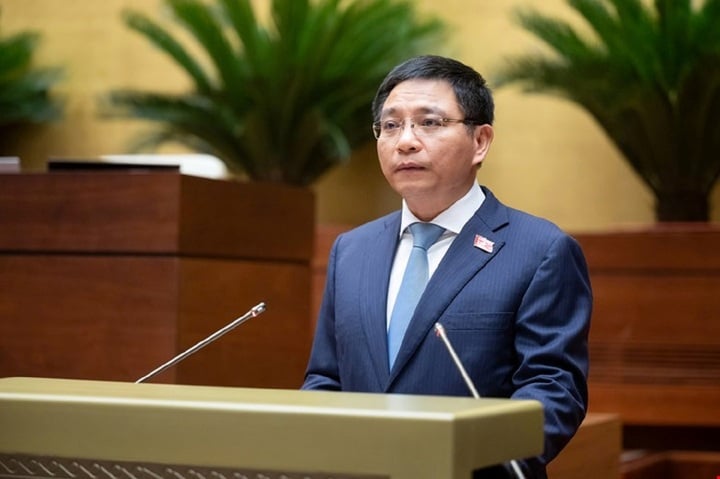
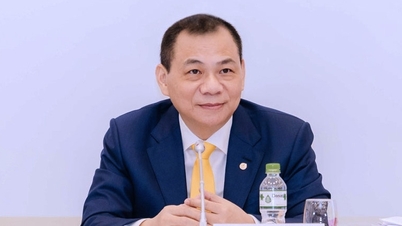
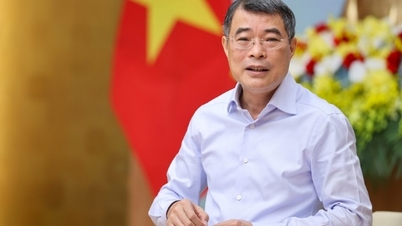
Minister of Finance Nguyen Van Thang. (Photo: National Assembly Media).
According to Mr. Thang, in addition to the fundamental achievements, the Vietnamese economy still has limitations and shortcomings and continues to face many difficulties and challenges.
The growth drivers have not yet shown a clear breakthrough as required by the growth targets, such as difficulties in production and business activities, high production costs, and a slow but improved domestic purchasing power, especially following the US announcement of retaliatory tariffs on countries, including Vietnam.
To contribute to boosting economic development, supporting people and businesses, and promoting domestic production, tourism, and consumption in 2025 and 2026, it is necessary to continue implementing the VAT reduction policy.
Regarding the draft content, the Government proposes reducing the VAT rate by 2% for groups of goods and services currently subject to a 10% tax rate (to 8%).
Except for certain groups of goods and services such as telecommunications, financial activities, banking, securities, insurance, real estate business, metal products, mining products (excluding coal), and goods and services subject to excise tax (excluding gasoline).
Regarding the impact on budget revenue, Mr. Thang said that the projected decrease in state budget revenue in the last six months of 2025 and the whole year of 2026 is approximately 121,740 billion VND (of which the decrease in the last six months of 2025 is about 39,540 billion VND, and the decrease in 2026 is about 82,200 billion VND).
"Reducing VAT will contribute to lowering the cost of goods and services, thereby boosting production and business, creating more jobs for workers, and contributing to macroeconomic stability and economic growth in the last six months of 2025 and throughout 2026," Mr. Thang said.
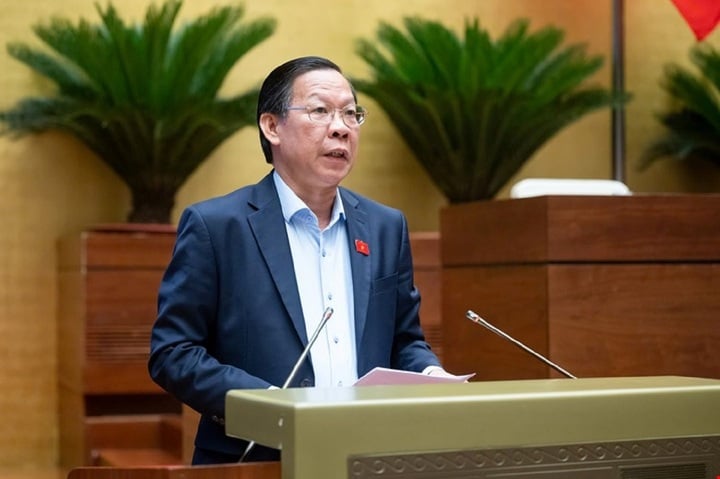
Chairman of the Economic and Finance Committee Phan Van Mai. (Photo: National Assembly Media).
Reviewing this matter, the Chairman of the Economic and Financial Committee, Phan Van Mai, stated that the majority of opinions within the committee agreed on the necessity of issuing a resolution to continue applying the VAT reduction policy for the last six months of 2025 and the entire year of 2026, as proposed by the Government.
This is to support businesses in boosting production and business activities, while maintaining macroeconomic stability.
In the context of a domestic economy facing numerous difficulties and challenges, and a global economy experiencing unpredictable and unstable fluctuations, continuing to implement this policy can be seen as a measure aimed at boosting domestic consumption to promote growth and contribute to achieving the set 8% growth target.
However, some argue that continuing to propose and enact policies is not truly appropriate and unlikely to achieve the set goals of stimulating consumer demand, as the policy's ability to stimulate demand has reached its saturation point after a long period of implementation.
Similarly, the continuous extension and prolongation of tax reduction policies sets a bad precedent, making tax policy unstable and inconsistent.
Source: https://vtcnews.vn/de-xuat-giam-2-thue-vat-den-het-2026-ar942972.html
![[Photo] My Son at night: A thousand-year-old heritage site amidst the Milky Way](https://vphoto.vietnam.vn/thumb/1200x675/vietnam/resource/IMAGE/2026/04/15/1776261039184_ndo_br_chon6-jpg.webp)
![[Photo] Mrs. Ngo Phuong Ly meets and exchanges views with Mrs. Peng Li Yuan](https://vphoto.vietnam.vn/thumb/1200x675/vietnam/resource/IMAGE/2026/04/16/1776277858080_phu-nhan-1-jpg.webp)
![[Photo] The General Secretary, President and his wife meet with Vietnamese-Chinese friendship leaders.](https://vphoto.vietnam.vn/thumb/1200x675/vietnam/resource/IMAGE/2026/04/15/1776264829725_vna-potal-tong-bi-thu-chu-tich-nuoc-to-lam-gap-mat-nhan-sy-huu-nghi-viet-nam-trung-quoc-8703641-3130-jpg.webp)

![[Photo] National Assembly Chairman Tran Thanh Man attends the opening session of IPU-152](https://vphoto.vietnam.vn/thumb/1200x675/vietnam/resource/IMAGE/2026/04/16/1776277863731_ctqh5-jpg.webp)


























































Comment (0)