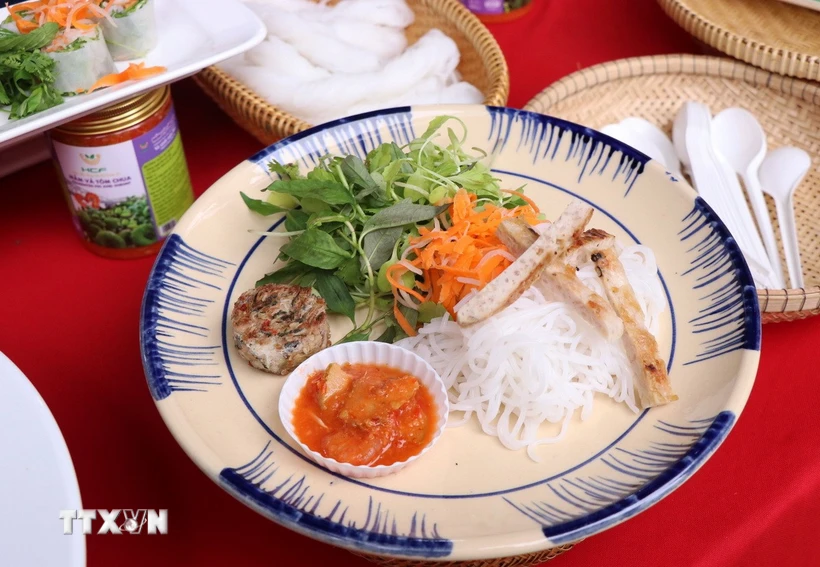
 Bun Van Cu is prepared into many unique dishes that reflect the rich culture of Hue . (Photo: Tuong Vi/TTXVN)
Located peacefully north of Hue city, stretching along the picturesque southern bank of the Bo River, Van Cu village is a famous place associated with the traditional vermicelli-making craft.
For generations, the pristine white rice noodles from this village have been regularly transported by locals to markets, eateries, and restaurants throughout Hue city.
Van Cu vermicelli is not only an important ingredient in local cuisine but has also become a symbol contributing to the reputation of Hue beef vermicelli – a famous specialty of the ancient capital city.
It's difficult to mention Hue without mentioning the image of the Vân Cù noodle vendors, a symbol of tradition and long-standing cultural beauty.
A century-old craft village along the Bo River
Since ancient times, the craft of making rice noodles in Van Cu village has not only been a means of livelihood but also considered a unique cultural feature, clearly reflecting the life and spirit of the people here.
According to oral tradition in Van Cu village, long ago, a group of people from the North followed Lord Nguyen Hoang south to settle and chose Co Thap village (now in Quang Dien district) as their place of residence. Among them was a beautiful and talented girl who was always well-liked by everyone.
The villagers were mostly engaged in farming, but the girl created her own unique profession by choosing to make rice noodles from the rice grains of her hometown. Thanks to her skillful hands and the delicious flavor of her noodles, people affectionately called her "Miss Noodle."
However, some envious people took advantage of the fact that the region had suffered from crop failures for three consecutive years to fabricate rumors that the gods were punishing the villagers. They claimed that the cause was "Miss Bun" daring to use "heavenly-given pearls" to soak, grind, and rub into rice noodles.
The villagers were outraged and pressured her to choose between giving up her job or leaving. Determined to keep her work, "Ms. Bun" decided to leave.
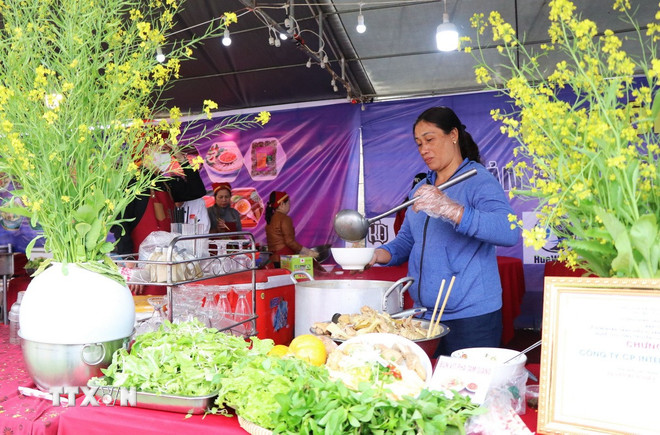 Van Cu vermicelli is used to create many unique dishes that reflect the rich culture of Hue. (Photo: Tuong Vi/VNA)
Being a kind-hearted woman, she was given the right by the villagers to choose her own path and was even assigned five strong young men to escort her, helping her carry the heavy millstone. Together they marched tirelessly eastward. When the fifth young man was exhausted, she suddenly realized that this very place, by divine will, was destined to be her final resting place.
Seeing the lush greenery all around, and the cool, winding Bo River flowing through the village, she decided to choose Van Cu as her place to settle down and build her career.
Here, she passed on her secret recipe for making rice noodles to the local people. Over time, the rice noodle making profession continuously developed, becoming a famous brand throughout the Southern region and during the Nguyen dynasty.
Since then, the craft of making rice noodles has been preserved by the descendants of Van Cu village through generations, and Van Cu is the only locality in Central Vietnam that organizes a ceremony to worship the patron saint of the craft, Ba Bun, on the 22nd day of the first lunar month.
The process of making the famous rice noodles.
Each strand of rice noodle is not only a combination of rice, water, and the skillful hands of the artisans of Van Cu, but also embodies spiritual values, the culmination of a process of preserving and developing a traditional craft through many generations.
The noodle makers here not only create products to sell, but they also work with all their heart, a deep love for their craft, profound pride, and a profound appreciation for the heritage left by their ancestors.
In Van Cu noodle village, almost every family wakes up at dawn, their lamps and torches blazing, to prepare noodles for the morning market. To ensure they have enough ingredients ready, they soak the rice, grind it finely, and meticulously prepare every step from the evening before.
To create delicious rice noodles, many meticulous steps are required. Each step in this process demands its own secrets to ensure quality. In particular, the type of rice chosen plays a crucial role, greatly determining the perfection of the finished product.
The rice used is Khang Dan, a common local variety. It's not the most premium or expensive rice, but simply a short-season variety commonly grown by locals to ensure food security during lean seasons. The rice doesn't need to be overly glossy, but it must be clean, with just the right dryness – not too dry and not too wet.
The rice is soaked thoroughly to remove all impurities, then rinsed again with cold water to ensure it is completely clean. Next, it moves on to the stages of grinding the rice, kneading the dough, shaping it, and cooking the rice noodles.
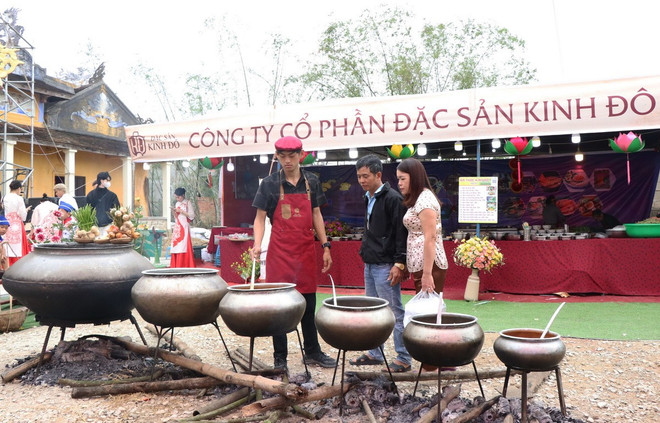 Vietnamese Noodle Heritage Food Festival - Van Cu Noodle Village. (Photo: Tuong Vi/VNA)
Van Cu rice noodles are known not only for their distinctive delicious flavor but also for their meticulous and refined preparation process. What makes Van Cu rice noodles different is that the locals use absolutely no additives other than raw salt.
Thanks to this, the rice noodles from the village not only achieve a rare smoothness but also possess an attractive translucent white color and a glossy, appealing surface. When enjoyed, the noodles have no sour taste but instead a subtle aroma of rice flour, a moderate chewiness, and are neither too soft nor too hard.
Previously, rice noodles were produced using traditional methods, which were time-consuming and labor-intensive. Nowadays, people in the craft villages use modern machinery and equipment, saving time and effort while still ensuring quality, food safety, and higher productivity.
Making Van Cu an attractive tourist destination.
According to data from the People's Committee of Huong Toan commune, Van Cu village currently has 125 households engaged in vermicelli making, accounting for nearly one-third of the total 399 households in the village. Approximately 325 people are regularly involved in production.
Currently, the village plays an important role in supplying rice noodles as an ingredient to many restaurants and eateries in Hue city as well as neighboring provinces.
The craft of making rice noodles in Van Cu is not simply a food production job; more profoundly, it embodies the soul, memories, and unique characteristics of the local culture. Thanks to these unique and meaningful values, the Van Cu rice noodle making village has been officially recognized as a National Intangible Cultural Heritage by the Ministry of Culture, Sports and Tourism under Decision No. 3979/QD-BVHTTDL issued on December 10, 2024.
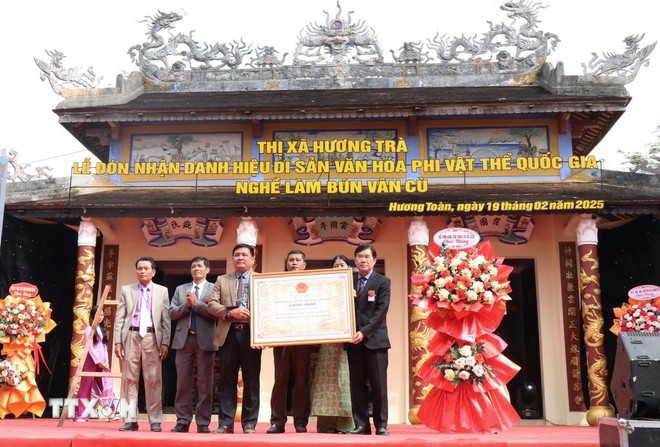 The traditional craft of making Van Cu vermicelli receives the title of National Intangible Cultural Heritage. (Photo: Tuong Vi/VNA)
In the coming period, the People's Committee of Huong Tra town will strengthen the implementation of comprehensive solutions, focusing on harmonizing the preservation of cultural heritage and promoting production development, aiming towards the goal of sustainable development.
This area is planned to develop a dedicated exhibition space for the Vân Cù vermicelli-making craft at the Bà Bún temple. Simultaneously, systematic practical training and teaching activities will be organized to preserve and promote the value of this intangible cultural heritage. Alongside this, incentive and support policies will be integrated to promote the sustainable development of the craft and traditional craft villages.
Van Cu Village, with its unique cultural heritage and prime location along the Bo River, is becoming an ideal destination for craft village tours, combining land and water travel in Hue and the surrounding area.
This also serves as the basis for Huong Tra town, Huong Toan commune, and relevant departments to coordinate in surveying and researching the inclusion of Van Cu craft village into key tour routes following the model of "Traditional handicraft village sightseeing and experience" when tourists visit Hue city.
Source: https://www.vietnamplus.vn/den-hue-tham-lang-nghe-lam-bun-van-cu-co-tuoi-doi-hon-400-nam-post1013239.vnp


![[Photo] Admire the coral "masterpiece" amidst the million-year-old heritage of Dak Lak province.](https://vphoto.vietnam.vn/thumb/1200x675/vietnam/resource/IMAGE/2026/05/30/1780107638639_y25-jpg.webp)


























































































Comment (0)