

 |
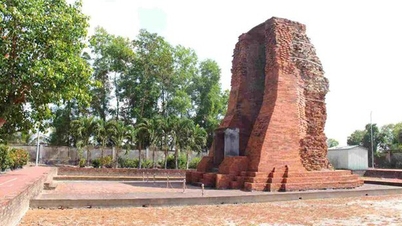
| Having existed for decades, the Co Nhac Tu historical site has not been restored and is seriously deteriorating. |
Built in 1966 at alley 127 Nguyen Trai Street (Phu Xuan Ward), Co Nhac Tu is ancestral temple dedicated to the founders of Hue's traditional music, a form of ancient music with a long history and an important place in the national cultural heritage. Every year, artists hold a ceremony commemorating the founders of the profession on the 16th of March and the 16th of October according to the lunar calendar.
The land on which the Co Nhac Tu (Ancient Music Temple) was built was originally the Tan Mieu area, created by King Thanh Thai in 1891 to worship his father, King Duc Duc (1853-1884). In 1899, King Duc Duc was moved to Long An Palace for worship. In 1966, Empress Dowager Tu Cung, also known as Doan Hy Hoang Thai Hau, wife of King Khai Dinh, agreed to allow the Imperial Music Ensemble to use the land to build the ancestral temple. The official construction date is recorded as August 11th, 1966 (the year of the Fire Horse). The Co Nhac Tu has been managed and used by the Hue Traditional Music Association until today.
This plot of land, nearly 250 square meters in size and facing south, includes architectural structures such as a gate, a system of walls, a front hall, an inner sanctuary, and a garden…
The Co Nhac Tu temple has a special and close relationship with the development of music in general and Hue's traditional music in particular. It is also a sacred place of worship deeply connected to the spiritual and professional lives of Hue's traditional musicians and singers, as well as those from Binh Tri Thien province. In 2010, the People's Committee of Thua Thien Hue province (now Hue City) issued a decision recognizing the Co Nhac Tu temple as a provincial-level historical site.
However, over time, this monument is seriously deteriorating. According to assessments from the authorities, the church's foundation is tilting, sinking, and cracking in some sections; the plaster layers are deteriorating; most of the walls are cracked, and the murals are blistering and severely damaged.
Meanwhile, the wooden roof structure has severely deteriorated due to decay and termite infestation. Some components have cracked along their length, and the tiled roof is sagging and breaking, causing leaks. In particular, a section of the tiled roof has recently collapsed and is at risk of further collapse. Furthermore, external structures such as screens, gates, and fences are in a similar state of disrepair.
 |
| The roof of the Co Nhac Tu historical site is damaged. |
Poet Vo Que, head of the Hue Chamber Music Club – who has repeatedly spoken out about the deterioration of this historical site – said that recently, on the 16th day of the 3rd lunar month (May 2nd), the Hue Traditional Music Association was unable to hold the annual commemoration ceremony for the founders of the profession here on the same scale as in previous years because the site was too dilapidated. However, out of gratitude to their ancestors, he and several artists tried their best to organize the ceremony as solemnly and respectfully as possible, with regret. “This is an important historical site for Hue. Therefore, the relevant authorities need to have a plan to restore the site soon,” poet Vo Que hoped.
According to representatives of the Phu Xuan Ward People's Committee, Co Nhac Tu is a historical and cultural relic of outstanding value, a part of the Hue Imperial Citadel complex. It is also a unique cultural and artistic institution with an equally important position in the traditional music of the nation. In recent years, this relic has never been restored, and furthermore, it has been severely degraded due to the effects of weather. Therefore, the preservation, restoration, and rehabilitation of the relic is extremely necessary and urgent.
Recently, leaders from the Phu Xuan Ward Public Service Center visited and surveyed the site. According to a representative from the unit, they will propose an emergency protection plan first, and only then consider long-term preservation and restoration plans.
The estimated cost for preservation and restoration is approximately 3.6 billion VND. In the near future, Phu Xuan ward will submit a request to the Hue City Department of Culture and Sports to review, inspect, and confirm the condition of the Co Nhac Tu Church relic. This will provide a basis for establishing, evaluating, and approving the plan for preservation, restoration, and rehabilitation of the Co Nhac Tu Church relic in accordance with the prescribed authority and procedures.
Source: https://huengaynay.vn/van-hoa-nghe-thuat/di-tich-co-nhac-tu-cho-duoc-trung-tu-166019.html




![[Photo] General Secretary and President To Lam presides over the meeting to approve the draft report on the results of the second inspection by the Politburo of the Standing Committee of the Hanoi City Party Committee.](https://vphoto.vietnam.vn/thumb/1200x675/vietnam/resource/IMAGE/2026/05/26/1779789811432_a2-bnd-4430-9620-jpg.webp)



















































































Comment (0)