

You're guaranteed to get cold and wet when parachuting through clouds, regardless of the type of cloud.
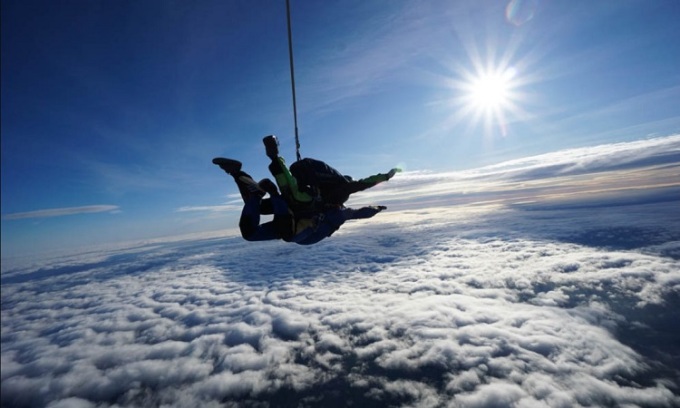
The experience of skydiving through the clouds depends on the type of cloud. Photo: Skydive Langar
The experience of falling through a cloud will depend on the type of cloud, protective gear, and weather conditions. But the general outcome is that you will be soaked, freezing cold, and even unconscious, according to those who have experienced it.
Clouds form when water molecules condense around airborne particles called aerosols, the nature of which influences the type and size of the cloud. However, according to Marilé Colón Robles, an atmospheric scientist at NASA's Langley Research Center in Virginia who specializes in cloud research, "not all aerosol particles are the same."
Some natural aerosols, such as dust, often promote the formation of ice particles, while sea vapor contributes to the creation of water molecules. Scientists are also experimenting with introducing artificial aerosols into the atmosphere, including silver or lead iodide, to produce dense, bright clouds that reflect solar radiation or create rain and snow.
Since the paratroopers are falling from an altitude of 4,000 meters, the most likely scenario is that they will encounter thick stratocumulus clouds and flat-bottomed cumulus clouds. Both of these cloud types are composed primarily of water molecules. When they appear at altitudes above 1,980 meters, they are called mesothelial and mesocumulus clouds to mark their position in the atmosphere.
Ryan Katchmar, a skydiving instructor in Utah with 10,000 jumps, emphasizes that people shouldn't try to fall through clouds because there's no way to track potential hazards, including other jumpers or aircraft. But sometimes they can't avoid it. "It feels unlike anything else. You fall through a white room, then come out at the bottom. If it's a thick, dark cloud, you'll be soaking wet," Katchmar shared. He enjoys the feeling of the air in the area being humid yet fresh.
Katchmar has also experienced unexpectedly cold conditions. For this reason, skydivers usually dress warmly to avoid injury from exposed skin. During a recent jump in Utah, while filming another skydiver, Katchmar noticed the woman's nose and cheeks turned white due to ice forming around her as she fell through the clouds.
The most extreme scenario for skydiving in bad weather involves thunderstorms. Inside a thunderstorm cloud, hot air can rise at speeds of up to 160 km/h, but at high altitudes, the particles fall as rain or hail. Additionally, most lightning strikes in thunderstorms occur within or between the clouds.
Only two people have survived parachute jumps through thunderstorms. In 1959, American Lieutenant Colonel Henry Rankin ejected from his fighter jet in violent weather and spent 40 minutes inside a thunderstorm, suffering from frostbite and nearly drowning before ejecting from over a hundred meters above the ground and falling into a treetop. Decades later, in 2007, paraglider Ewa Wiśnierska was accidentally swept into a thunderstorm while training for the world championships. Wiśnierska lost consciousness due to lack of oxygen and landed hours later 60 kilometers away.
An Khang (According to Live Science )
Source link
![[Photo] First session of the 14th Congress of the Vietnam Trade Union](https://vphoto.vietnam.vn/thumb/1200x675/vietnam/resource/IMAGE/2026/06/03/1780465947883_ndo_br_img-3852-jpg.webp)
![[Photo] General Secretary and President To Lam presides over a meeting with the Central Organizing Committee.](https://vphoto.vietnam.vn/thumb/1200x675/vietnam/resource/IMAGE/2026/06/03/1780482764658_a1-bnd-4741-3342-jpg.webp)
![[Photo] Secretary of the National Assembly Party Committee, Chairman of the National Assembly presides over the meeting of the Standing Committee and Executive Committee of the National Assembly Party Committee.](https://vphoto.vietnam.vn/thumb/1200x675/vietnam/resource/IMAGE/2026/06/03/1780480353201_ndo_br_bnd-2585-jpg.webp)



















































![[Video] Sunset at Lap An Lagoon – Where the sun sets over the fishing nets](https://vphoto.vietnam.vn/thumb/1200x675/vietnam/resource/IMAGE/2026/05/31/1780192137701_beach-landscape-sea-water-nature-grass-745871-pxhere-com.jpeg)








































Comment (0)