

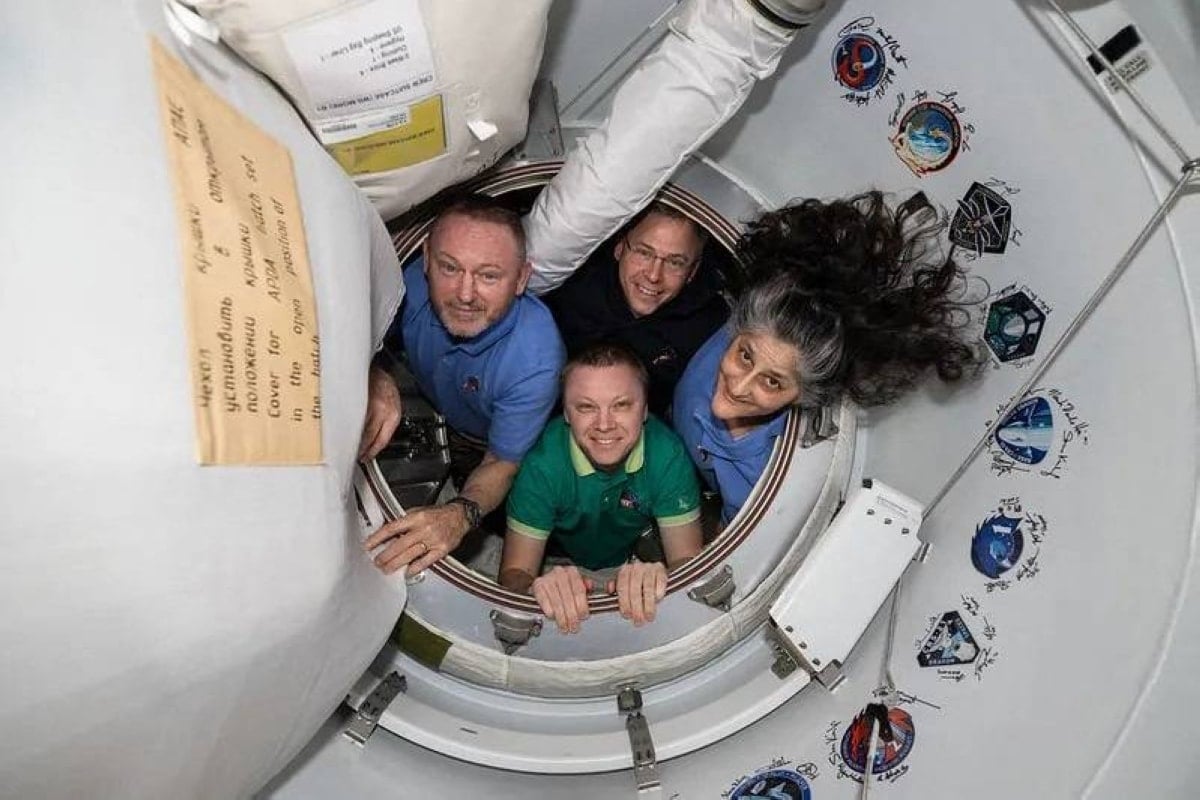
US astronauts Butch Wilmore and Suni Williams have returned to Earth after nine months on the International Space Station (ISS), with some of the health risks they faced well documented and managed, while others remain a mystery.
These dangers will only increase as humanity pushes deeper into the solar system, creating a need for innovative solutions to protect the future of space exploration.
Exercise is key
While the American astronaut's mission has received attention, Wilmore and Williams' nine-month stay in space is "normal," said Rihana Bokhari, assistant professor at Baylor College's Center for Aerospace Medicine.
ISS missions typically last six months, but some astronauts can stay for up to a year, and researchers are confident in the astronauts' ability to stay healthy throughout that time.
Most people know that lifting weights builds muscle and strengthens bones, but this activity is impossible in space because of the lack of gravity. To combat this, astronauts use three exercise machines on the ISS, including a resistance device installed in 2009 that simulates free weights using vacuum tubes and flywheel cables.
Exercising for two hours a day helps them stay in shape. “The best results are that astronauts don’t have any broken bones when they return to Earth, although bone loss can still be seen on X-rays,” said Bokhari.
Loss of balance is another issue, added Emmanuel Urquieta, vice chair of aerospace medicine at the University of Central Florida. It happens to all astronauts, even those who are only in space for a few days. After returning to Earth, astronauts must retrain their bodies in NASA’s 45-day post-mission rehabilitation program.
Another challenge is “fluid shift”—the redistribution of body fluids toward the head in microgravity conditions. This can increase calcium levels in the urine, increasing the risk of kidney stones.
The fluid shift may also contribute to increased intracranial pressure, changing the shape of the eyeball and causing spaceflight-associated neuro-ophthalmic syndrome (SANS), which causes mild to moderate vision loss. Another theory is that elevated carbon dioxide levels are to blame.
Radiation management
Radiation levels on the ISS are higher than on Earth because they pass through the Van Allen radiation belts, but the Earth's magnetic field still provides significant protection. Shielding is crucial, and NASA wants to limit astronauts' lifetime increased cancer risk to 3 percent.
“However, missions to the Moon and Mars will expose astronauts to much more radiation,” explains astrophysicist Siegfried Eggl.
Future space probes may provide some warning time for high-radiation events, such as coronal mass ejections—clouds of plasma from the Sun—but cosmic radiation remains unpredictable.
Shielding is best done with heavy materials like lead or water, but large amounts of these materials are needed, says Eggl of the University of Illinois Urbana-Champaign.
Artificial gravity, created by rotating the spacecraft’s frame, could help astronauts maintain function when they arrive after the nine-month journey to Mars. Alternatively, the spacecraft could use powerful acceleration and deceleration forces that match Earth’s gravity. This approach would be faster, reducing the risk of radiation exposure, but would require nuclear propulsion technologies that are currently unavailable.
Future drugs and even gene therapy could boost the body's defenses against cosmic radiation.
Preventing internal conflict between groups is also important, said Joseph Keebler, a psychologist at Embry-Riddle Aeronautical University. "Imagine being stuck in a van with anybody for three years. These ships are not very big, there is no privacy, there is no backyard to go outside. I really admire the commitment of astronauts to this. It is not an easy job," Keebler said.
Source: https://daidoanket.vn/dieu-gi-xay-ra-voi-co-the-con-nguoi-trong-khong-gian-10302014.html























































































Comment (0)