

On the afternoon of December 8th, explaining to the National Assembly the investment plan for Gia Binh International Airport, Minister of Construction Tran Hong Minh stated that the project is a strategic decision, a breakthrough in restructuring the aviation network of the Capital region. Research results show that Noi Bai International Airport is overloaded, while expansion plans face many difficulties due to high land acquisition costs, especially for creating independent runways.
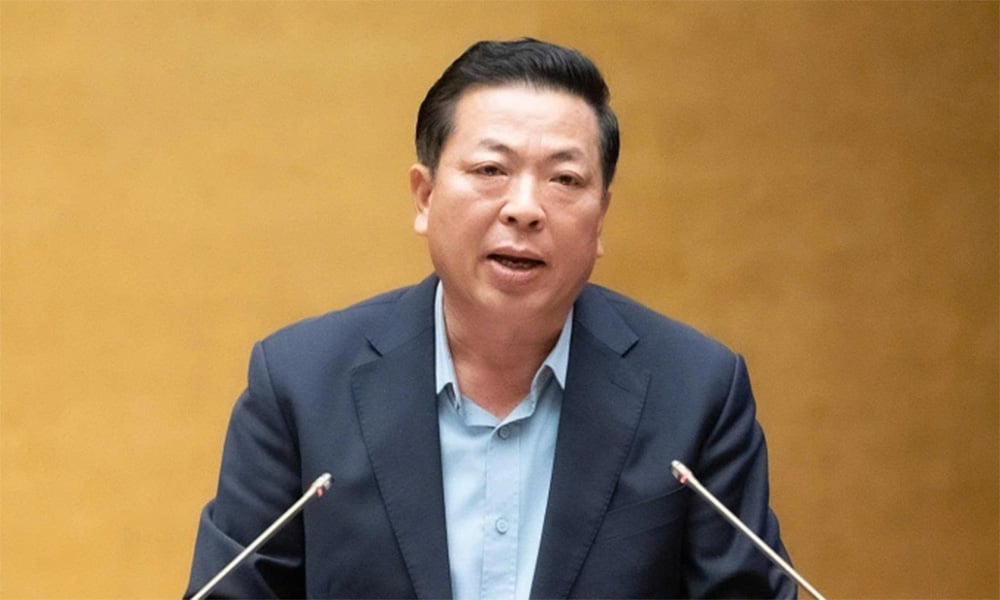 |
Minister of Construction Tran Hong Minh. |
According to the Minister, Gia Binh Airport will help alleviate the burden on Noi Bai Airport and restructure the aviation network according to a multi-hub model. The simultaneous operation of multiple airports in a region has been adopted by many countries. The air traffic control authority will establish a common airspace, with each flight path designed separately using satellite navigation to ensure safe distances and minimize intersections and conflicts.
Regarding issues related to the relocation of historical relics and housing, the Minister stated that during construction, solutions will be applied to preserve the architectural form of the relics, and relocation will be in accordance with the wishes of the people and conservation regulations. In addition to compensation costs, the project will also provide financial support to help people stabilize their lives in the new resettlement area, which will be implemented by the local authorities according to regulations.
Speaking earlier, delegate Duong Khac Mai, Deputy Head of the Lam Dong delegation, agreed with the investment plan for the project, stating that Gia Binh International Airport would open up new development opportunities for the region, especially for manufacturing, logistics, trade, and aviation-related industries. However, he suggested a review to ensure consistency with the planning of Bac Ninh province after the merger, especially given the large land use area, including many areas of land used for double-cropping rice cultivation.
Delegates also noted that converting rice land to non- agricultural purposes is irreversible, therefore careful consideration is needed to minimize the impact on food security in the context of climate change. Regarding technical criteria such as five-star and zero-carbon standards, delegates suggested clearly quantifying them to ensure financial feasibility, avoid cost overruns, and prevent delays in recovery time.
Representative Tran Van Tien from Phu Tho province stated that the total investment capital for the project is 196,000 billion VND, of which equity accounts for 15%, with the remainder mobilized from legal sources and not using state capital. However, the project description mentions the state budget participating in the reimbursement of technical infrastructure such as cemeteries, religious buildings, resettlement, schools, irrigation, transportation, and electricity. The representative requested clarification on the scale of state capital, the allocation source, and the recovery time to ensure feasibility.
Gia Binh International Airport, located in the communes of Gia Binh, Luong Tai, Nhan Thang, and Lam Thao in Bac Ninh province, is being built to the 4F standard of the International Civil Aviation Organization. It has a capacity of approximately 30 million passengers and 1.6 million tons of cargo per year by 2030, and 50 million passengers and 2.5 million tons of cargo by 2050. The total investment is approximately VND 196,370 billion, spread over two phases, using capital from investors.
Source: https://baobacninhtv.vn/dieu-hanh-bay-noi-bai-gia-binh-bang-dan-duong-ve-tinh-postid432735.bbg


![[Photo] General Secretary and President To Lam presides over a meeting on preparations for the review of one year of operation of the three-tiered government system.](https://vphoto.vietnam.vn/thumb/1200x675/vietnam/resource/IMAGE/2026/06/02/1780391821195_a1-bnd-4595-9717-jpg.webp)






































































Comment (0)