

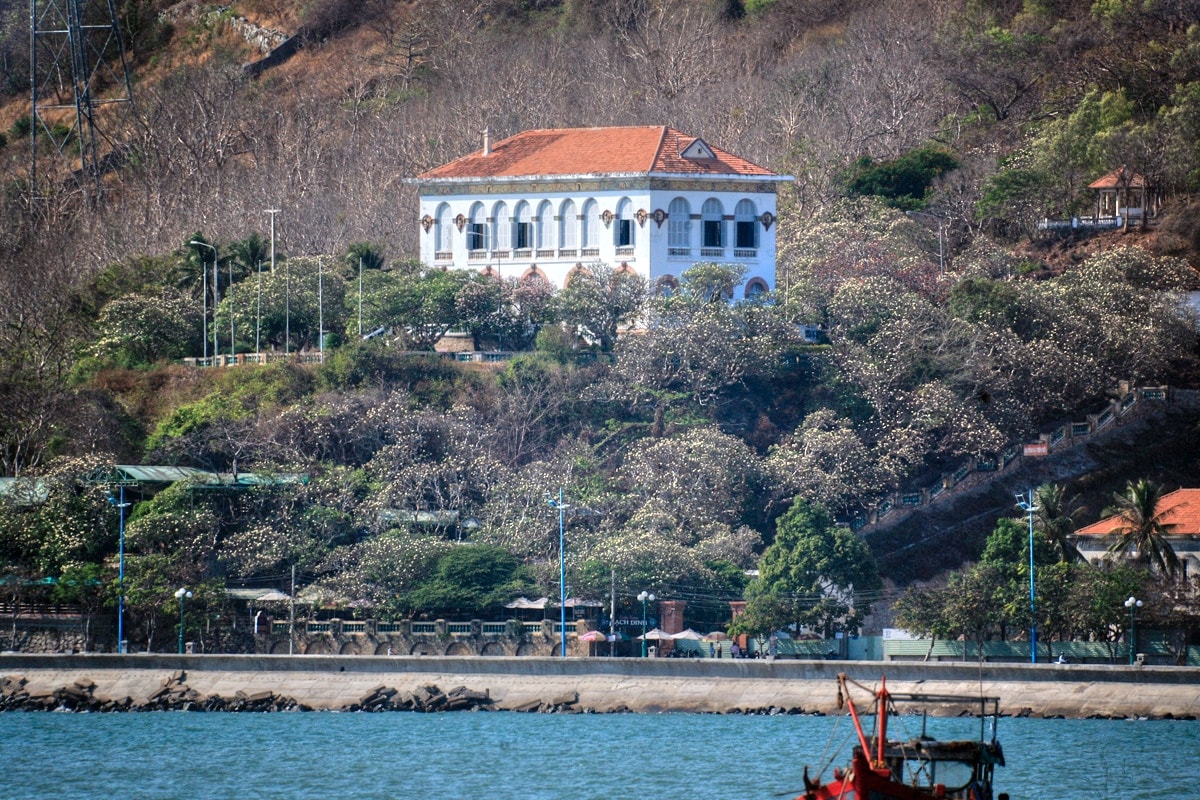
The White Palace (also known as Villa Blanche) was built from 1898 to 1902 in the 19th-century European architectural style on the site of the Phuoc Thang fortress (built by order of Emperor Minh Mang in 1839). This beautiful white mansion is located on the slopes of Mount Large, between Bai Truoc and Bai Dau beaches, with views overlooking the sea in Vung Tau ( Ho Chi Minh City).
For a long time, this unique white mansion has been familiar to the people of Vung Tau under the affectionate name "Mr. Thuong's Mansion".
Situated on the slopes of Mount Large, Bach Dinh boasts a prime and secure location: facing the vast sea in front and backed by high mountains behind.
The mansion is isolated from the city center (10km away), standing 27m above sea level, nestled amidst a vast ecosystem of ancient teak and frangipani trees spanning 6 hectares. The White Mansion is surrounded by lush greenery and the gentle sound of the waves, a soothing reminder of a place that has witnessed countless historical ups and downs and transformations.
The name "Dinh Ong Thuong" (Lord's Palace) is associated with the event where King Thanh Thai (the 10th king of the Nguyen dynasty) was held under house arrest here by the French colonial government for 10 years (1907-1916) - before the White Palace was used as a summer retreat for the Governor-General of Indochina, Emperor Bao Dai...
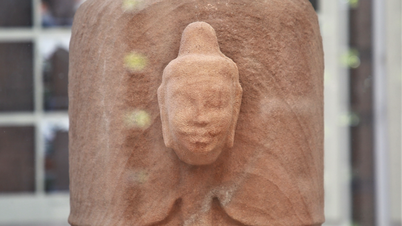
The White Palace is likened to a gilded cage that once imprisoned the heart and soul of the patriotic King Thành Thái. Its red tiled roof, arched windows, and busts of eight famous European figures, sculpted in the Greek architectural style, surround three sides of the palace, witnessing the ten years of suffering and hardship endured by the former emperor.
The White Palace in Vung Tau was officially recognized as a National Historical and Cultural Architectural Monument on August 4, 1992.
After experiencing ups and downs, Bach Dinh is now a popular destination in Vung Tau thanks to its beautiful scenery, architectural design, historical significance, and advantageous elevation.
The White Palace has three floors, is 19 meters high and 25 meters long. The entire mansion is painted white, with a red tiled roof and elegant French-style arched windows.
The first and second floors, besides the reception hall, also house and display ancient artifacts bearing the distinct mark of Vietnamese culture: a royal long bench dating back to the time of Emperor Khai Dinh, a pair of vases depicting a hundred birds worshipping a phoenix, a set of three deities representing Fortune, Prosperity, and Longevity... This is also considered a miniature museum containing artifacts salvaged from a shipwreck off Con Dao in the 17th century, including thousands of Chinese ceramics from the time of Emperor Kangxi.
The third floor served as the resting place for the Governor-General of Indochina, Emperor Bảo Đại, and successive Presidents of the Republic of Vietnam.
To reach Bach Dinh, visitors have two options: starting from the foot of Nui Lon Mountain, walk along the picturesque path marked by the footsteps of ancestors under the canopy of ancient frangipani trees, climbing 146 steps to reach the palace; or drive around the mountainside to the palace through the back entrance.
Young people who come here often enjoy immersing themselves in the cool green space of the teak and frangipani forests, breathing in the intoxicating fragrance of the frangipani flowers before setting foot in Bach Dinh. From the palace's beautiful Romanesque arched windows, visitors can admire the lush green beauty of Vung Tau sea and listen to the gentle sound of the waves.
The White Palace is beautiful all year round, but it's more convenient to visit during the dry season. The White Palace is not just a simple sightseeing and photography spot. Coming here, you feel as if you're touching the past, witnessing the ups and downs of history, and understanding the feelings of our ancestors.
For over a hundred years, through countless seasons of frangipani blossoms blooming and fading, Bach Dinh remains a pure white frangipani flower by the seashore, as if still waiting for the footsteps of people.
Source: https://baodanang.vn/doa-su-trang-ben-bo-bien-xanh-3333190.html
![[Photo] First session of the 14th Congress of the Vietnam Trade Union](https://vphoto.vietnam.vn/thumb/1200x675/vietnam/resource/IMAGE/2026/06/03/1780465947883_ndo_br_img-3852-jpg.webp)
![[Photo] General Secretary and President To Lam presides over a meeting with the Central Organizing Committee.](https://vphoto.vietnam.vn/thumb/1200x675/vietnam/resource/IMAGE/2026/06/03/1780482764658_a1-bnd-4741-3342-jpg.webp)
![[Photo] Secretary of the National Assembly Party Committee, Chairman of the National Assembly presides over the meeting of the Standing Committee and Executive Committee of the National Assembly Party Committee.](https://vphoto.vietnam.vn/thumb/1200x675/vietnam/resource/IMAGE/2026/06/03/1780480353201_ndo_br_bnd-2585-jpg.webp)





































![[Video] Sunset at Lap An Lagoon – Where the sun sets over the fishing nets](https://vphoto.vietnam.vn/thumb/1200x675/vietnam/resource/IMAGE/2026/05/31/1780192137701_beach-landscape-sea-water-nature-grass-745871-pxhere-com.jpeg)





















Comment (0)