

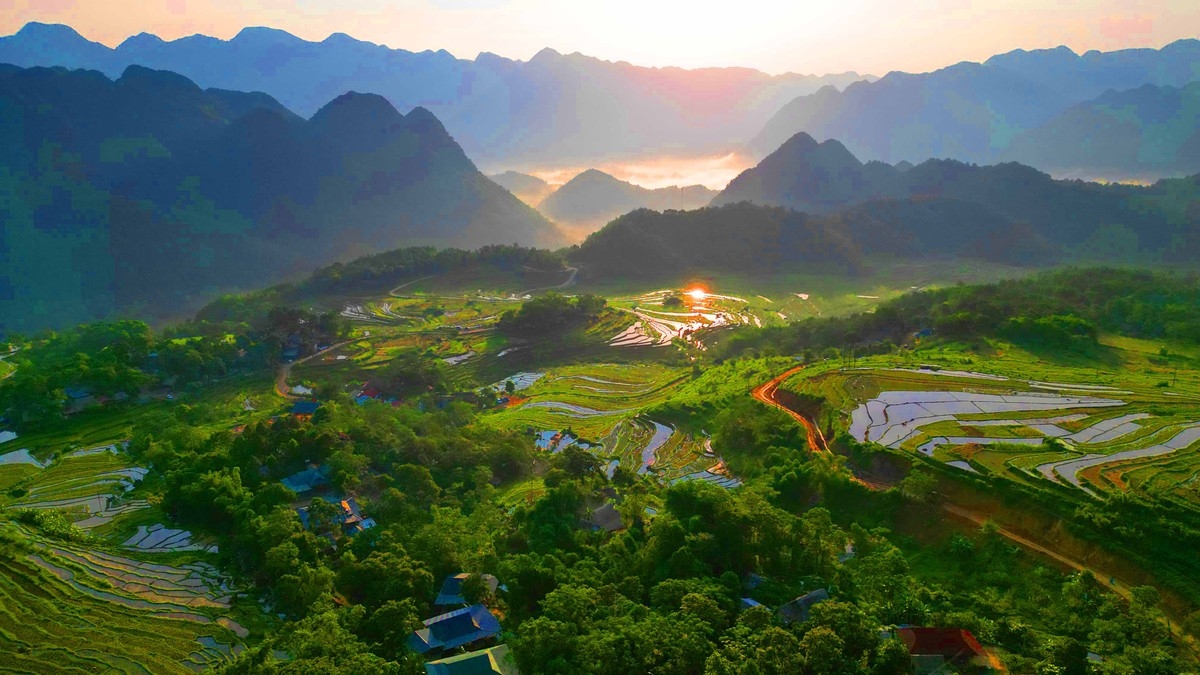
Binh Chuan commune ( Nghe An province) is nestled in isolation in a valley, surrounded by towering mountain ranges and the vast forests of the Pu Huong Biosphere Reserve.
For hundreds of years, when the Thai ethnic community came here to clear land, settle, and establish villages, they learned to make and use water wheels to replace human labor in drawing water from flowing streams to irrigate the land in higher areas, creating the fertile terraced rice fields of Na Co, Na Bo, etc.
Today, waterwheels are not only a means of irrigation, a testament to the creativity, ingenuity, and resilience of the Thai people in overcoming difficulties in production, but also a beautiful traditional cultural feature of the Thai people in this region.
The unique highlight of the waterwheel.
Located on the only access route of National Highway 48C, Binh Chuan Valley is primarily inhabited by the Thai ethnic community in seven villages. The long, winding, and towering slopes of Pu Liu and Pu Huot mountains serve as two "gateways" from Muong Choong and Nga My to this valley.
In Binh Chuan, one can easily spot waterwheels situated along the banks of the Khe Met and Khe Co streams, which run across the valley. These waterwheels resemble giant wheels, with a radius of 1.2-2 meters.
Each waterwheel is a harmonious structural system consisting of many parts such as: supporting pillars, columns, axle, wheel, bamboo tubes, water fan... Among them, the "soul" of the waterwheel is the support system consisting of hundreds of bamboo tubes of equal length inserted into the center of the wooden axle, creating stability for the "wheel rim" with a circumference of more than 7-12m.
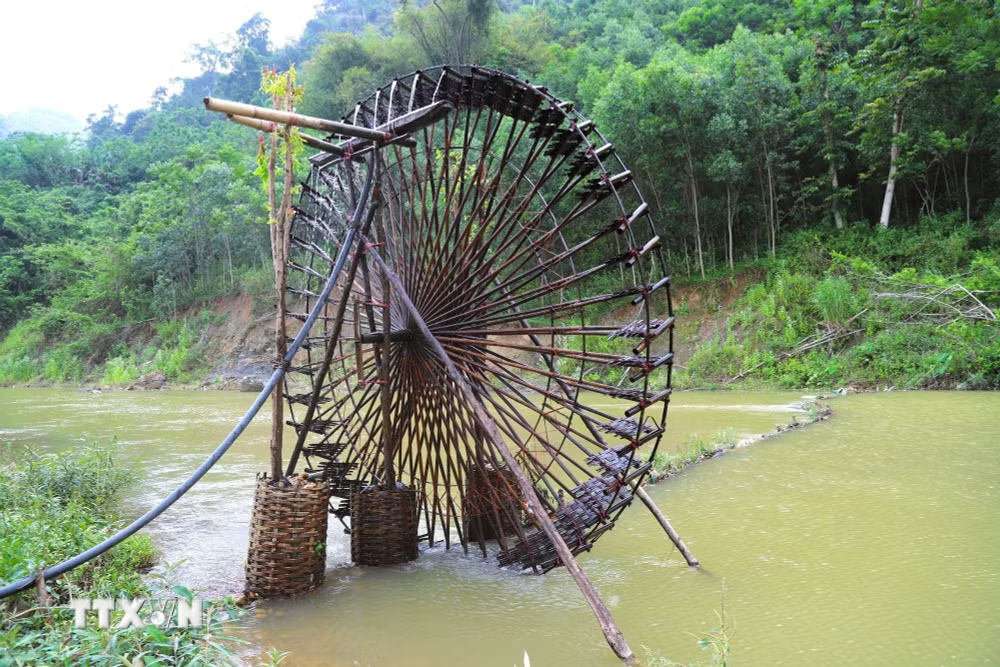
The weight of the waterwheel is supported by a system of support columns, the bases of which are driven deep into the stream bed and reinforced with stones in woven bamboo baskets to keep the columns and wheels upright.
To ensure the waterwheel's wheels rotate steadily, numerous woven bamboo and rattan panels are installed all around the rim. These panels continuously receive the thrust of the water flow in a self-propelled manner.
Hundreds of bamboo tubes are attached to the rim of the waterwheel, which collect water from the stream and rise as the wheel rotates. Thanks to the optimal angle of attachment to the wheel rim, these bamboo tubes, once they reach a certain height, automatically empty the water into the trough and flow through a system of channels to the rice fields.
The wheel's durability and sturdiness are due to hundreds of bamboo poles woven together and linked by knots made of rattan or wicker at the intersections.
Mr. Kha Van Trang, head of Na Co village, Binh Chuan commune, said that the waterwheels are always located on the stream banks. When installing waterwheels, the owners of the rice fields must carefully survey the location to save costs and effort while ensuring the long-term, continuous, and durable operation of the waterwheel.
To ensure the stream's water level remains deep enough and has sufficient flow to power the waterwheels, the locals meticulously arrange pebbles across the streambed to block the flow, raise the water level, and concentrate the force of the current towards the waterwheel area.
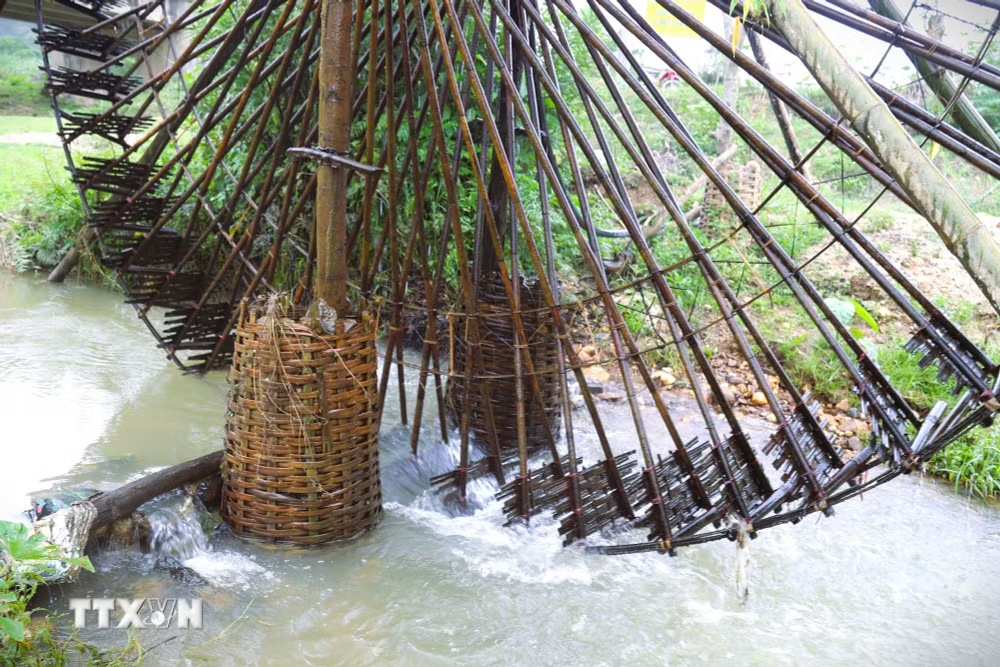
Mr. Lo Van Mann, from Na Co village, shared that the villagers have painstakingly erected barriers in front of the waterwheel to prevent trash, branches, and leaves from the forest from getting caught in the blades and water pipes. This helps the wheel and shaft operate more smoothly.
In areas with strong currents, additional support pillars must be constructed to help the waterwheel stand firmly.
Upstream of the Khe Met stream, giant waterwheels nestle beside rice paddies, rising nearly 3 meters above the stream's water level.
According to local residents, in areas with such significant differences in elevation, manual methods like bailing water onto the fields are impossible. Using water pumps would be prohibitively expensive. Using water wheels is the optimal solution, offering the most efficiency and effectiveness.
Ms. Lo Thi Ly from Met village said that besides functioning as perpetual "water pumps," tirelessly pouring water day and night onto the fields, the waterwheels in Binh Chuan valley also create a traditional beauty, closely associated with the life of the Thai community in many villages.
People often go to the waterwheels to wash grass, do laundry, rinse agricultural products, and clean farming tools after each time they go to the fields...
Creating a golden harvest season in the valley.
Mr. Lang Van Tuat, from Na Co village, said that building a waterwheel requires a lot of time and effort. The materials—bamboo, rattan, ropes for tying, wood for the trough, water channels, and rotating shaft—must be found, harvested, and transported manually from deep within the old-growth forest to the village.
Construction of the waterwheel begins only when sufficient materials are available. Typically, the "construction site" for the waterwheel is set up near the installation location by the stream to shorten the distance and travel time to the construction site.
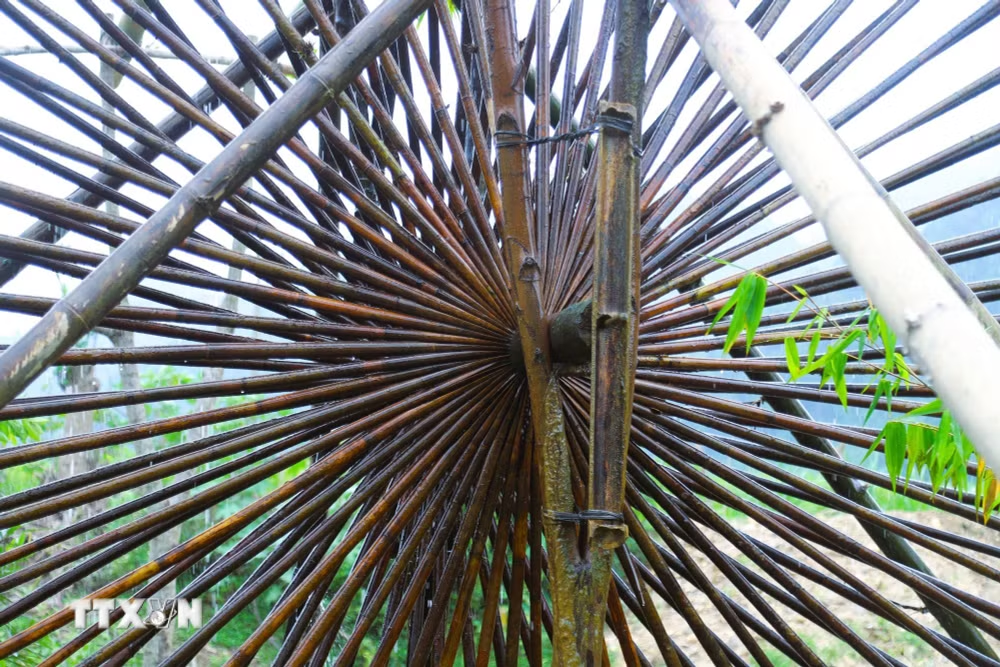
To complete a waterwheel weighing 200-400kg takes about 10 days to half a month of continuous work right on the stream bank, involving tasks such as chiseling, sawing, assembling, weaving, tying, and binding.
The work of constructing and installing waterwheels is arduous and requires the help and support of many people. Whenever a family builds a waterwheel, relatives, clan members, and villagers all participate in providing assistance. Through this, the spirit of solidarity and community cohesion in the village is strengthened.
Mr. Kha Van Trang, head of Na Co village, said that although waterwheels are a common and indispensable means of agricultural production for the Thai people in the Binh Chuan valley, they are not used for wholesale production to generate profit.
In the villages, people build waterwheels solely to provide water for irrigating their fields. Each waterwheel has a lifespan of about one to two years.
Mr. Lo Van Ly, Chairman of the People's Committee of Binh Chuan commune, said that the entire commune has more than 180 hectares of rice fields, of which over 80 hectares are terraced fields located in areas with a height difference of 1 to 3 meters above the stream water level.
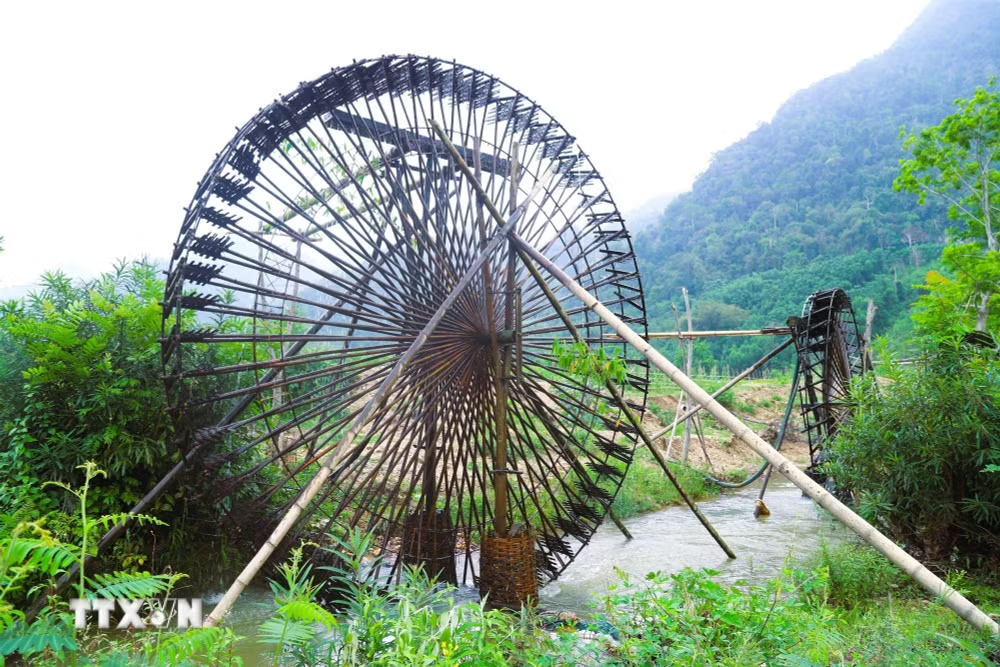
Over the years, these high-altitude rice paddies have survived thanks to nearly 60 waterwheels located along the Khe Chon, Khe Chọi, Khe Cố, and Khe Mét streams. These are large streams originating from the Pù Huống mountain range, with a fairly abundant water supply throughout the year.
“For the Thai ethnic group, waterwheels have been around for generations, a familiar tool in agricultural cultivation and a crucial factor determining the success or failure of each rice crop in high-lying areas where direct water intake from the irrigation canal system is impossible. Thanks to the waterwheels that turn day and night to supply irrigation water, they have contributed to the ‘golden harvests’ on the rice fields of Na Co, Met, Tong, Dinh, and Xieng villages. The waterwheels have ensured food security for hundreds of households in the area whose rice fields are located in high-lying areas in the valley,” said Lo Van Ly, Chairman of the People's Committee of Binh Chuan Commune.
The proverb "the Thai people live by the water" has long referred to the geographical location, production practices, lifestyle, and cultural origins of the Thai people. The Thai people live in the lower reaches of large rivers and streams, and their wet rice cultivation culture has been closely linked to their centuries-old settlement process. Waterwheels are an indispensable image in the Thai cultural sub-regions.
Traveling through the western mountainous region of Nghe An province, to communes such as Quy Chau, Que Phong, Tien Phong, Chau Tien, Yen Hoa, and Tuong Duong, one can easily spot rows of waterwheels along streams and riverbanks, diligently "waiting" for water to irrigate the fields.
As night falls, the mountainous villages quickly sink into the silence of the vast forest. When the stilt houses are closed and locked, ending the rhythm of daily life, the villages once again echo with the rhythmic sound of waterwheels turning on the streams.
Today, along with the natural landscape of the highlands, the gentle and refreshing rivers, the waterwheel has become an attractive destination, drawing tourists to explore the natural beauty and daily life of the local people.
Source: https://www.vietnamplus.vn/doc-dao-con-nuoc-cua-nguoi-thai-o-thung-lung-binh-chuan-post1113477.vnp



![[Photo] Admire the coral "masterpiece" amidst the million-year-old heritage of Dak Lak province.](https://vphoto.vietnam.vn/thumb/1200x675/vietnam/resource/IMAGE/2026/05/30/1780107638639_y25-jpg.webp)




















































































Comment (0)