

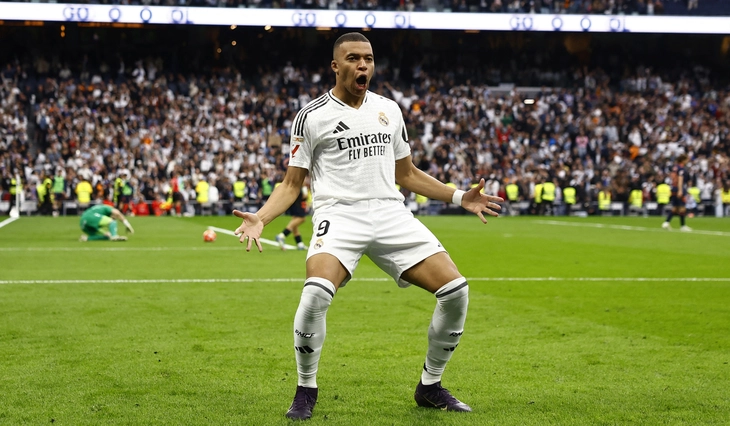
Mbappe promises to shine at the FIFA Club World Cup - Photo: REUTERS
Both projects share the same goal: to encourage the development of football in middle-income countries.
The early years were boring.
The FIFA Club World Cup is actually a very old idea, with the first edition of the tournament dating back to 2000. Eight teams participated that year, with two representatives from South America, two from Europe, and four other clubs from Africa, Asia, Australia, and North America-Caribbean.
Real Madrid and Manchester United were the two European representatives in the tournament that year. Despite their superior strength, neither team made it to the final. Corinthians defeated Vasco Da Gama in the final to win the championship and a prize of 6 million euros. However, Real Madrid, despite finishing fourth, still received 3 million euros. Manchester United even received 2.5 million euros, even though they didn't advance beyond the group stage.
That year's FIFA Club World Cup took place in January. Because this was right after the European football winter break, all the teams were preparing for the extremely intense second half of the season.
Therefore, it's understandable why both Real Madrid and Man United arrived in Brazil (the host country) that year with a half-hearted attitude. They had to play five matches and win the final to receive 6 million euros. But if they were eliminated early, they would still receive 2.5 million euros and only have to play three matches. That difference of 3.5 million euros was only enough for Real Madrid to pay Luis Figo's salary for about three months.
FIFA's strategy
Overall, the FIFA Club World Cup over the past two decades has largely existed as a friendly tournament, serving primarily to enhance the trophy cabinets of major clubs.
FIFA had a clear principle in organizing the FIFA Club World Cup when the tournament first opened in 2000, and then became an annual event when it returned in 2005: it would never be held in Europe. After Brazil, the FIFA Club World Cup was held for four consecutive years (2005-2008) in Japan, then moved to the UAE for the next two years, then back to Japan, then Morocco, UAE, Qatar, UAE, Morocco, Saudi Arabia...
That's an understandable strategy from FIFA. Generally, countries with less developed football will welcome the tournament more enthusiastically than Europe – where there's an abundance of top-level competition. Not to mention, holding it on a different continent generally makes things difficult for European representatives, aiming to balance the tournament.
Historical milestone
It wasn't until the fourth edition (2007) that the FIFA Club World Cup welcomed a champion from Europe, when AC Milan beat Boca Juniors 4-2 in the final. In subsequent editions, European giants demonstrated their overwhelming strength, winning 16 out of 20 tournaments.
But that only makes the FIFA Club World Cup boring. The big European teams participate in the tournament simply to embellish their perfect year, after having already won the Champions League. The prize money and commercial effect are almost negligible.
The FIFA Club World Cup continued to be held until FIFA decided to revamp the tournament in 2019. That year, FIFA finalized a plan to create a 32-team version of the tournament, with the number of qualifying spots allocated to each continent similar to the World Cup for national teams.
To complete its grand reform, FIFA created the FIFA Intercontinental Cup. This tournament would be held annually on a similar scale – around six teams, the continental champions of the year. The FIFA Club World Cup, on the other hand, would take place every four years, becoming a larger-scale version of club football.
According to the original plan, the new FIFA Club World Cup was scheduled to begin in 2021 in China. However, the COVID-19 pandemic caused the tournament to be canceled and postponed to 2025. This time, the United States is the host. A little late, but that's okay. The important thing is that the football world will finally welcome a historic tournament.
Does the FIFA Club World Cup really have that impact? Absolutely.
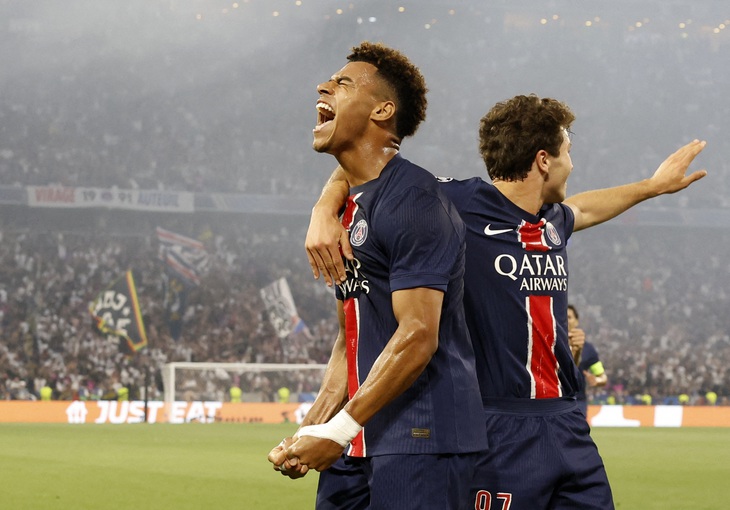
PSG is one of the teams participating in the FIFA Club World Cup 2025 - Photo: REUTERS
When FIFA "ties down" European giants
Look at the impact the 2002 World Cup had on Korean and Japanese football. The FIFA Club World Cup created an opportunity for North American and Asian clubs to face European giants in truly top-level matches, rather than the friendly tournament versions of the past.
In the new version, the attitude of European giants has changed significantly. Look at Real Madrid's reaction. They were willing to pay 10 million euros to acquire new signing Trent Alexander-Arnold a month early, in order to secure his services for the FIFA Club World Cup. Why was Real Madrid willing to spend so much? Because simply participating in this tournament would earn them at least 35 million euros in prize money, and potentially up to 110 million euros.
Everything has its price. FIFA has bound the big European clubs with the clause that they "must bring their best squad to the tournament." No one complains, because here they receive prize money equivalent to what they would receive in the Champions League.
It's no exaggeration to say that the FIFA Club World Cup has created a historic milestone for football. After more than two decades, the world of football has truly welcomed a version of the tournament that means "the World Cup of clubs".
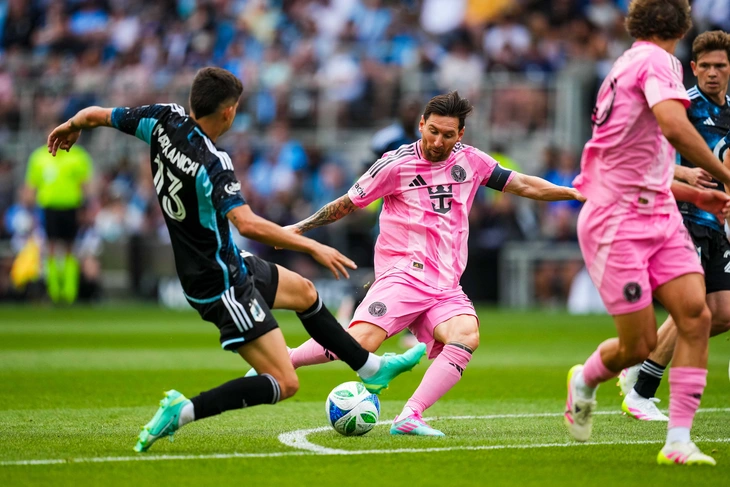
Messi wears the Inter Miami jersey for the opening match of the tournament - Photo: REUTERS
Messi's Inter Miami will play the opening match.
The FIFA Club World Cup 2025 will take place from June 14 (local time) to July 13. The tournament includes 32 teams, with UEFA contributing a total of 12 representatives. Next is South America (CONMEBOL) with 6 slots, North and Central America - Caribbean (CONCACAF) with 4 official slots plus 1 host nation slot. Asia and Africa each have 4 slots, while Australia has 1 slot.
Messi's Inter Miami will participate in the tournament as the host nation and will play the opening match against Al Ahly. The tournament follows a similar model to the old World Cup, with 32 teams divided into 8 groups, then progressing to a knockout round…
Source: https://tuoitre.vn/fifa-club-world-cup-se-thay-doi-lang-bong-da-20250603095359024.htm
![[Photo] Mrs. Ngo Phuong Ly meets and exchanges views with Mrs. Peng Li Yuan](https://vphoto.vietnam.vn/thumb/1200x675/vietnam/resource/IMAGE/2026/04/16/1776277858080_phu-nhan-1-jpg.webp)
![[Photo] My Son at night: A thousand-year-old heritage site amidst the Milky Way](https://vphoto.vietnam.vn/thumb/1200x675/vietnam/resource/IMAGE/2026/04/15/1776261039184_ndo_br_chon6-jpg.webp)
![[Photo] National Assembly Chairman Tran Thanh Man attends the opening session of IPU-152](https://vphoto.vietnam.vn/thumb/1200x675/vietnam/resource/IMAGE/2026/04/16/1776277863731_ctqh5-jpg.webp)
![[Photo] The General Secretary, President and his wife meet with Vietnamese-Chinese friendship leaders.](https://vphoto.vietnam.vn/thumb/1200x675/vietnam/resource/IMAGE/2026/04/15/1776264829725_vna-potal-tong-bi-thu-chu-tich-nuoc-to-lam-gap-mat-nhan-sy-huu-nghi-viet-nam-trung-quoc-8703641-3130-jpg.webp)




















































Comment (0)