

Over 70,000 tons of "Green, low-emission Vietnamese rice"
Last October, Aan rice was awarded the "Green Vietnamese Rice - Low Emission" trademark by the Vietnam Rice Industry Association (VIETRISA). This affirms Aan's strong commitment to sustainable production and greenhouse gas emission reduction, marking initial successes in implementing the "Sustainable Development of 1 Million Hectares of High-Quality, Low-Emission Rice in the Mekong Delta by 2030" project. To be granted the right to use the trademark, businesses and cooperatives must ensure transparency in production origin and cultivation processes. Currently, Aan rice products also display the Eco-Friendly label on their packaging to affirm their commitment to sustainable development and environmentally friendly production.
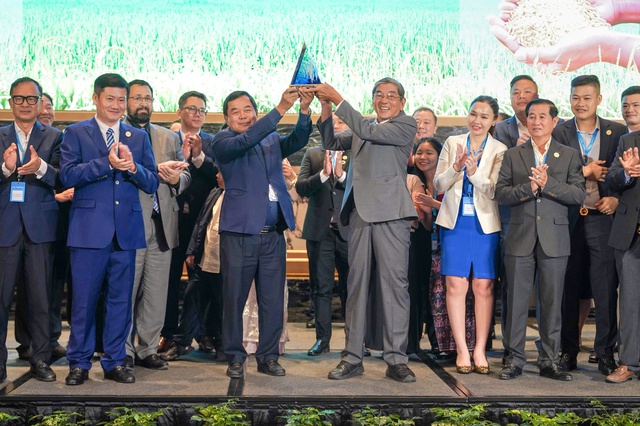
Vietnamese rice has been honored as the "best rice in the world " for the third time.
SOURCE: VFA
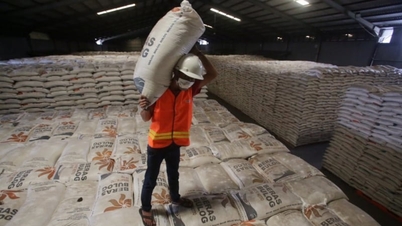
The Vietnam Rice Industry Association (VIETRISA) announced that, as of the end of November 2025, it had certified over 70,000 tons of rice as "Green Vietnamese Rice - Low Emission". Products bearing this "green rice" certification have gained a significant competitive advantage in the export market.
This is the result after two years of piloting the project to cultivate 1 million hectares of high-quality, low-emission rice (the Project). Reporting on the results, Mr. Le Thanh Tung, Vice Chairman of VIETRISA, stated: By the end of the 2025 summer-autumn crop season, the Project had 354,839 hectares participating, exceeding the plan by 197%. Eight businesses participated, producing over 70,000 tons of rice certified as "Green Vietnamese Rice, Low Emission".
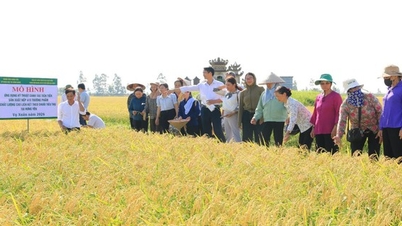
In terms of economic efficiency, farmers participating in the model reduced production costs by 1.7 - 4.9 million VND/ha compared to production outside the model. This translates to a reduction in production costs of 326 - 1,052 VND/kg of fresh rice; seed usage decreased by 50 - 65%, equivalent to a saving of 70 - 130 kg/ha. In addition, the average amount of nitrogen fertilizer used decreased by up to 31.3%; irrigation water usage was reduced, with at least 2-3 times the standard water drainage, and pesticide spraying was reduced by 1-3 times. Despite reduced seed and input materials, yields increased by 1.4 - 15.9 quintals/ha, equivalent to an average increase of 3.2 - 22.1% compared to traditional farming. Notably, the model achieved a reduction in CO2 emissions of 3.7 tons/ha/season. This figure indicates significant potential for expanding production area.
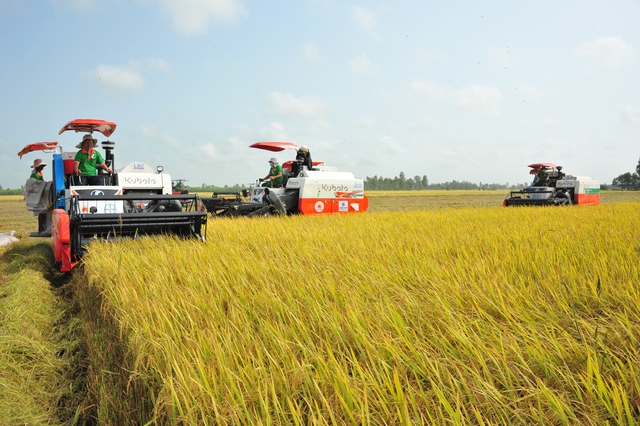
The 1 million hectare project helps to enhance the value of Vietnamese rice in the global market.
PHOTO: CONG HAN
According to Associate Professor Bui Ba Bong, Chairman of VIETRISA, greenhouse gas emissions have been independently verified by the international organization Regrow. This serves as a basis for clarifying the advantages of low-carbon rice. The certified varieties are mainly high-quality varieties such as OM18, Dai Thom 8, DS1, ST25, and Japanese rice varieties (Hana, Akita, Koshi) developed by Angimex Kitoku. "Expanding to include imported varieties shows that the company is targeting the high-end market segment, especially markets with stringent environmental standards," Associate Professor Bui Ba Bong commented.
The project has attracted the attention not only of the Vietnamese government and people but also of the international community. Besides the 1 million hectare project initiated by the Vietnamese government, participating businesses are also members of the "Transforming the Rice Value Chain to Respond to Climate Change and Sustainable Development in the Mekong Delta (TRVC)" project, implemented by the Ministry of Agriculture and Environment and the Netherlands Development Organization (SNV) with funding from the Australian government. The project, launched in 2023, aims to attract 200,000 farming households across 200,000 hectares by 2027 and reduce at least 200,000 tons of CO₂ equivalent. Angimex Kitoku Co., Ltd., a participating enterprise in the TRVC project, affirms that this is a leverage to access green credit from MUFG Bank (Japan), opening up a new direction for sustainable finance in the rice industry.
Vietnamese rice has been named "best in the world" three times.
The fact that Vietnam's ST25 rice has been honored as the world's best rice for the third time is a source of joy, honor, and pride for everyone in the industry. This also confirms the consistent quality of Vietnamese rice. In the context of this year's challenging export season, this is a significant boost for Vietnam's rice industry in the future.
Mr. Do Ha Nam, Chairman of the Vietnam Food Association
Vietnam is the world's largest supplier of delicious and clean rice.
Having dedicated his life to rice cultivation and Vietnamese agriculture, Mr. Bui Ba Bong observes that Vietnamese rice in recent years has "broken the curse" of low-quality, cheap rice. In some segments and at certain times, the price of Vietnamese rice has even been among the highest in the world. Besides ST25 rice, which won the award for best rice in the world, the main rice varieties exported from the Mekong Delta are now high-quality varieties such as OM18, Dai Thom 8, OM5451, etc., which are favored by the market. "The special achievement of Vietnam's rice industry is the transition to high quality without reducing productivity, while still maintaining a top position in the world – that is the unique characteristic of Vietnamese rice," Mr. Bong proudly stated.
Nevertheless, Mr. Bong expects that in this new phase, the rice industry needs to continue to climb to higher levels of development. These include clean and green products for the health of producers, consumers, and the environment. The green color symbolizes prosperity and sustainability.
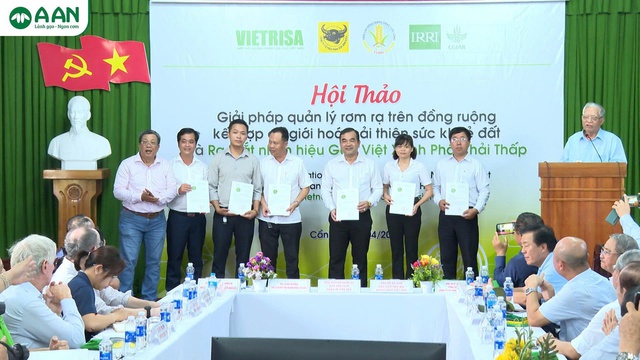
Businesses will be awarded the "Green Vietnamese Rice - Low Emission" certification in October 2025.
PHOTO: TL
"Vietnam has been very proactive and determined in implementing the Project to develop 1 million hectares of high-quality, low-emission rice cultivation areas in the Mekong Delta by 2030. Achieving this will make Vietnam a pioneer in the world in large-scale low-carbon rice production. After two years of implementation, the success of the models has spread and achieved impressive results. In particular, for the first time in Vietnam, and perhaps in the world, there will be low-emission rice products by June 2025. This is a very important milestone for Vietnam's rice industry in this new phase," said Associate Professor Dr. Bui Ba Bong.
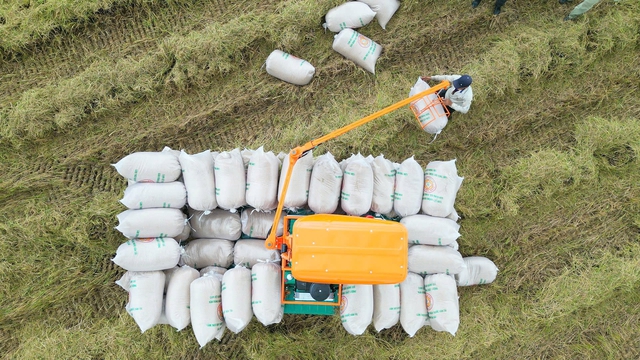
Vietnam - a major supplier of high-quality rice that is good for consumers' health and environmentally sustainable.
PHOTO: CONG HAN
Dr. Tran Thu Ha, Director of the TRVC Project, who has been involved with the 1 million hectare high-quality, low-emission rice project, explained: TRVC applies a system for monitoring agricultural practices down to the plot level through satellite imagery, using biogeochemical models (DNDC) to calculate emissions and quantify socio-economic effects according to standards recognized by the United Nations Framework Convention on Climate Change. This is an important foundation for forming carbon credits for the rice industry. TRVC is considered the "core model" of the 1 million hectare project, creating typical chain linkages, providing scientific data and practical results as evidence to expand the area, connect with domestic and international resources, enhance the value of Vietnamese rice in a green and sustainable direction, and simultaneously generate climate finance. "Our common goal is to promote the transition to climate-resilient, low-carbon rice farming methods through the development of sustainable and inclusive value chains in the Mekong Delta region. This will help improve the livelihoods of small-scale rice farmers," said Dr. Ha.
Vietnam is the world's second largest rice exporter.
India's opening of its rice stocks from the end of 2024 caused world rice prices to plummet, a trend that continued into 2025. Furthermore, Indonesia, the world's second-largest rice importer, stopped importing rice from the beginning of 2025, further dampening the market. In September, Vietnam's largest customer temporarily suspended imports for four months, causing the market to freeze. However, amidst this situation, Vietnamese businesses managed to expand their markets to African countries and other traditional markets. This helped Vietnam's rice exports reach 7.5 million tons by the end of November, generating $3.8 billion in revenue. Despite a decrease compared to the previous year, Vietnam surpassed Thailand to become the world's second-largest rice exporter.
Creating new value for Vietnamese rice.
At the workshop "Promoting the expansion of high-quality, low-emission rice production area towards the target of 1 million hectares by 2030" held at the end of November, Mr. Nguyen Quoc Manh, Deputy Director of the Department of Crop Production and Plant Protection, affirmed: "There is no better time than now. We currently have all the necessary elements to develop an industry: market, technology, policies, and determination to bring Vietnamese rice to a new level: greener, cleaner, and more competitive. Each unit will become a strong link, contributing to the creation of a million-hectare ecosystem. It will not only achieve the target area but also create new value for farmers and the Vietnamese rice industry."

The Department of Crop Production and Plant Protection is committed to working closely with localities, businesses, and cooperatives on three key areas: coordinating and monitoring the implementation of measurement procedures; supporting the development and expansion of supply chain linkage models, with businesses as the core and farmers at the center; and creating optimal conditions for the application of technological advancements, from water, soil, and straw management to digitalization, until the government allows carbon credit trading.
To achieve this goal, Mr. Manh suggested that localities, especially the Departments of Agriculture and Environment, should support businesses, cooperatives, and farmers in the value chain, providing synchronized guidance on applying high-quality rice production processes, reducing emissions, and upgrading production areas. Businesses participating in the value chain need to proactively collaborate with cooperatives and farmers, register to participate in the TRVC Project, and produce according to the issued emission reduction processes. In particular, they need to leverage technical support in monitoring and evaluating emission reductions to ensure reliability.
VIETRISA needs to coordinate closely to monitor, guide, and support businesses within and outside the TRVC Project, and consider certifying "Green, Low-Emission Vietnamese Rice" for businesses and cooperatives that are locally certified as fully compliant with the process. We propose that the Australian Government and other international donors consider expanding the TRVC Project area to Can Tho, Vinh Long, and Ca Mau, giving more businesses, cooperatives, and farmers the opportunity to participate, thereby accelerating the completion of 1 million hectares by 2030.
Japan explores sources of Vietnamese rice supply.
Mr. Do Ha Nam, Chairman of the Vietnam Food Association (VFA), stated that on December 5th, at the VFA office, he held a meeting with Ms. Fumiko Yagihashi, Deputy Director of the Food Security Office, Planning and Policy Department, and Secretary to the Minister of Agriculture, Forestry and Fisheries of Japan. The Japanese side wanted to learn about Vietnam's orientation towards high-quality rice production, especially the 1 million hectare low-emission high-quality rice project currently being implemented in the Mekong Delta. The VFA proposed cooperation, with the Japanese side jointly investing in specialized rice cultivation areas in Vietnam using Japanese processes, varieties, and techniques. Rice produced in these areas would then be exported back to Japan. Initially, the VFA requested that Japan facilitate the import of Japonica and ST25 rice from Vietnam to serve the community of over 600,000 Vietnamese people living and working in Japan.
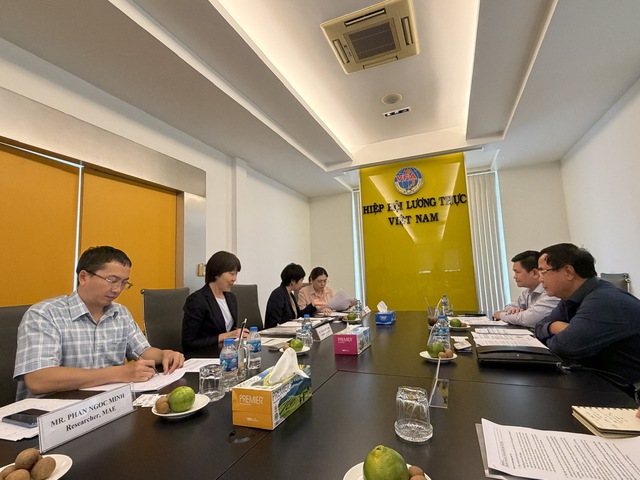
Mr. Do Ha Nam (on the right) receives representatives from the Japanese Ministry of Agriculture, Forestry and Fisheries to explore opportunities for cooperation in the field of food security.
SOURCE: VFA
Currently, Vietnamese rice exported to Japan is subject to a 400% tariff, not to mention stringent technical barriers, which severely limits exports to the country. The US, India, Thailand, and several other suppliers are seeking ways to increase their rice supply to this market.
Source: https://thanhnien.vn/gao-viet-tu-ngon-nhat-den-xanh-nhat-the-gioi-185251206212637344.htm

![[Photo] General Secretary and President To Lam presides over the meeting to approve the draft report on the results of the second inspection by the Politburo of the Standing Committee of the Hanoi City Party Committee.](https://vphoto.vietnam.vn/thumb/1200x675/vietnam/resource/IMAGE/2026/05/26/1779789811432_a2-bnd-4430-9620-jpg.webp)


















































Comment (0)