

 |
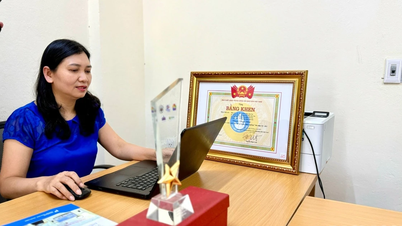
| Mr. Tran Yen Binh reviews the certificates and awards he has kept for many years. |
Searching for the missing pieces
Mr. Tran Yen Binh, born in 1954, is now over 70 years old. He walks slowly but remains very sharp-minded. He founded the Thai Nguyen Cai Luong Club in 2005. At that time, Cai Luong was no longer a popular choice for the public, especially young people. Those who used to sing and perform had gone their separate ways, each pursuing their own livelihood.
Mr. Binh hoped to revive the art form that had been so closely associated with him. Without a phone or social media, he reached out to people through old acquaintances, referrals, and face-to-face meetings. After more than a month of persistent effort, a group of 25 people came together, united by their love for Cai Luong (Vietnamese traditional opera).
Mr. Binh spoke in a deep, warm voice, reflecting years of experience on stage: "My aspiration is to repay life and my profession. Cai Luong (Vietnamese traditional opera) is a unique cultural feature; if we don't participate in preserving it, it will be lost someday."
Mr. Tran Quang Minh, a member who has been involved since the early days, recalled: "Back then, Mr. Binh came to find my mother, who was a former member of the Bac Thai Cai Luong Troupe. Seeing that I also liked it, he let me join and taught me very diligently. He was a very dedicated person, capable of staging performances at any time."
Gently stroking the certificates and awards he keeps as treasures, Mr. Binh said that he came to the arts at a very young age. In 1974, he joined the Bac Thai Cai Luong (traditional Vietnamese opera) Troupe, bringing his youth with him to perform for the battlefield. In those years, the stage had no curtains, no professional lighting, but it had a special audience: the soldiers on the front lines.
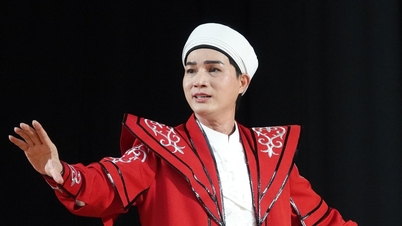
In 1979, the troupe disbanded, and he transferred to the provincial drama troupe, and later worked at the Provincial Cultural Center. But it seems that cải lương (Vietnamese traditional opera) remained a place he never left. He still recalls roles like Sùng Ân in "Nùng Văn Vân," Triệu Trung in "Old Forest, New Fragrance," or "Code Name A20" as unforgettable milestones.
Perhaps that's why, as cải lương (Vietnamese traditional opera) gradually faded into the background, he chose to return and gather what remained. After more than 20 years of dedication, through countless ups and downs, his small house remains a place where cải lương lovers can come together, sing, and share their passion.
The members range in age from 40 to 70; some are former professional artists, while others are simply enthusiasts. Together, they rehearse classic excerpts such as "The Life of Miss Luu" and "To Anh Nguyet," and then try their hand at new compositions about their homeland, the sea and islands, and the changes in Thai Nguyen today.
As long as there are listeners, cải lương (Vietnamese traditional opera) will continue to exist.
 |
| The Thai Nguyen Cai Luong Club holds its activities at Mr. Binh's house. |
Lacking a stable source of funding, the club operates on voluntary contributions. Everyone contributes a little, from rehearsal fees to performance costs. The programs and performances are all created and staged by the members themselves.
Mr. Binh mused: "There are many difficulties, but without an audience, without listeners, we can't do anything. We perform to show our gratitude to the audience, to those who still love Cai Luong (Vietnamese traditional opera)."
One detail that many members mention when talking about him is that his family owned a shop that rented out performance costumes, but he never charged the club any fees. For each performance, he prepared every costume and prop in advance, as if it were an unnamed task. For an art form like cải lương (Vietnamese traditional opera) that requires many costumes, this significantly reduced the club's burden.
Ms. Nong Thi Hoa, who has been involved with the club for over 10 years, shared: "There was a time when I had an accident and broke my leg, but Mr. and Mrs. Binh still came to my house to teach me to sing. Here, people not only learn to sing, but also learn to love their profession."
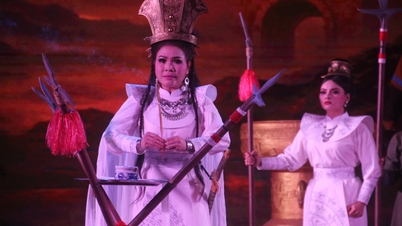
For over 20 years, he and the club members have not only held internal activities but have also taken cải lương (Vietnamese traditional opera) to perform hundreds of shows in many places such as Hanoi and Hai Phong, participating in provincial-level programs and mass art festivals. Performances such as "Thai Nguyen - Heroic City," "The Flavor of Thai Tea from My Homeland," and "War Zone - Motherland"... have been modernized to suit contemporary life.
Nevertheless, cải lương (Vietnamese traditional opera) remains a niche art form, primarily appealing to older audiences, with fewer young people. Therefore, Mr. Bình's concern isn't whether the club can survive, but rather who will continue it in the future.
He confided: "In the future, I plan to select suitable songs to bring Cai Luong (Vietnamese traditional opera) closer to the public. More importantly, I hope to be given the opportunity to introduce Cai Luong into schools. If we want children to understand, we have to let them hear and see it. First, they need to know what Cai Luong is before they can love it, and only then can they cherish it."
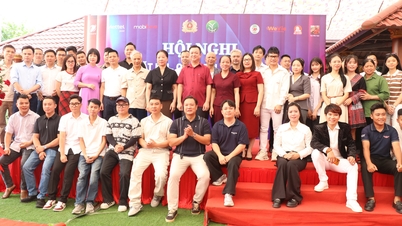
Perhaps that's why, in addition to regular meetings, for over 20 years, he and the club members have maintained a New Year's gathering and a celebration of Vietnamese Theatre Day. There, they not only sing, but also celebrate the birthdays of older members, reminisce about old memories, and express gratitude for a bygone era. For Mr. Binh, it's a way of giving back – to the profession, and to the people who have walked a long journey with him.
Few people know that Mr. Tran Yen Binh is also a dedicated writer, having composed dozens of short plays, skits, and folk songs. For many years, he has trained hundreds of students, teaching them everything from acting and singing traditional folk songs like "then," "cheo," and "cai luong"... as a way to ensure that these traditional art forms do not lose their continuity. In his small house, the sound of singing continues regularly, and Mr. Tran Yen Binh believes that as long as there are people singing and people listening, "cai luong" will not disappear from life.
Source: https://baothainguyen.vn/van-hoa/202604/gap-nguoi-giu-lua-cai-luong-3952dfe/
![[Image] Nearly 125,000 Hanoi students completed the Literature exam for the 10th grade entrance exam.](https://vphoto.vietnam.vn/thumb/1200x675/vietnam/resource/IMAGE/2026/05/30/1780117233041_ndo_br_thiet-ke-chua-co-ten-2-png.webp)











































































Comment (0)