

The global commodities market continued its mixed performance yesterday (June 2nd), with concerns about supply shortages pushing rubber prices to a nine-year high, while seasonal pressures and increased supply continued to weigh on wheat prices. At closing, the MXV-Index rose 0.4% to 2,869 points.
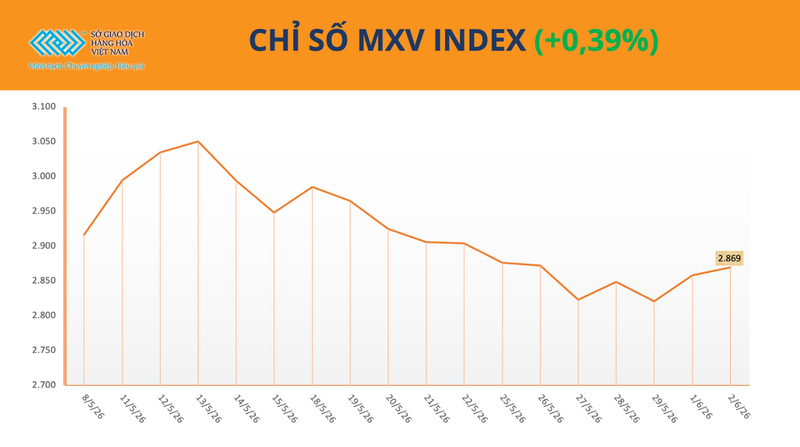
MXV-Index. Source: MXV
Tight supply continues to support the rubber market.
According to the Vietnam Commodity Exchange (MXV), the rubber market continued to be a bright spot in the June 2nd trading session, with both natural rubber prices rising sharply. Notably, the price of TSR20 rubber reached its highest level in 9 years.
The most significant driving force comes from a shift in the demand structure of the global tire manufacturing industry. Crude oil prices have remained high for the past three months due to instability in the Middle East, significantly increasing the cost of synthetic rubber production. This has forced many manufacturers to prioritize the use of natural rubber to optimize input costs, thereby boosting market demand.
Furthermore, demand for rubber remains strong thanks to the recovery of the global automotive industry. In particular, sales of new energy vehicles continue to grow strongly in many major markets. According to experts, the amount of rubber used per electric vehicle is approximately 15% higher than that of traditional internal combustion engine vehicles, while the faster tire wear rate also leads to a greater need for replacements.
On the supply side, the market continues to face numerous challenges in Southeast Asia – which accounts for over 70% of global natural rubber production. Aging plantations, declining cultivated areas, and prolonged extreme weather events are significantly impacting productivity.
In Thailand, the world's largest rubber producer, more than half of the rubber plantations are now in their aging stage, with trees over 25 years old. Meanwhile, the prolonged impact of El Niño has resulted in rainfall in many key rubber-producing regions of Thailand and Vietnam being 30-50% lower than the multi-year average, slowing down harvesting progress and reducing latex production.
Supply pressures are also reflected in Thailand's export figures. In April, natural rubber exports reached only about 183,000 tons, down 15.3% year-on-year and marking the fifth consecutive month of double-digit decline.
At the close of trading, the price of RSS3 rubber for July delivery rose by more than 2%, to $2,598 per ton. Meanwhile, the price of TSR20 rubber for July delivery increased by 2.27%, reaching $2,345 per ton.
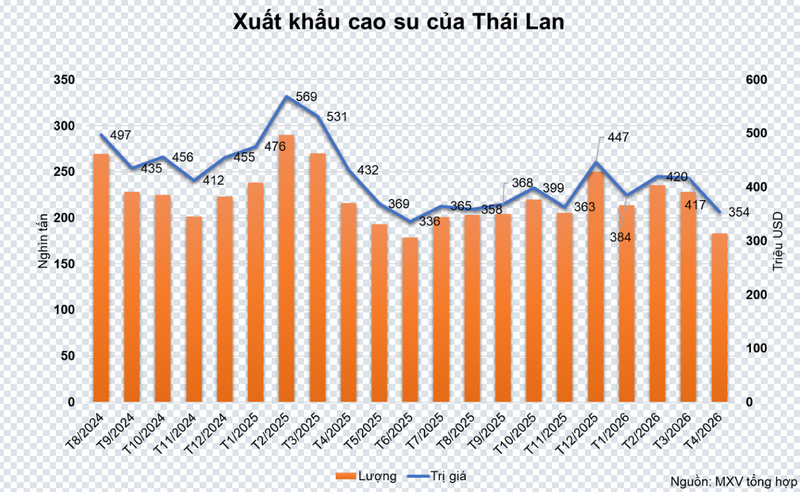
Thailand's rubber exports. Source: MXV
In the domestic market, rubber latex prices continue to remain stable in highland areas after several consecutive weeks of increases. In Binh Phuoc, the price of liquid latex fluctuates around 550-565 VND/degree, while the price of cup latex is commonly at 27,000-28,000 VND/kg.
Harvest pressure and favorable weather conditions have weakened the wheat crop.
In contrast to the rubber market, the grain sector continued to face selling pressure, especially wheat.
According to MXV, the main pressure comes from the fact that the winter wheat harvest in the US has officially begun. As of the end of last week, the national harvest progressed to about 5%, higher than the multi-year average of 3%. In key producing states like Texas and Oklahoma, farmers have completed harvesting about 25% of the acreage.
The outlook for global supply has also strengthened after the analytics firm SovEcon raised its forecast for Russian wheat exports in the 2026-2027 season. This increases competitive pressure on US wheat in the international market.
In addition, favorable weather conditions in the Southern Delta region of the United States are showing a clear upward trend. Widespread rains forecast for next week will provide much-needed moisture to key production areas, contributing to improved yield prospects.
The latest report from the U.S. Department of Agriculture (USDA) also shows that the quality of the spring wheat crop is in a more favorable state compared to the same period last year. The percentage of acreage rated as Good to Excellent reached 47%, higher than the 45% of the previous year.
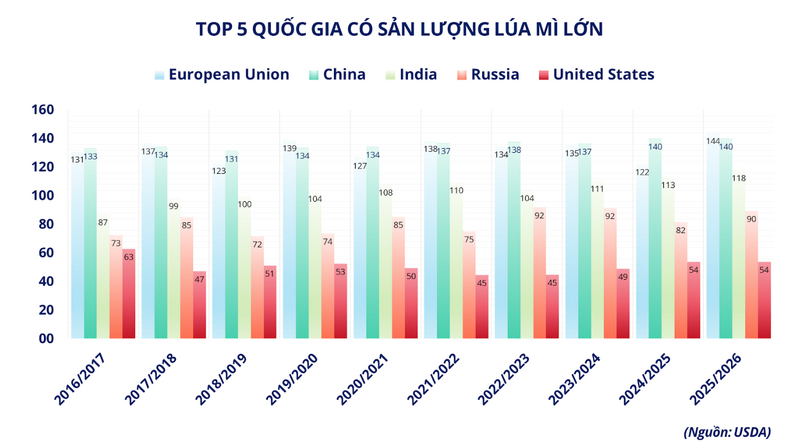
Top 5 countries with the largest wheat production. Source: MXV
From a technical perspective, downward pressure also stems from a wave of liquidation by speculators. The last trading session marked the ninth consecutive day of declines for wheat prices, as the weakening trend in corn and soybeans continued to spread across the entire agricultural sector.
At the close of trading, Kansas wheat prices fell nearly 2%, to $233.2 per ton. Chicago wheat prices also declined nearly 1%, closing at $221.5 per ton.
Domestically, in the first half of May, Vietnam imported over 121,700 tons of wheat worth nearly $35 million. Cumulatively from the beginning of the year to May 15th, imports exceeded 4.1 million tons, bringing the total import value to over $1 billion. Businesses increasing their purchases early is seen as a proactive step to secure raw materials for production amidst logistical risks and rising sea freight costs in the context of ongoing geopolitical tensions and potential instability.
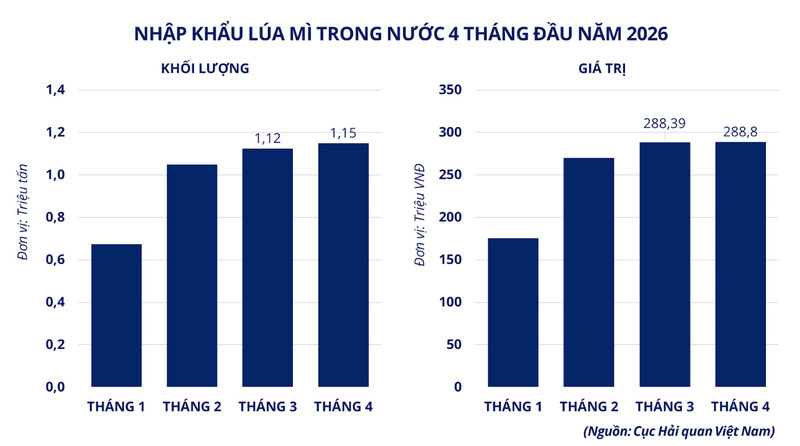
Domestic wheat imports in the first four months of 2026. Source: MXV
Source: https://congthuong.vn/gia-cao-su-the-gioi-tang-manh-459665.html
![[Photo] First session of the 14th Congress of the Vietnam Trade Union](https://vphoto.vietnam.vn/thumb/1200x675/vietnam/resource/IMAGE/2026/06/03/1780465947883_ndo_br_img-3852-jpg.webp)



































![[Photo] Delegation attending the 14th Congress of the Vietnam Trade Union visits the Mausoleum of President Ho Chi Minh.](https://vphoto.vietnam.vn/thumb/1200x675/vietnam/resource/IMAGE/2026/06/03/1780451842301_ndo_br_img-3824-jpg.webp)






































































Comment (0)