Tet paintings - where grandparents entrust their hopes for the Spring.
In traditional Vietnamese life, Tet (Lunar New Year) is not only the transition from the old year to the new, but also an occasion for people to remember their families, ancestors, and the good things to come. In this context, Tet paintings play a special role. Hanging these paintings is not simply for decoration, but a cultural ritual, a way of "welcoming good fortune" in the new year.
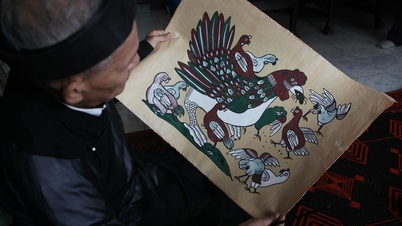
Dong Ho paintings are intimately connected with Tet (Vietnamese Lunar New Year) because of the spirit they embody. Familiar paintings such as "Herd of Pigs," "Herd of Chickens," "Prosperity," and "Wealth" don't tell grand stories or flaunt riches. They depict everyday life: a herd of pigs gathered together, a mother hen and her chicks, chubby children with innocent eyes. But it is precisely this simplicity that profoundly reflects the ancient Vietnamese philosophy of life.
Happiness in Dong Ho paintings is not measured by wealth or power, but by a balanced sense of contentment, a feeling of peace within the family, and the continuity of generations. Children always appear at the center of many paintings. The "Vinh Hoa" painting depicts a baby holding a rooster, while the "Phu Quy" painting shows a baby carrying a duck. This composition reflects a mindset that prioritizes descendants, considering the future of the next generation as the measure of blessings and good fortune.
Another noticeable point is that Dong Ho paintings only retain bright, peaceful, and joyful images, like a New Year's greeting sent to each family. Even paintings like "Jealousy" or "Mouse Wedding" are just witty, lighthearted satires. This reflects a philosophy of living in harmony with nature, believing in the law of cause and effect, and wishing for a peaceful and happy new year.
In the Tet memories of many generations of Vietnamese people, alongside green sticky rice cakes and red couplets, Dong Ho paintings were once an indispensable part. These paintings not only beautified the space but also shaped the aesthetics of Vietnamese Tet, where beauty was intertwined with the way of life and the way of being a good person.
Preserving the craft and their concerns.
Today, with the increasingly fast pace of modern life, Dong Ho paintings are no longer as common in every household as they once were. However, in Dong Ho painting village, Thuan Thanh ward, Bac Ninh province, there are still people quietly preserving the craft, considering it a responsibility to their ancestors' heritage.
According to Meritorious Artisan Nguyen Dang Tam, son of Artisan Nguyen Dang Che, Mr. Che has turned 90 this year. The story of Dong Ho paintings is therefore continued through the next generation, who both preserve the craft and face the very ordinary challenges of life today.


Artisan Nguyen Dang Tam guides young children through the steps of creating traditional Dong Ho paintings. (Photo in article: Provided by the artist)
According to Meritorious Artisan Nguyen Dang Tam, preserving and conserving Dong Ho paintings requires not only dedication but also a stable livelihood for artisans to confidently commit to their craft. Most painters today still have to make a living from their traditional craft. With so many worries in life, devoting oneself entirely to preservation, teaching, and creation becomes a challenging journey.
From a professional perspective, Mr. Tâm believes that relying solely on external support makes it difficult for the heritage to be sustainable. Preserving the craft must begin with those involved. Each artisan family and each painting artist needs to promote the heritage through concrete actions, such as displaying Dong Ho paintings appropriately in their living spaces. When the paintings are regularly present in daily life, the heritage truly "lives," rather than existing only during festivals or in museums.
Not limited to family spaces, Meritorious Artisan Nguyen Dang Tam believes that office spaces also play a role in spreading cultural values. In particular, at local government offices in Thuan Thanh ward, which directly manages the folk painting village, the presence of appropriate folk paintings would ensure that the heritage is placed in the right place and context. The paintings would then not only be for viewing but would also become a cultural story connected to the land and local history.
Based on his practical experience in the craft, Mr. Tâm also expressed his hope that state management agencies would continue to pay attention to and research appropriate mechanisms and policies for artisans. According to him, when the livelihoods of those who preserve the craft are ensured at a stable level, they will have more conditions and a positive mindset to wholeheartedly preserve, teach, and promote the value of the heritage.
Preserving heritage through community and government efforts.
Not only artisans, but also organizations, associations, and local authorities in Thuan Thanh are gradually bringing Dong Ho paintings back into daily life through concrete methods. Ms. Nguyen Thi Trang, President of the Women's Union of Thuan Thanh Ward, said that during commemorative days and programs promoting the image of the Union, many Dong Ho folk paintings have been selected for display as a way to spread traditional cultural values.
Notably, at the First Congress of Women's Representatives of Bac Ninh Province, term 2025-2030, the exhibition space featured familiar folk paintings such as carp, a baby hugging a chicken, a mouse wedding, a herd of pigs, Thach Sanh, and paintings from the Tale of Kieu. According to Ms. Nguyen Thi Trang, incorporating folk paintings into socio-political events not only enriches the cultural space of the Congress but also helps heritage to be naturally present in contemporary life.
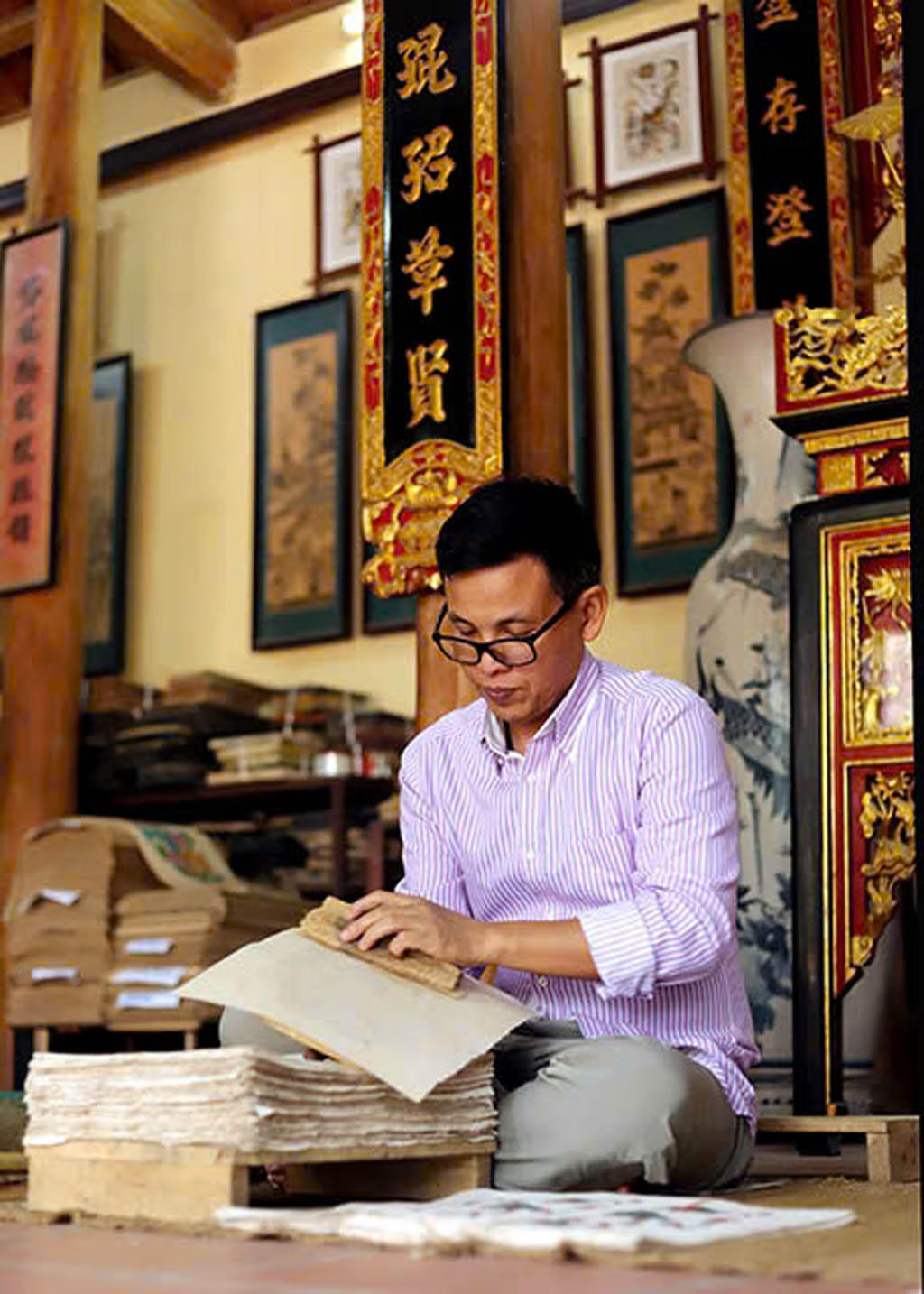
The artisans of Dong Ho painting village are preserving this traditional heritage every day.
From a state management perspective, Mr. Vuong Quoc Anh, Head of the Culture Department of Thuan Thanh Ward People's Committee, stated that Dong Ho paintings are a typical cultural heritage associated with the local identity. Over the past period, the ward government has coordinated with organizations, artisans, and the community to incorporate Dong Ho paintings into cultural activities and socio-political events.
According to Mr. Vuong Quoc Anh, integrating heritage into community living spaces not only contributes to preserving traditional values but also creates conditions for people, especially the younger generation, to access and better understand the historical and humanistic significance of each painting. Currently, the locality continues to identify the preservation and promotion of Dong Ho paintings as a long-term task requiring the collaboration of artisans, the community, and relevant sectors.
Tet, the Lunar New Year, is a time for reunion, memories, and new beginnings. In this context, Dong Ho paintings stand out as an integral part of Vietnamese culture, where our ancestors conveyed their philosophy of peaceful, fulfilling, and compassionate living. When this heritage is preserved within the community, spread through families, workplaces, and education , Dong Ho paintings will not only thrive during Tet but will continue to accompany Vietnamese life through many more springs to come.
One approach that many passionate artisans are pursuing is linking the preservation of Dong Ho paintings with heritage education. Meritorious Artisan Nguyen Dang Tam hopes that the education sector will organize field trips for primary and secondary school students to directly learn about the history of Dong Ho paintings at the craft village. When children witness the painting process firsthand and listen to the stories behind each painting, the heritage will become more accessible and vibrant.
In traditional Dong Ho folk paintings, children have always been the central image. Bringing students to the painting village, from the perspective of the artisans, is also a continuation of the thinking of our ancestors: sowing the seeds of cultural preservation awareness from an early age, so that the heritage can be passed on naturally, without coercion.
Source: https://baophapluat.vn/giu-lua-tranh-dong-ho.html


![[Photo] Capturing the moment the tide recedes at Yen Binh Son rapids - a million-year-old scenic spot in Quang Ngai.](https://vphoto.vietnam.vn/thumb/1200x675/vietnam/resource/IMAGE/2026/05/19/1779175463885_yen9-1199-jpg.webp)
![[Photo] National Assembly Chairman Tran Thanh Man attends the groundbreaking ceremony for the National Highway 1A spatial axis project.](https://vphoto.vietnam.vn/thumb/1200x675/vietnam/resource/IMAGE/2026/05/19/1779161360398_ndo_br_bnd-1412-jpg.webp)

































![[Photo] General Secretary and President To Lam receives Indian Defense Minister Rajnath Singh](https://vphoto.vietnam.vn/thumb/402x226/vietnam/resource/IMAGE/2026/05/19/1779184046302_anh-man-hinh-2026-05-19-luc-16-46-58.png)











Comment (0)