

It is noteworthy not only for the emergence of deviant behaviors on social media, but also for the fact that some behaviors are gradually being downplayed, repeated, and easily perceived as "normal." In this context, maintaining the information base at the grassroots level, enhancing the responsibility of cadres, Party members, and grassroots Party branches in guiding public opinion and providing official information is becoming an increasingly clear requirement.
When a mistake is repeated so often that it becomes commonplace.
Observing current online life, one can see many thought-provoking phenomena: inappropriate language is called "frankness"; a biased comment is praised as "speaking the truth"; unverified information is shared because "many people have posted it"; or offensive behavior is justified by the word "entertainment." If these behaviors are repeated many times, they will gradually blur the lines between right and wrong in information consumption.

What is concerning is that deviant behaviors don't appear as a major event with a loud bang, but rather infiltrate life through very small actions: sharing information impulsively, commenting based on mob mentality, or reacting without verification. From there, false information spreads, and deviant behaviors are easily repeated and reinforced.
This cannot be considered merely an "online" issue. The online space today is a place where information spreads very quickly, directly impacting public opinion and community psychology. False information, an image placed out of context, or a manipulated video clip, if not verified promptly, can create multiple differing opinions and cause information chaos.
It's important to emphasize that not all differing opinions on social media are negative. A developed society always needs diverse debates and exchanges. However, it's crucial to distinguish between constructive criticism and attacks, between constructive feedback and generalizations, and between the right to express opinions and reckless speech. When information is consumed based on emotion rather than verification, it easily leads to biased judgments.
From behavioral deviations to the need for information guidance from the grassroots level.
The cyberspace opens up many opportunities for information access and digital transformation, but at the same time, it places higher demands on information verification and user responsibility. If deviant behaviors are not identified and corrected promptly, the information environment can easily become chaotic, affecting public perception and opinion.
Practical experience at the grassroots level shows that if official information lags behind rumors, shaping public opinion becomes much more difficult. When people tend to turn to social media for explanations instead of accessing information from official agencies, this places a clearer demand on local Party committees and authorities to proactively provide quick, accurate, and timely information.
At the commune level today, the requirement is not only to manage the local area in the traditional way but also to proactively monitor public opinion on the internet, promptly detect inaccurate or misleading information, and take appropriate action.
In Gia Lam commune, amidst the accelerated digital transformation, the task of gathering and processing information on the internet places increasingly higher demands on local Party committees and authorities. Issues directly related to people's lives, such as land, land clearance, policies, or feedback and suggestions, if not communicated promptly and transparently, can easily generate conflicting opinions on social media.
In practice, even a single piece of information that is slow to be verified or explained can generate diverse opinions, putting pressure on leadership and management at the grassroots level. In this context, the role of advisory staff, especially in the fields of information technology and digital transformation at the Gia Lam Commune Party Committee, is becoming increasingly important in ensuring that official information is transmitted quickly, accurately, and promptly to the people.
Each official and Party member is a "point of reference" for information standards.
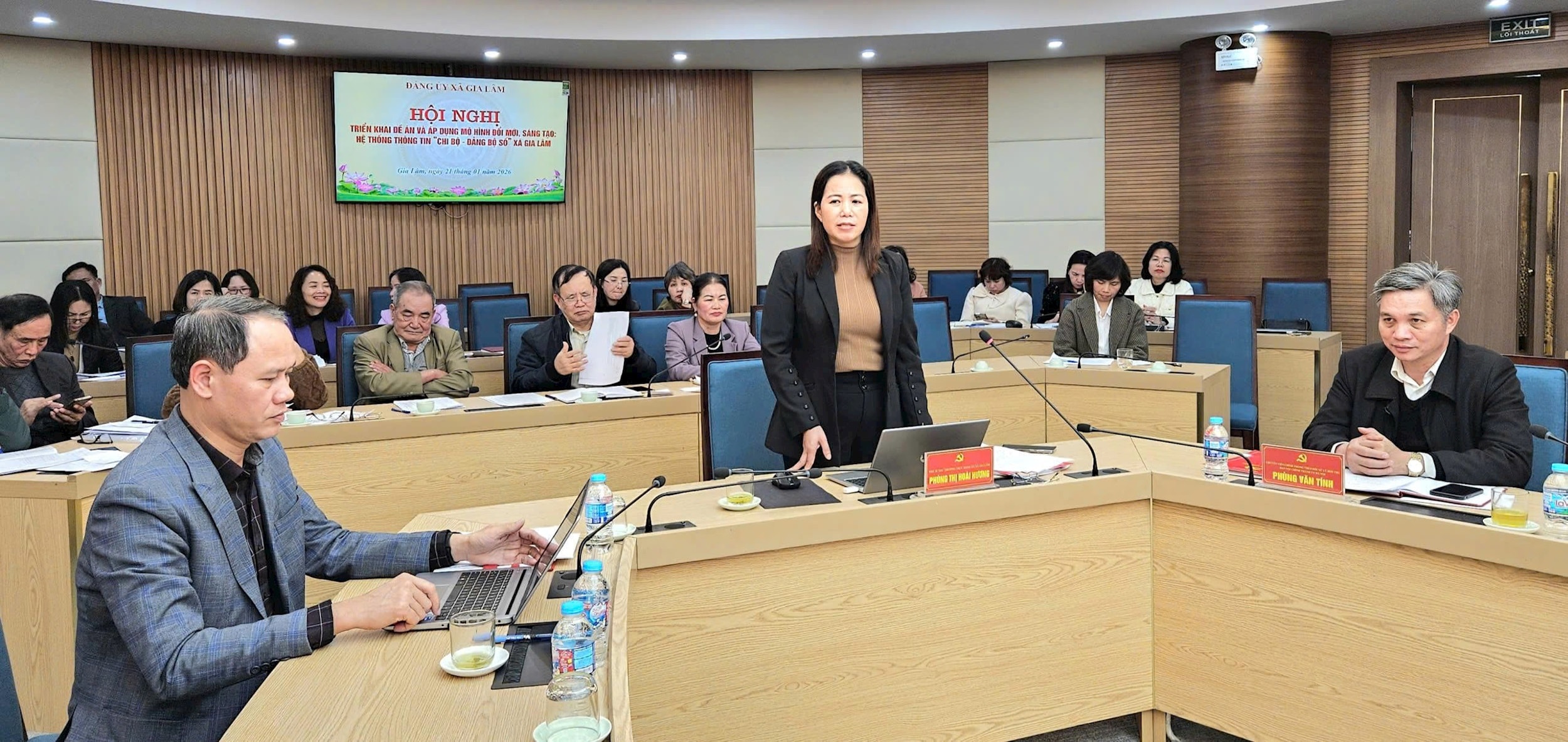
At the grassroots level today, the requirements are becoming increasingly clear: Official information must not only be accurate but also timely, clear, easily accessible, and closer to the people. The work of monitoring public opinion must shift from passive to proactive, from post-procedure handling to early prevention. Protecting the Party's ideological foundation at the grassroots level is inseparable from the task of maintaining a firm "information front" starting from the specific issues of daily life.
In an era where every social media account can become a "point of information dissemination," every official and Party member must be an "point of upholding standards." The use of social media must be placed within the framework of political responsibility and official duties. Do not share unverified information, do not make emotional statements, and do not allow personal feelings to affect the reputation of the organization and the trust of the people.
Furthermore, grassroots Party branches need to pay more attention to understanding public opinion, guiding information, and building a culture of digital behavior among cadres and Party members. Party branch meetings should be more closely linked to practical issues arising in cyberspace, thereby enabling timely exchange, guidance, and consensus building.
Proactively providing information early on, from the grassroots level, is crucial in curbing rumors, building consensus, and strengthening public trust. When official information is provided promptly, transparently, and clearly, information gaps are narrowed, reducing the risk of distortion or misunderstanding.
The online space will continue to evolve, and the flow of information will become increasingly faster. In this context, maintaining critical thinking in information reception, using appropriate language, and acting responsibly become even more crucial.
This is not only a general requirement of the digital society, but also a direct responsibility of every cadre, Party member, and grassroots Party organization in building a healthy information environment, contributing to strengthening the people's trust from the grassroots level. It is also a practical way to protect the Party's ideological foundation from the grassroots, from each Party organization, each cadre, and each Party member in today's digital landscape.
Source: https://hanoimoi.vn/giu-vung-tran-dia-thong-tin-tu-co-so-tren-khong-gian-mang-750330.html


![[Photo] Solemn bathing ceremony and Buddha procession in Hue](https://vphoto.vietnam.vn/thumb/1200x675/vietnam/resource/IMAGE/2026/05/31/1780228263543_1-jpg.webp)
![[Photo] Admire the coral "masterpiece" amidst the million-year-old heritage of Dak Lak province.](https://vphoto.vietnam.vn/thumb/1200x675/vietnam/resource/IMAGE/2026/05/31/1780221235105_anh-man-hinh-2026-05-31-luc-16-53-27.png)
![[Photo] The General Secretary, President and his wife begin their state visit to the Philippines.](https://vphoto.vietnam.vn/thumb/1200x675/vietnam/resource/IMAGE/2026/05/31/1780230559452_anh-man-hinh-2026-05-31-luc-19-28-11.png)
















![[Video] Sunset at Lap An Lagoon – Where the sun sets over the fishing nets](https://vphoto.vietnam.vn/thumb/340x192/vietnam/resource/IMAGE/2026/05/31/1780192137701_beach-landscape-sea-water-nature-grass-745871-pxhere-com.jpeg)



![[Live] News program May 31st: Talented people today](https://vphoto.vietnam.vn/thumb/402x226/vietnam/resource/IMAGE/2026/05/31/1780229174610_ts.jpeg)



































![[Photo] Admire the coral "masterpiece" amidst the million-year-old heritage of Dak Lak province.](https://vphoto.vietnam.vn/thumb/402x226/vietnam/resource/IMAGE/2026/05/31/1780221235105_anh-man-hinh-2026-05-31-luc-16-53-27.png)




























Comment (0)