

"I hope the family will supervise and monitor our child more closely. He lacks focus, and his academic performance is at the bottom of the class," said Ms. Tran Phuong Thao (39 years old, Tuong Mai, Hanoi ), anxiously showing her husband a message from the homeroom teacher assessing their child's academic performance.
Three weeks into the new school year, Thao has received similar comments from her son's teacher. Minh, who is in second grade this year, is intelligent, talkative, and sociable with his friends, but his academic performance has consistently been rated poorly by his teacher.
A parent whose child was in the same class as Minh whispered to Ms. Thao that she should send her child to the teacher's house for extra tutoring every evening, and that her child would naturally improve. To be more convincing, she sent Ms. Thao a picture of her son's academic results. In the first semester of first grade, her son's academic performance was rated as "good," but his cognitive abilities were still slow. After sending her son to the teacher's house, in the second semester, the student's academic performance suddenly improved significantly, and he became an outstanding student.
Ms. Thao discussed the matter with her husband before deciding to entrust the tutor to help their child with homework at home on weekday evenings.
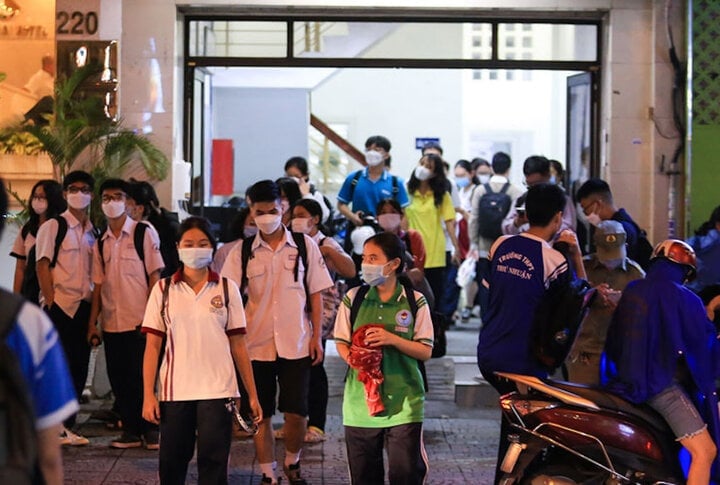
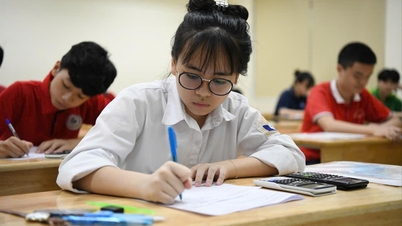
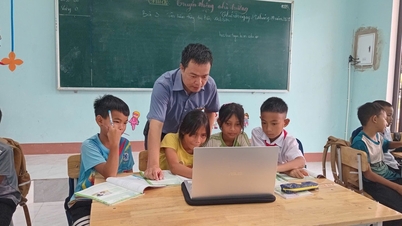
Many parents send their children to extra classes so they don't "fall behind their friends." (Illustrative image: GDTĐ)
As soon as she raised the issue, her son's homeroom teacher added Ms. Thao to a Zalo group announcing the tutoring schedule. "I was surprised because two-thirds of the group members were parents of my son's classmates; it felt like I was in a different world ," the parent recounted. The tutoring class at the homeroom teacher's house had been running since first grade.
The extra classes are held four times a week, evenly divided between Math and Vietnamese, at a fee of 120,000 VND per session, with a total of 36 students. The teacher also announced that as the mid-term and final exams approach, the number of sessions will increase to six per week to help students achieve the best possible results and see clear progress.
"After registering our child for the tutoring, both my husband and I were amazed by the teacher's average income – nearly 70 million VND per month – three times the total income of our entire family combined," Ms. Thao shared. For Minh alone, the family invests nearly 2 million VND per month in extra tutoring, totaling 20 million VND per year for 10 months.
This mother expressed concern that her and her husband's combined salaries weren't high, and now they had to shoulder the burden of sending both children to extra classes. Their already limited finances had to be tightened even further. She encouraged her husband to work overtime to ensure their children could attend extra classes at the teacher's house in the evenings. "It's better to spend a little money on extra classes than to be scrutinized by the teacher and receive constant negative feedback about poor academic performance every day," she said.
Having attended tutoring classes taught by the homeroom teacher since his child was in 3rd grade, Mr. Tran Van Thuy (41 years old, Dong Da district, Hanoi) now has his child in 5th grade. He calculated that in 3rd grade, the tuition was 100,000 VND per session, 3 sessions a week. By 4th grade, the teacher cited rising prices and inflation as reasons for the increase, raising the fee to 130,000 VND per session, 3 sessions a week.
This year, at the very beginning of the school year, she messaged parents to register their children for extra math and English classes at her home, and she would invite teachers from the school to teach. At the same time, the extra class fee increased to 180,000 VND per session. The children attended six sessions a week, with the explanation that it was their final year of middle school, requiring more time for revision and extra tutoring to ensure they had enough knowledge to pass the entrance exams for top schools.
Mr. Thuy and his wife run a small grocery stall in the market, selling goods at a leisurely pace each day. "On busy days, we make a few hundred thousand dong in profit; on slow days, just having enough money to feed the family is a blessing. Now, the cost of extra tutoring for our youngest daughter has skyrocketed to 180,000 dong per session, averaging over 4.3 million dong per month – a huge burden on the family," he said.
Many times, Mr. Thuy discussed with his wife the possibility of stopping their child's tutoring with the homeroom teacher to save money. However, they ultimately decided to continue, feeling confident in their child's education, receiving preferential treatment from the teacher, resulting in a good report card, and also hoping their child could enter a better secondary school.
In first and second grade, my child's academic performance was at the bottom of the class, with math and Vietnamese test scores of only 7-8 points. However, since sending my child to the tutor's house, not a single test score has been below 9, the report card is a stunning 10, and the comments are "diligent, well-behaved, and excellent"... making me much prouder.
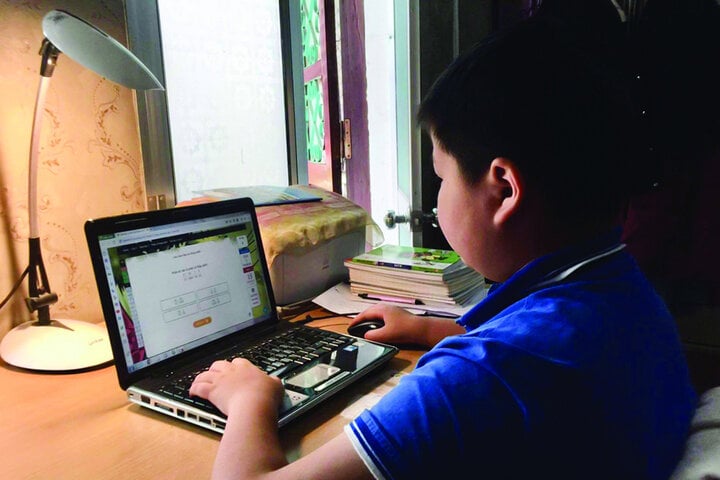
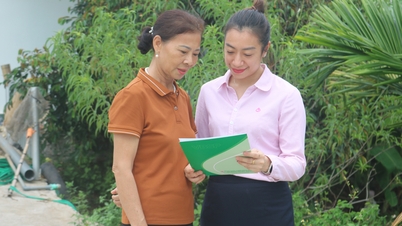
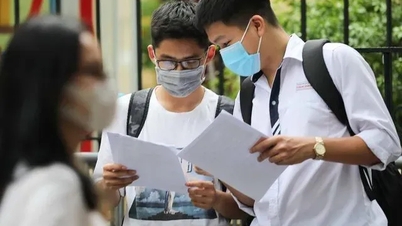
Many teachers believe that parents themselves don't want their children to fall behind their peers, which is why they ask teachers to help with tutoring. (Illustrative image: Cao Bang Newspaper)
Dr. Nguyen Thi Hue, a psychologist at Hanoi Pedagogical University, shared that she has witnessed many parents complaining about their children's extra tutoring. Everyone believes that extra tutoring mainly stems from the teachers' demands. These teachers exploit the parents' psychology by saying that their children are struggling academically, will have difficulty catching up with their peers, and will lose momentum in secondary school.
Meanwhile, many teachers argue that extra tutoring is driven by parental demand. Parents themselves don't want their children to fall behind their peers, so they ask teachers for extra help. Where there is demand, there will inevitably be supply.
The "battle" over right and wrong in tutoring and extra classes will probably never end, and the disadvantages always fall upon the children who have no time to live a proper childhood.
"To be fair, there are students who don't need extra tutoring and still pass exams with high scores. However, that number is very small, and those are truly students who are conscientious, have the ability to self-study, and have been carefully taught and trained since childhood. The majority, on the other hand, have to attend extra tutoring and study hard to even hope to pass the entrance exams for top secondary and high schools..." , Dr. Hue said.
Ms. Tran Thu Loan (a literature teacher in Ba Dinh, Hanoi) believes that sending children to too many extra classes easily leads to dependence, laziness in thinking, and reliance on teachers' tutoring and revision... In addition, elementary school students are at an age of intellectual and physical development, and their concentration ability is still low. Although the main activity has shifted from playing to learning, it is still primarily a form of learning through play.
On the other hand, forcing children to study too much will cause them to become stressed, excessively tired, and mentally inhibited, making them afraid of learning and even lazier. When forced, children will learn mechanically and passively. Because they lack enjoyment and passion, they develop a rebellious mindset, viewing learning as a difficult task. This limits their creativity and cognitive development.
Therefore, the advice for parents is to stop being afraid that their children will fall behind their peers, or be discriminated against by the teacher... and then force them to attend extra classes. Whether extra classes actually bring benefits is uncertain; all we know is that some children are terrified and tremble at the mere mention of the word "study," Ms. Loan advised.
Tutoring fees are the biggest expense.
In 2022, the Vietnam Institute of Educational Sciences and UNESCO conducted a comprehensive analysis of Vietnam's education sector from 2011 to 2020, revealing that tutoring costs constitute the largest portion of current educational expenses for primary school students' families. Specifically, tutoring costs account for 32% of total educational expenses for primary school students, 42% for lower secondary school students, and 43% for upper secondary school students.
Ha Cuong
Source
![[Photo] Enchanting ancient rose garden on the mountainside in Nghe An](/_next/image?url=https%3A%2F%2Fvphoto.vietnam.vn%2Fthumb%2F1200x675%2Fvietnam%2Fresource%2FIMAGE%2F2025%2F12%2F19%2F1766109900916_vuon-hong-chin-do-thu-hut-du-khach-toi-check-in-o-ha-noi-3-20162778-1671624890024-1671624890104198100259.jpeg&w=3840&q=75)
![[Photo] General Secretary To Lam visits the exhibition space showcasing books, photo exhibitions, and achievements of digital transformation in journalism.](/_next/image?url=https%3A%2F%2Fvphoto.vietnam.vn%2Fthumb%2F1200x675%2Fvietnam%2Fresource%2FIMAGE%2F2025%2F12%2F19%2F1766110879215_1766110240024-jpg.webp&w=3840&q=75)


























































































Comment (0)