

Understanding refractive errors correctly
According to doctors, refractive errors are when the eyeball's axis is abnormal: too long (myopia) or too short (hyperopia, commonly seen in older adults). Therefore, when looking at distant objects, the image of the object will not be projected onto the retina but will instead appear in front of or behind the retina. Causes of refractive errors include genetics, lack of outdoor activity, poorly lit living environments, improper lighting, excessive close-up viewing (playing video games, watching television, using computers for too long), and incorrect posture while studying.
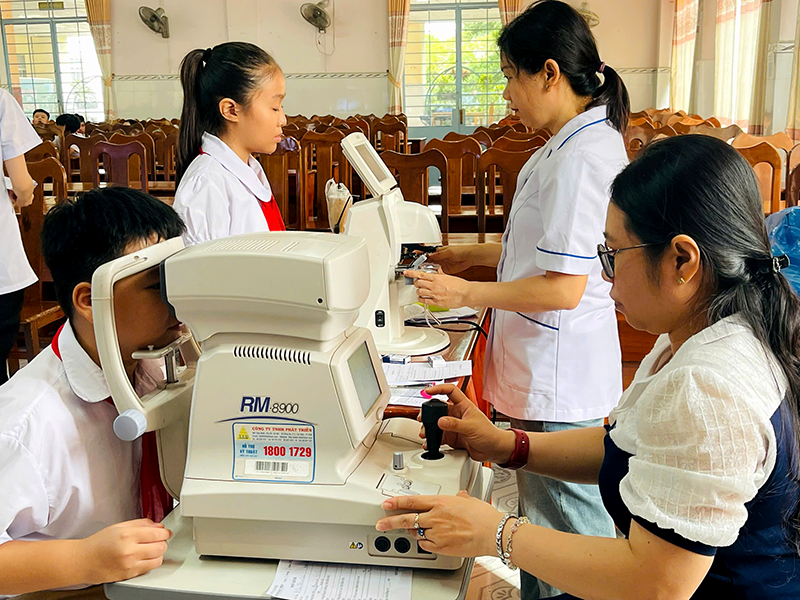
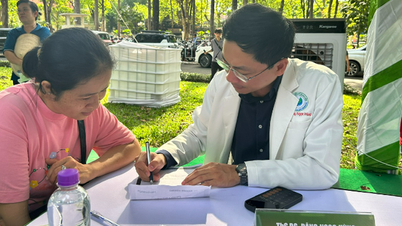
Staff at the Can Tho City Eye and Maxillofacial Hospital measure refractive errors and determine the prescription for eyeglasses for students.
If refractive errors in children are detected early and treated promptly, optimal vision can be achieved, and interventions can be implemented to limit the progression of myopia. Conversely, if children are not examined and do not wear glasses, there is a risk of developing severe amblyopia, leading to strabismus, permanent vision loss, and affecting their quality of life: reduced or lost ability to work and live normally, and potentially impacting their psychological development. In particular, severe myopia can cause many complications, such as amblyopia, myopic retinal degeneration, vitreous opacity, and retinal detachment, resulting in permanent vision loss.
Dr. Duong Thi Anh Tho, Head of the Pediatric Ophthalmology Department at the Can Tho City Eye, Dental and Maxillofacial Hospital, stated: "Some parents believe that wearing glasses for nearsighted children will increase their prescription, as they often have to change glasses at each follow-up visit due to the increased myopia. In reality, as a child's body develops, the eyeball lengthens, and the degree of myopia will increase accordingly. Currently, there are many methods to control the progression of myopia, such as using low-dose atropine eye drops, corrective lenses, or wearing Ortho-K lenses at night. If children have their eyes examined according to the recommended schedule, with regular check-ups every six months, it will help adjust the prescription appropriately, detect eye diseases, and identify early stages of myopia. From there, ophthalmologists can promptly apply measures to control the progression of myopia, reducing the risk of complications and protecting and improving the child's visual health."
Currently, many parents only take their children for checkups when they experience blurred vision or other unusual symptoms. Therefore, refractive errors are not detected early enough for timely intervention. Some parents also believe that surgery will cure nearsightedness, so they don't pay attention to controlling its progression. According to specialists, surgery only corrects the refractive error, allowing patients to avoid wearing glasses, but it does not treat dangerous complications of severe nearsightedness such as amblyopia, myopic retinal degeneration, vitreous opacity, or retinal detachment.
The child has a refractive error, but is wearing the wrong glasses.
Examinations have revealed that up to 50% of children wear glasses with the wrong prescription, posing a risk to their visual development. According to Dr. Duong Thi Anh Tho, there are two main reasons for this. Firstly, inaccurate initial measurements (in some cases, the prescription is higher than the actual myopia). Secondly, children do not receive regular check-ups (in many cases, the glasses are under-prescription, resulting in visual acuity of only 2/10). Myopia in elementary school children gradually increases with age, potentially by 0.5-1.00D or more, so children need regular check-ups every 6-12 months at specialized clinics to determine their current degree of myopia.
The common practice is to avoid taking children to medical facilities with optometrists and ophthalmologists for refractive error checkups, instead opting to go to shops for prescription measurements and glasses fitting. This creates the risk of wearing glasses with the wrong prescription, affecting vision and visual development.
Dr. Duong Thi Anh Tho, a specialist in internal medicine, stated: "Children must wear glasses with the correct prescription, the frames must fit the child's face, not too big, not too small, and the lens center must be correct for the child to achieve optimal vision."
Text and photos: H.HOA
Source: https://baocantho.com.vn/hieu-va-hanh-dong-dung-khi-tre-mac-tat-khuc-xa-a205514.html



![[Image] Hanoi's urban life under the challenge of a "scorching hot" environment](https://vphoto.vietnam.vn/thumb/1200x675/vietnam/resource/IMAGE/2026/05/25/1779706979265_nang-nong-t5-2026-minh-duy-7-4636-jpg.webp)





















































































Comment (0)