


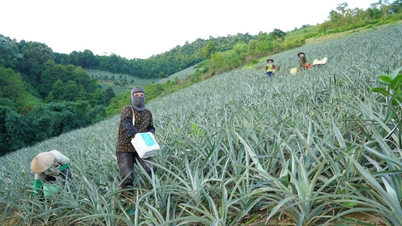
The people of Hang Lia A village are tending to the potato plants that are being grown on their rice paddies for the first time.
Taking us to visit the potato garden planted on single-crop rice land belonging to Mr. Vang A Dua's family in Hang Lia B village, Ms. Bach Thi Yen Ly, an official from the Party Building Committee of Tia Dinh commune, said: "Mr. Dua's family has 1,000 square meters planted with Actrice Dutch potatoes. Like the other nine families in Hang Lia A and Hang Lia B villages who participated in this potato farming model, potatoes are a new crop for Mr. Dua and his family in Tia Dinh."
Here, according to custom, the H'Mông people only cultivate one crop of wet rice and one crop of upland rice, then leave the fields fallow for eight months, even though the paddy fields (over 60 hectares) have water and favorable production conditions. This production habit is one of the reasons why many families in Tìa Dình remain poor or, if they escape poverty, do not achieve sustainable poverty alleviation.
To help people change their production habits and proactively introduce more crops to cultivate on rice paddies and alluvial land, right from the start of the two-tiered local government model, the leaders of the Party Committee and People's Committee of Tia Dinh commune conducted field surveys of production in each village and simultaneously developed plans to introduce new crops to support people's production. Taking advantage of the favorable conditions of the two villages (Hang Lia A and Hang Lia B) with large rice paddies, the commune decided to implement a community support model for potato cultivation (using the Dutch Actrice potato variety); the area covered was 22,000 m2 of rice paddies belonging to 10 families, all of whom are H'Mong ethnic minority people.
To ensure a high survival rate of seedlings and the effectiveness of the model, the People's Committee of the commune has assigned specific tasks to each official, civil servant, and Party member responsible for guiding each family from land preparation, planting, watering, fertilizing, and caring for the plants. Mr. Nguyen Duc Do, Vice Chairman of the People's Committee of the commune, said: From the end of October 2025, the commune organized training on the process and techniques for all families; at the same time, assigned 10 local agricultural experts to guide 10 families on the techniques of planting and caring for potatoes using a "hands-on" approach.
Furthermore, whenever the weather changes drastically (excessive heat or frost), the assigned officials must proactively propose to the commune leaders to send more youth union members to assist families in caring for and protecting the plants. Thanks to the dedication and concrete work of the officials and civil servants of Tia Dinh commune, 100% of the experimental potato planting area in the two villages is developing well. Currently, the plants have started to produce tubers, promising a successful new potato crop on the new land.
Speaking about the joy of the H'Mông people in Tìa Dình for the first time planting potatoes on their single-crop rice fields, Vàng A Mua, head of Háng Lìa A village, said: “There are no words to describe the joy of the villagers, because for generations here they have only cultivated single-crop rice in the fields, and upland rice yields are low, but now they have potatoes as well, so the villagers are very happy. Now many families in the village are asking about planting experience and ordering potatoes to use as seeds for the next season.”
Sharing the joy with potato farmers in Tia Dinh, Mr. Vang A Lau, an agricultural extension officer from the Economic Department of the commune, added: According to assessments, the potato crop grown experimentally in the two villages is very suitable for the soil and climate. The potatoes have already formed tubers and are expected to be harvested in about 1.5 months, coinciding with the planting season so that farmers can prepare the land for the new rice crop.
As the first trial planting of a new crop on new land has shown promising results, the commune will evaluate the experience immediately after the model concludes to develop a plan to further expand it to other villages. The success of the model also promises to bring new production prospects for agriculture in Tia Dinh, as the people are ready to abandon old habits and production methods to rotate crops on the same land.
LE LAN
Source: https://nhandan.vn/ho-tro-dong-bao-hmong-tang-vu-บน-dat-lua-post941786.html





















































Comment (0)