

Leaders of the BRICS emerging economies – Brazil, Russia, India, China, and South Africa – have highlighted the bloc's economic strength and called for deeper integration.
The comments were made on the first day of the group's 15th Summit in Johannesburg on August 22. The meeting of heads of state and government will last until August 24.
“The changes that have taken place in the BRICS economies over the past decade have done much to reshape the global economy,” said South African President Cyril Ramaphosa at the Summit’s Economic Forum.
“Together, the BRICS countries make up a quarter of the global economy, account for a fifth of global trade, and are home to more than 40% of the world’s population,” Ramaphosa emphasized at the Sandton Convention Centre, Johannesburg’s financial hub, where the summit was taking place.
The South African leader noted that the bloc “exists not only to strengthen government-to-government relations but also to forge stronger bonds between the people of our five nations.”
Expand for peace and development
At the conference, the topic of expanding the BRICS bloc was raised and enthusiastically supported by Chinese President Xi Jinping. Beijing has been focusing its efforts on the BRICS expansion plan in an attempt to assert its political and economic influence on the global stage.
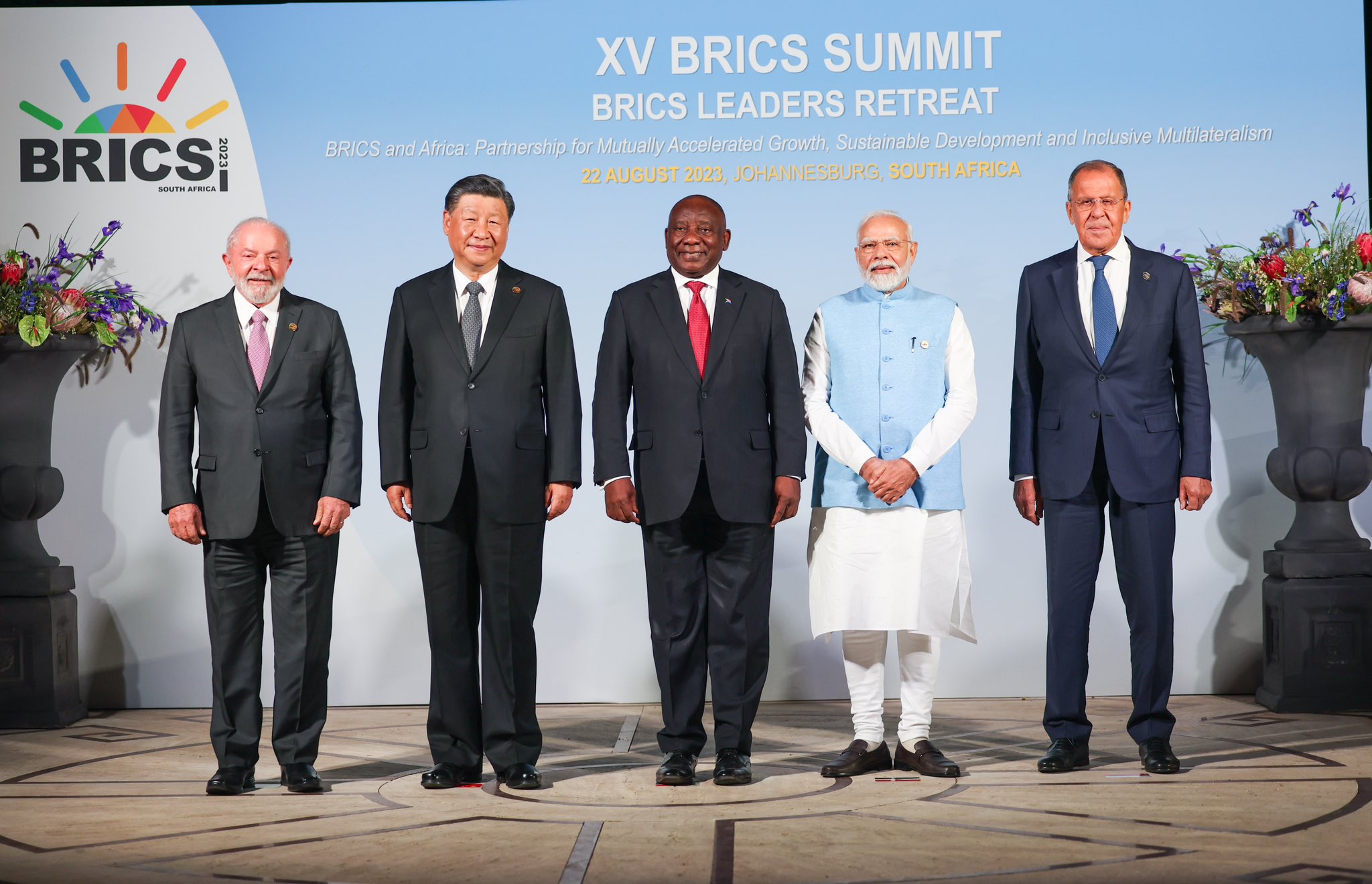
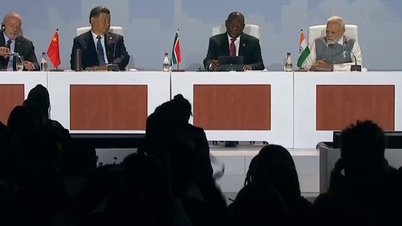
From left to right: Brazilian President Luiz Inacio Lula da Silva, Chinese President Xi Jinping, South African President Cyril Ramaphosa, Indian Prime Minister Narendra Modi, and Russian Foreign Minister Sergey Lavrov. Photo: Twitter MEAIndia.
This summit is not aimed at demanding that countries take sides, but rather at calling for expansion for peace and development, Xi said in a speech delivered on his behalf by Chinese Commerce Minister Wang Wentao.
"Hegemonism is not in China's DNA," Xi said. The Chinese leader arrived in South Africa on August 21, but did not attend the BRICS Economic Forum. No official explanation has been given.
"We will strengthen the BRICS strategic partnership even more. We will expand the BRICS+ model, actively promote membership growth, and enhance solidarity and cooperation with other emerging markets and developing countries," the Chinese leader emphasized.
“Regardless of any potential resistance, BRICS, a positive and stable force of goodwill, will continue to grow,” he said. “We will build a stronger BRICS strategic partnership, actively promote membership expansion, and help make the international order more just and equitable.”
China is the most powerful economy in the BRICS group, and President Xi Jinping's state visit to South Africa is his second international trip this year. On his previous trip, the Chinese leader visited Moscow for talks with Russian President Vladimir Putin.
An "irreversible" trend
In addition to the issue of expansion, promoting the use of member countries' domestic currencies in trade and financial transactions to reduce dependence on the US dollar was also on the agenda of the Summit.
In his online address, Russian President Putin said that abandoning the US dollar in transactions between Brazil, Russia, India, China, and South Africa is an "irreversible" trend.
"The process of objective and irreversible de-dollarization in our economic relations is gaining momentum," Putin said.
"As a result, the proportion of US dollars in import and export transactions within the BRICS bloc has decreased. Last year, this figure reached 28.7%," the Russian president said, emphasizing the "de-dollarization" process of the bloc's economies, which he wants to promote through trade in the member countries' national currencies.
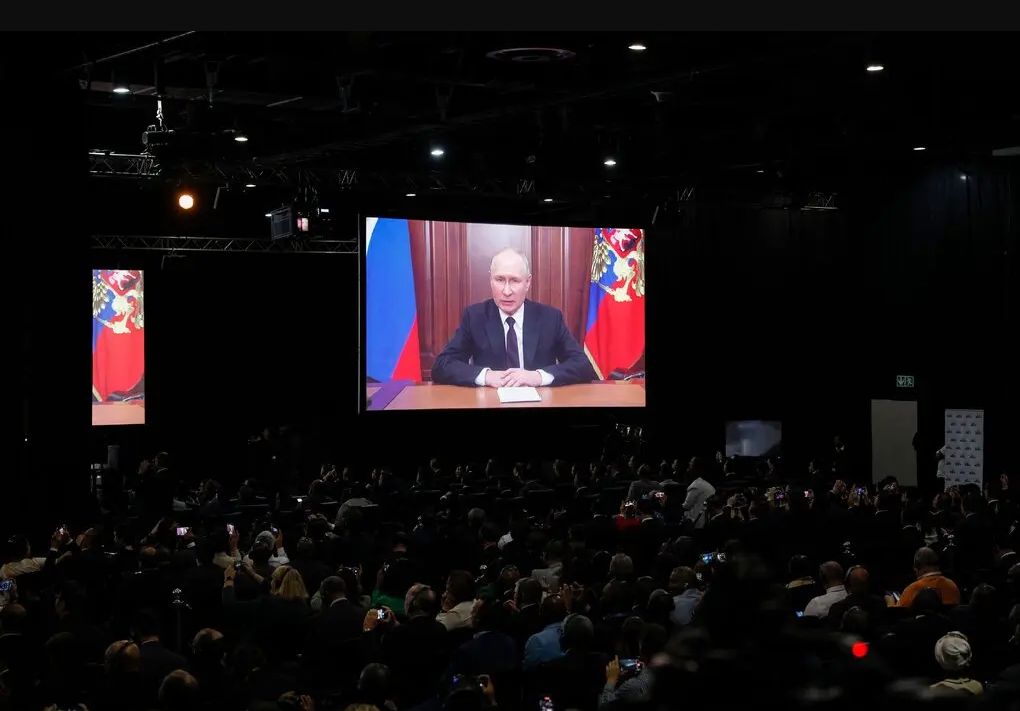
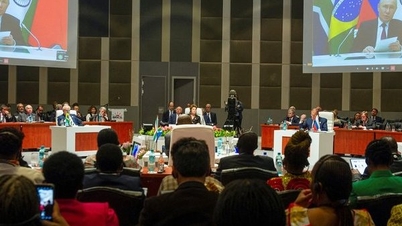
Russian President Vladimir Putin speaks online to the BRICS Summit in South Africa, August 22, 2023. Photo: Getty Images
The Russian leader also stated that the five BRICS countries are surpassing the G7 – the group of seven leading economies – “in terms of purchasing power parity,” and that BRICS is on track to fulfill the aspirations of most people around the world.
"We cooperate on the principles of equality, supporting partnerships and respecting each other's interests, and this is the essence of the bloc's future-oriented strategic roadmap, a roadmap that meets the aspirations of the global majority," Putin said.
Russian President Putin did not attend the summit in Johannesburg in person to avoid an awkward situation for host country South Africa, as the International Criminal Court (ICC) arrest warrant against him remained pending.
The BRICS summit in Johannesburg highlighted the gap in Western efforts to isolate Russia over the war in Ukraine.
Among BRICS member states, South Africa, China, and India have not condemned Russia's military campaign in Ukraine, while Brazil has refused to join Western nations in sending weapons to Ukraine or imposing sanctions on Moscow.
Negotiations on the basis of equality
Indian Prime Minister Narendra Modi and Brazilian President Luiz Inacio Lula da Silva were also present at the talks, and approximately 50 other leaders were invited.
Representing 40% of the world's population, the BRICS nations share a common desire for a global order that they see as better reflecting their growing interests and influence.
“We don’t want to be a counterweight to the G7, the G20, or the United States,” Lula da Silva said in a social media broadcast from Johannesburg on August 22. “We want to sit at the negotiating table on an equal footing with the European Union (EU), the United States, or any other country.”
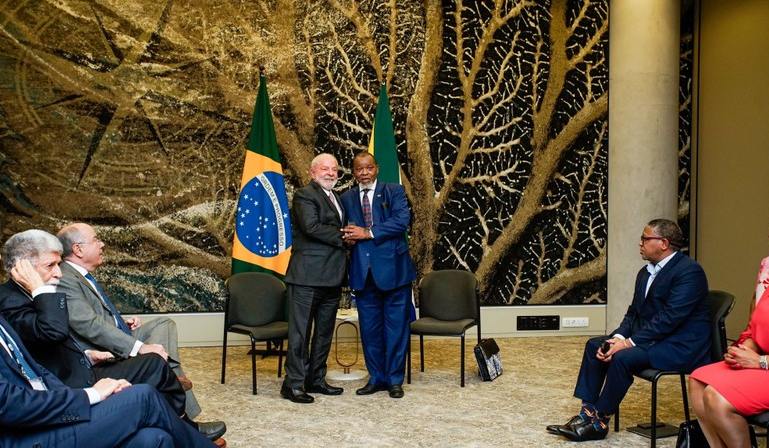
Brazilian President Lula Da Silva meets with leaders of the African National Congress (ANC) on the sidelines of the BRICS Summit in South Africa, August 22, 2023. Photo: IOL
The theme of the 15th Summit was “BRICS and Africa,” chosen as the continent emerged as a new diplomatic battleground with the US, Russia, and China vying for influence.
The bloc started with four countries in 2009 but expanded the following year with the addition of South Africa.
Around 40 countries from across the “Southern Hemisphere”—a broad term referring to countries outside the West—have expressed interest in joining BRICS, according to the South African government, with 23 countries having formally expressed their desire, including Argentina, Iran, Saudi Arabia, Bolivia, Cuba, Honduras, Venezuela, Algeria, and Indonesia.
"This shows that the BRICS family is growing in importance, stature, and influence in the world," said South African President Ramaphosa .
Minh Duc (According to TRT World, La Prensa Latina)
Source











![[Photo] Prime Minister Pham Minh Chinh attends the Conference on the Implementation of Tasks for 2026 of the Industry and Trade Sector](/_next/image?url=https%3A%2F%2Fvphoto.vietnam.vn%2Fthumb%2F1200x675%2Fvietnam%2Fresource%2FIMAGE%2F2025%2F12%2F19%2F1766159500458_ndo_br_shared31-jpg.webp&w=3840&q=75)








































Comment (0)