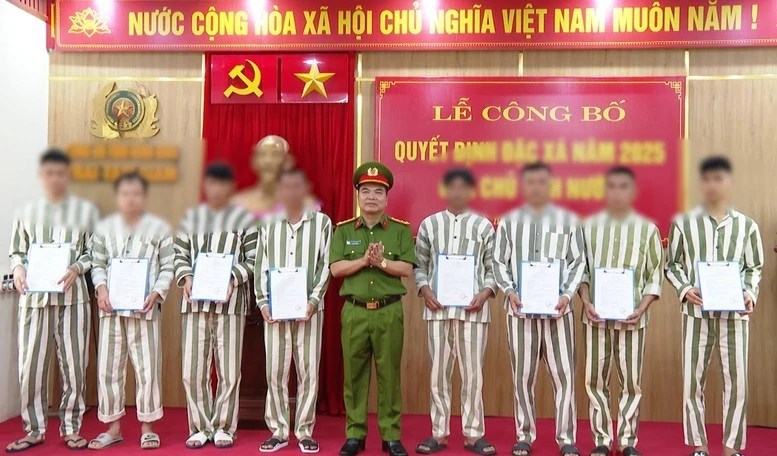
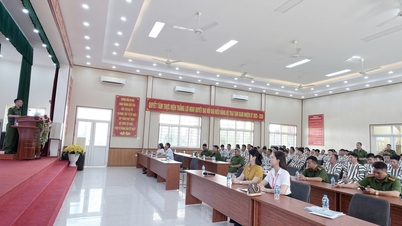
Organizations releasing individuals granted amnesty by the President 's Decision on June 1, 2026 - Illustration.
Individuals eligible for amnesty
According to the guidelines, the subjects eligible for amnesty include:
1. Persons sentenced to fixed-term imprisonment or life imprisonment whose sentences have been reduced to fixed-term imprisonment and who are currently serving their sentences in prisons or detention centers (prisoners).
2. Persons whose prison sentences are temporarily suspended.
Conditions for being recommended for amnesty
The Clemency Advisory Council provides the following specific guidance:
1. The provision in point a, clause 1, Article 3 of the Decision on amnesty in 2026 is the provision in point b, clause 2, Article 2 of the Law amending and supplementing a number of articles of the Penal Code and clause 1, Article 4 of Government Decree No. 52/2019/ND-CP dated June 14, 2019, detailing the implementation of a number of articles of the Law on Amnesty (Decree No. 52).
According to Clause c and Clause e, Article 18 of Government Decree No. 118/2024/ND-CP dated September 30, 2024, detailing the implementation of some articles of the Law on Execution of Criminal Sentences, the classification of prison sentence compliance for the first quarter is determined on the last day of February. Therefore, by the time prisons and detention centers hold meetings to consider and propose pardons, prisoners must have completed the quarters for which they have been classified as "fair" or "good" for each sentence level, and the period from March 1st to the date the prison or detention center's pardon review council meets must have been assessed as "fair" or "good" for their prison sentence compliance.
For prisoners whose sentences have been temporarily suspended or who have been subjected to compulsory medical treatment and have returned to prison or detention center to continue serving their sentences, in addition to the required quarterly performance ratings for each sentence level during their imprisonment (which were rated "fair" or "good"), they must also obtain confirmation from the People's Committee of the commune where they reside, the military unit assigned to manage them during the suspension period, or the medical facility where they received treatment during the compulsory medical treatment period that they have strictly complied with the law and regulations of the medical facility during the suspension or compulsory medical treatment period.
2. The time served in prison includes the time spent in temporary detention, custody, or serving the sentence in prisons or detention centers, excluding time spent on bail, postponement, suspension, or reduction of the sentence. Time spent undergoing compulsory medical treatment during the investigation, prosecution, trial, and execution phases is also counted towards the time served in prison.
The time reduced from the prison sentence is calculated and deducted from the remaining prison sentence. For example: Nguyen Van A was sentenced to 12 years in prison, arrested on May 31, 2017. As of May 31, 2026, Nguyen Van A has actually served 9 years, has had his sentence reduced 3 times, totaling 2 years, so the remaining prison sentence is 1 year.
3. Regarding regulations on the implementation of supplementary penalties such as fines, court fees, obligations to return property, compensation for damages, and other civil obligations:
a) Prisoners or persons whose sentences have been temporarily suspended and who have not yet completed the supplementary penalty of a fine or court fee, but who have been granted exemption from the fine or court fee by the Court, are also eligible for the conditions stipulated in point c, clause 1, Article 3 of the Decision on Amnesty in 2026.
b) Prisoners or persons whose sentences have been temporarily suspended and who have fulfilled their obligations to return property, compensate for damages, and other civil obligations as stipulated in point d, clause 1, Article 3 of the 2026 Amnesty Decision are among the cases specified in clause 2, Article 4 of Decree No. 52. In addition, the following cases are also considered as having fulfilled their obligations to compensate for damages and other civil obligations:
- In cases where alimony is required, the obligation must be fully fulfilled according to the court's judgment or decision, or the obligation must have been fulfilled once, as confirmed by the People's Committee of the commune of residence or the civil enforcement agency handling the case. If only a part of the alimony obligation has been fulfilled, or the obligation has not been fulfilled at all, but there is an agreement or confirmation from the legal representative of the victim or the person receiving alimony that they are no longer required to fulfill the obligation according to the court's judgment or decision, and this is confirmed by the People's Committee of the commune of residence or the civil enforcement agency handling the case, then the alimony obligation shall also be considered fulfilled.
- In cases where the offender is under 18 years of age as stipulated in point d, clause 3, Article 3 of the 2026 Amnesty Decision, and the court's judgment or decision assigns responsibility for compensation for damages and other civil obligations to the parents or legal representative, there must be documentation to prove that the parents or legal representative have completed the compensation for damages or other civil obligations, including: receipts, invoices, and other documents showing this; or a decision to suspend the execution of the judgment issued by the head of the competent civil enforcement agency; or a written agreement from the person entitled to enforcement or their legal representative stating that they are not required to perform compensation for damages or other civil obligations according to the court's judgment or decision, confirmed by the People's Committee of the commune where they reside or the civil enforcement agency handling the case; or other documents showing this.
c) In cases where a person sentenced to imprisonment has partially fulfilled their obligations to return property, compensate for damages, or other civil obligations, but due to exceptionally difficult economic circumstances, they are unable to fulfill the remaining obligations as stipulated in the law on civil enforcement, as specified in point d, clause 1, Article 3 of the 2026 Amnesty Decision, this is the case stipulated in clause 3, Article 4 of Decree No. 52.
4. Regarding the provision that granting amnesty should not negatively impact security and order, as stipulated in point e, clause 1, Article 3 of the 2026 Decision on Amnesty, the following criteria should be considered:
- Personal background (family relationships, social relationships, personal history, criminal record), family circumstances of the offender, and potential impact on security, order, and crime prevention efforts in the locality.
- If pardons are granted, it could lead to mass protests, demonstrations, and disturbances, which hostile forces could exploit to incite opposition against the government, distort the Party's guidelines, and misrepresent the State's policies and laws.
- Past criminal acts, if pardoned, would cause confusion, fear, or outrage among the people.
- Past criminal offenses, if pardoned, would hinder the implementation of the Party's guidelines and the State's policies and laws.
When considering and recommending pardons, the Pardon Review Council of the prison or detention center, the inter-agency assessment team, and members of the Pardon Advisory Council assess the prisoner's sentence execution process and the documents in their file to determine whether a pardon could negatively impact security and public order. After the Pardon Review Council's meeting, the prisons and detention centers send the list of eligible prisoners to the Standing Agency of the Pardon Advisory Council for compilation and submission to local police departments for verification of factors affecting security and public order. Based on the verification results from local police departments, the Standing Agency of the Pardon Advisory Council compiles the information and proposes that the Pardon Advisory Council consider and decide at its meeting.
5. Cases where individuals have made significant contributions during their imprisonment, are suffering from serious illnesses, are frequently ill and unable to care for themselves, have exceptionally difficult family circumstances, and are the sole breadwinners in their families, as stipulated in Clause 3, Article 3 of the 2026 Amnesty Decision, are those specified in Clauses 4, 5, 6, and 7 of Article 4 of Decree No. 52.
Cases not eligible for amnesty
To ensure compliance with Article 4 of the 2026 Amnesty Decision, the Amnesty Advisory Council provides the following specific guidance:
1. In the case of individuals currently being prosecuted for other criminal offenses as stipulated in Clause 3, Article 4 of the 2026 Amnesty Decision, the person is being prosecuted as a defendant in another case.
2. The basis for determining the cases stipulated in Clause 8, Article 4 of the 2026 Amnesty Decision is the points, clauses, and articles in the Criminal Code that the Court applies when deciding on the punishment.
For cases of armed robbery as stipulated in Clause 8, Article 4 of the 2026 Amnesty Decision, in addition to the above-mentioned grounds, it is also necessary to refer to the provisions of legal documents on the management and use of weapons, explosives, and supporting tools in effect at the time the convicted person committed the crime (Ordinance on the Management and Use of Weapons, Explosives, and Supporting Tools; Law on the Management and Use of Weapons, Explosives, and Supporting Tools) to determine whether the object used by the offender to commit the crime is a weapon.
3. The basis for determining whether a case constitutes organized crime, as stipulated in Clause 12, Article 4 of the 2026 Amnesty Decision, is the points, clauses, and articles of the Criminal Code that the Court applies when deciding on the punishment. For cases involving the mastermind, leader, or commander in an organized crime case, the assessment in the judgment must be taken into account.
4. The basis for confirming the illegal use of narcotics in the case stipulated in Clause 13, Article 4 of the 2026 Amnesty Decision is the documents in the prisoner's file and the file for the execution of the temporary suspension of the prison sentence (for those whose sentences are currently suspended), such as: Judgments; Indictments; documents from the investigating agency; test results from the medical agency; self-declarations of the prisoner or the person whose sentence is currently suspended admitting to the illegal use of narcotics, clearly stating the time and number of times the narcotics were used...; health examination reports from the detention facility or prisoner detention facility; other documents from the prisoner detention facility or competent authorities confirming that the prisoner or the person whose sentence is currently suspended has previously used narcotics illegally.
The organization will release those granted amnesty on June 1, 2026.
Regarding the implementation timeline, from April 22, 2026 to May 2, 2026, inter-agency appraisal teams will visit units and localities directly to inspect and appraise dossiers and lists of those recommended for amnesty.
From April 26, 2026 to May 10, 2026, the Standing Committee of the Clemency Advisory Council will compile dossiers and lists and forward them to the members of the Clemency Advisory Council for review and verification.
From May 10th, 2026 to May 20th, 2026, the Standing Committee of the Clemency Advisory Council of the Supreme People's Court will synthesize the opinions of the members of the Clemency Advisory Council and prepare dossiers and lists of eligible and ineligible individuals for clemency to be submitted to the Advisory Council for review.
From May 24th to May 26th, 2026, the Clemency Advisory Council will meet to review the list of those eligible for clemency.
From May 27th to May 28th, 2026, the Standing Committee of the Clemency Advisory Council will compile and finalize the list of those eligible for clemency and submit it to the President for decision.
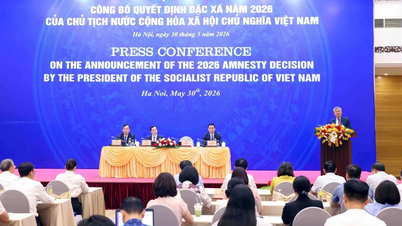
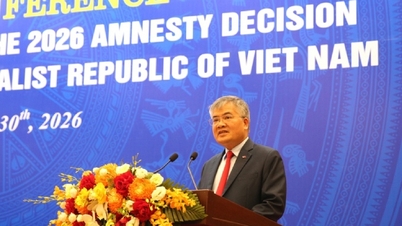
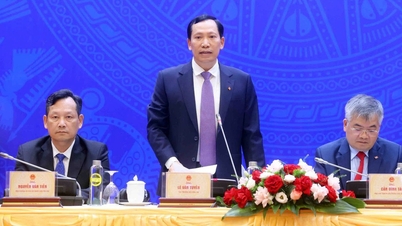
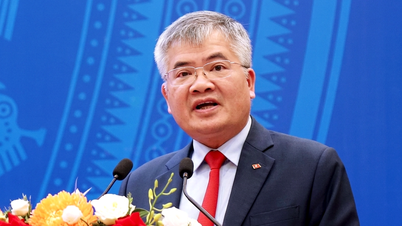
A press conference will be held to announce the President's amnesty decision on May 30, 2026.
The organization will release those granted amnesty according to the President's Decision on June 1, 2026.
baochinhphu.vn
Source: https://baolaocai.vn/huong-dan-dac-xa-nam-2026-post898006.html




![[Photo] Solemn bathing ceremony and Buddha procession in Hue](https://vphoto.vietnam.vn/thumb/1200x675/vietnam/resource/IMAGE/2026/05/31/1780228263543_1-jpg.webp)
![[Photo] Admire the coral "masterpiece" amidst the million-year-old heritage of Dak Lak province.](https://vphoto.vietnam.vn/thumb/1200x675/vietnam/resource/IMAGE/2026/05/31/1780221235105_anh-man-hinh-2026-05-31-luc-16-53-27.png)
![[Image] Hanoi Police officially crowned champions of V-League 2025/2026](https://vphoto.vietnam.vn/thumb/1200x675/vietnam/resource/IMAGE/2026/05/31/1780244769054_ndo_br_039d561b692be875b13a-jpg.webp)
![[Photo] The General Secretary, President and his wife begin their state visit to the Philippines.](https://vphoto.vietnam.vn/thumb/1200x675/vietnam/resource/IMAGE/2026/05/31/1780230559452_anh-man-hinh-2026-05-31-luc-19-28-11.png)

















![[Video] Sunset at Lap An Lagoon – Where the sun sets over the fishing nets](https://vphoto.vietnam.vn/thumb/340x192/vietnam/resource/IMAGE/2026/05/31/1780192137701_beach-landscape-sea-water-nature-grass-745871-pxhere-com.jpeg)


































![[Photo] Admire the coral "masterpiece" amidst the million-year-old heritage of Dak Lak province.](https://vphoto.vietnam.vn/thumb/402x226/vietnam/resource/IMAGE/2026/05/31/1780221235105_anh-man-hinh-2026-05-31-luc-16-53-27.png)




























Comment (0)