

I was born and raised in a poor rural area in western Nghe An province, where people are accustomed to the scorching Lao wind and the regular annual floods. Life was hard, a constant struggle, but strangely, in my memory, my homeland never appeared in harsh light. Because there, people cared for each other with a simple yet enduring affection, enough to alleviate all hardships. It was these memories that sustained me throughout my years away from home, when I faced loneliness and uncertainty in the city.
 |
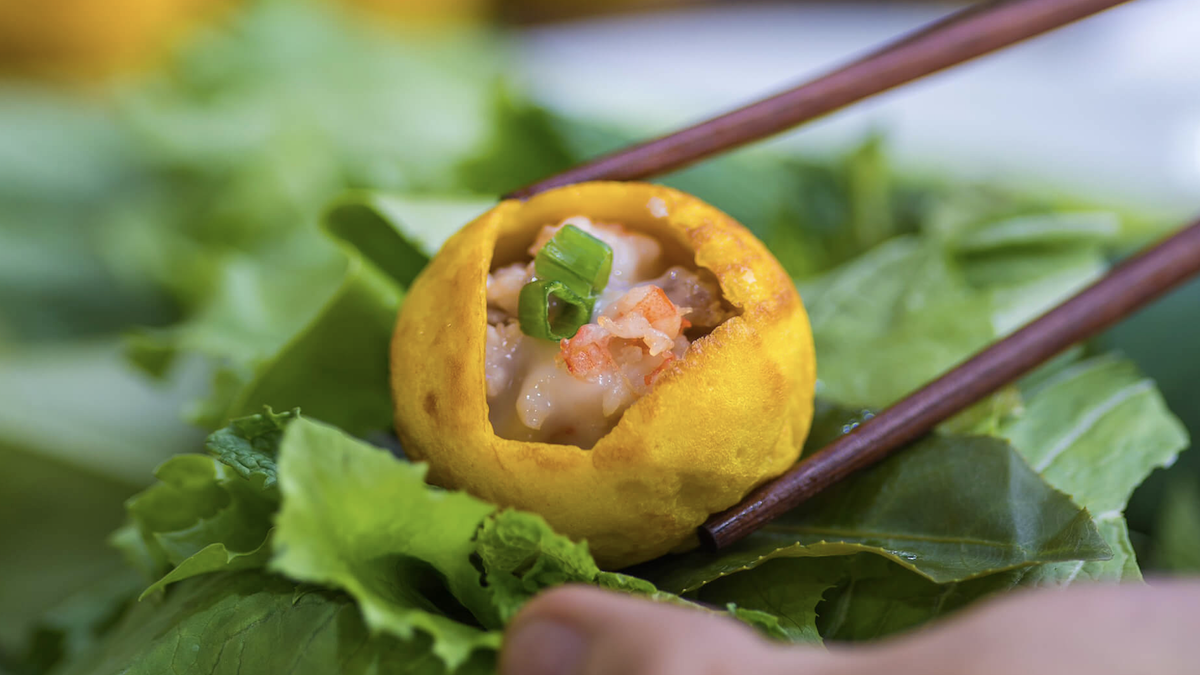
Nowadays, candy is mostly made by machine, resulting in perfectly round, golden-brown, crispy pieces. |
My family, like many others in the village, was rarely well-off. Droughts were followed by floods, and poverty clung to us relentlessly. But strangely, every Tet (Lunar New Year), my parents seemed to forget all their hardships to ensure my siblings and I had the most fulfilling celebration possible. It wasn't extravagant, just a few green sticky rice cakes, some cylindrical sticky rice cakes, a pot of grilled carp or pork braised in molasses. And especially, Tet in my memory wouldn't be complete without those fragrant packets of candied eggplant, a small, simple treat from my hometown that I haven't been able to forget for almost thirty years.
The "cà" candy from my hometown looks similar to the "bánh nhãn" (a type of Vietnamese cake) from the North, also tiny, round, golden brown pieces. But the flavor is distinctly different, with a mild spiciness from ginger, the rich creaminess of condensed milk and eggs blended into a fragrant glutinous rice flour. A batch of candy that meets the standard must be perfectly round, puffy, and crunchy when bitten into, leaving a light, warm, sweet aftertaste on the tongue. That taste, no matter how many more elaborately made and visually appealing types of "cà" candy I've eaten since, I can never fully recapture.
To make the perfect batch of candy, my mother always prepared the ingredients very early. No matter how busy she was, she always took the time to select the best glutinous rice, dry it thoroughly, and then take it to the shop to be milled into flour. The eggs had to be from our own chickens, carefully selected by my mother. The ginger was peeled, pounded, and strained to extract the juice. When those ingredients were ready, the Tet atmosphere would also arrive in my little house.
Strangely enough, back then, my friends in the neighborhood, without needing a call, would automatically flock over whenever they heard, "My family's making candy tonight." On that day, the kitchen would suddenly become packed. Laughter and chatter filled the air, and shouts echoed throughout the alley. One friend, who lived ten kilometers away, would still cycle through the night just to be there. One would bring corn, another a sweet potato, and yet another a few sugarcane stalks – supposedly to "help," but really, it was mostly to "gossip."
We said we'd help, but whenever it came to kneading the dough, everyone would find an excuse to skip it. That important task was always handled by my mother or the skillful neighbors. Watching my mother's hands move swiftly, we were all amazed. Mixing glutinous rice flour with sugar, milk, and eggs seemed simple, but making the candy fluffy, crispy, and delicious wasn't something everyone could do. We just stood around, waiting for the "easier" parts.
While waiting for the flour to rise, we children would share the task of building a fire, roasting potatoes, popping corn, and then vying with each other to tell stories about everything under the sun. The kitchen was like a bustling marketplace. Each child had something to say, making so much noise that it seemed no one could hear anyone else, yet at times we would all burst into laughter in unison, so carefree and innocent.
When the dough was ready, my mother spread it thinly on a tray, cut it into small square pieces the size of a fingertip, and then rolled them into balls. At this point, we children volunteered to join in the fun. Some of the candies were misshapen, some round, some square—it was quite funny to look at. But my mother just smiled kindly and told us to put them all into a bowl that had been sprinkled with a little dry flour and gently shake it. With just a few "magic" shakes, the candies instantly became round and pretty.
When it came to the most anticipated part of stirring the candy – the stirring – we all vied to "help." We said "help" to sound important, but in reality, we were a bunch of... troublemakers. While stirring the candy, we also roasted corn and baked potatoes, getting so engrossed that we forgot our task. As soon as the candy was put into the hot oil, the aroma filled the kitchen, awakening all the senses of the hungry children. After just a few batches, some pieces were burnt, others were still raw. Even knowing the outcome, Mom always softened at our pleading eyes.
The candies were spoiled, and Mom felt bad about wasting them, but we were so happy. Because there weren't many, we only got to eat the spoiled ones. Everyone was overjoyed, like it was a festival. Even though they were a little burnt and hard, in my memory, they were the best candies in the world. Not just because of the sweet, rich taste, but because they contained laughter, anticipation, and Mom's silent love. At the end of the day, feeling sorry for those eager eyes, Mom gave each of us a small handful, as a reward for everyone.
Now, amidst the bustling streets filled with shops, I can easily buy that treat anytime. The machine-made candies are perfectly uniform, golden brown, and crispy. But strangely, the more I eat, the more I feel like something is missing.
Every Tet holiday, amidst the hustle and bustle of life, my heart sinks with nostalgia. I miss the traditional candy, but more than anything, I miss the time spent gathering with family and friends, when Tet was a time of slowness, warmth, and overflowing love. And perhaps, for the rest of my life, I will never find that taste again, the taste of a time long gone, but forever etched in my heart.
Source: https://www.qdnd.vn/van-hoa/doi-song/huong-keo-ca-ngay-tet-1025772


















































































Comment (0)