

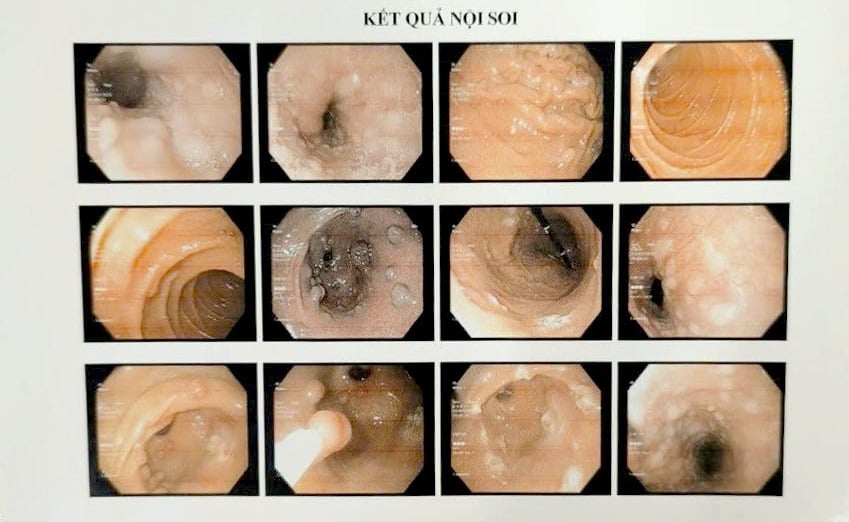
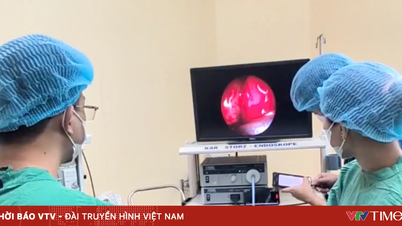
Endoscopy revealed multiple polyps in the stomach - Photo: Hospital provided.
On the afternoon of September 16th, the Gastrointestinal Endoscopy Department (A3D) of Military Central Hospital 108 announced that they had received a 37-year-old male patient who had been found to have multiple gastric polyps during an endoscopy at a previous hospital but had not yet received a clear diagnosis.
The patient was otherwise healthy, having a few soft skin lumps that had gradually grown over the past 10 years, but because they did not affect their appearance or quality of life, they had not been treated.
Following the recent death of his father from colon cancer, and with a preventative mindset, the patient decided to undergo a health check-up and incidentally discovered numerous polyps in his stomach ranging in size from 0.2 to 1.4 cm, along with glycogen deposition lesions in the esophagus.
Since multiple gastric polyps are quite rare, the doctors in the Gastroenterology Endoscopy Department removed the high-risk polyps and performed biopsies to determine their nature. The pathology results showed a hamartoma.
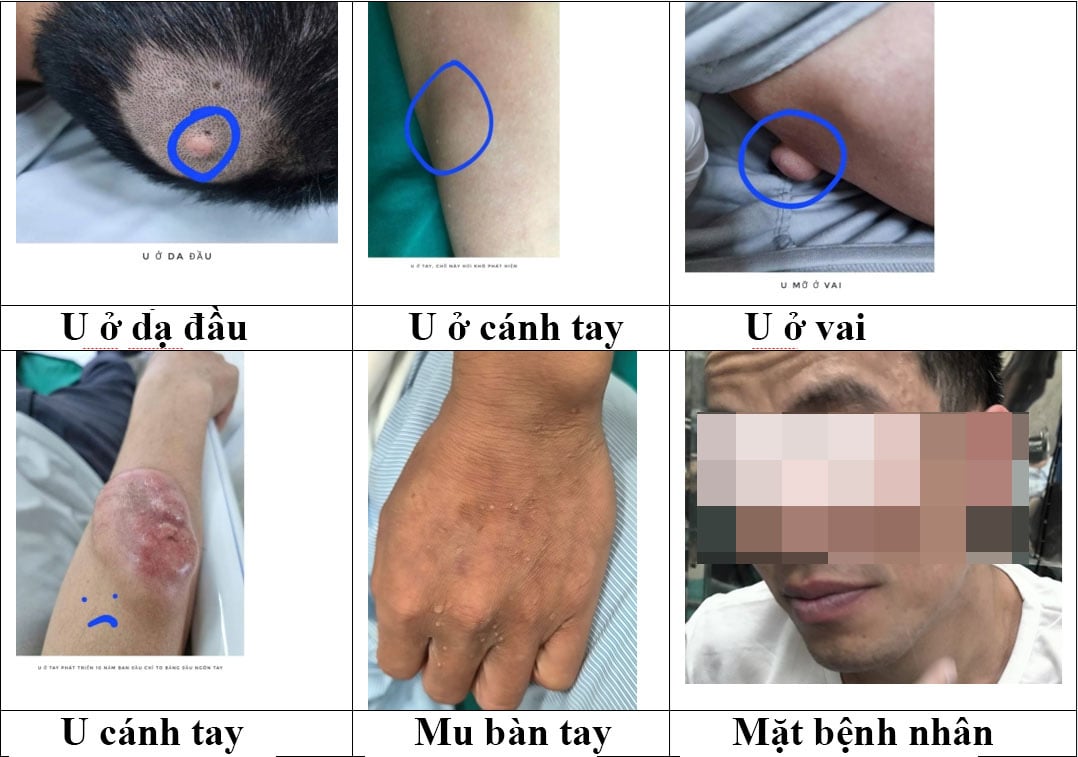
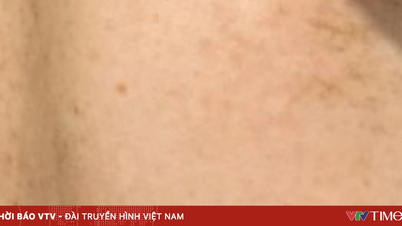
Tumors are growing all over the patient's body - Photo: Provided by the hospital.
For soft tissue tumors on the head, hands, shoulders, and nodules on the back of the hands and face (see image below), patients are advised to undergo surgery to remove large soft tissue tumors on the head and hands, both for diagnosis and cosmetic purposes. The results showed that all the masses were sclerotic fibroma-like dermatofibromas.
The clinical features and pathological lesions described above are entirely consistent with Cowden syndrome (benign multiple tumor syndrome), a genetic disease characterized primarily by non-cancerous tumors (hamartomas) in various parts of the body.
Dr. Nguyen Van Canh, from the Gastroenterology Endoscopy Department at Military Central Hospital 108, shared: Cowden syndrome is a rare genetic disorder with an incidence rate of 1 in 200,000 people worldwide . This syndrome occurs due to mutations in the PTEN (accounting for 25%), KLLN, or WWP1 genes.
Most patients with Cowden syndrome develop polyps in the upper gastrointestinal tract and in the colon and rectum, and their risk of developing colorectal cancer is significantly increased.
Skin abnormalities also appear in patients over 20 years old, such as: papillomas, benign tumors originating from the outer layer of hair follicles, follicular keratosis, hemangiomas, vascular malformations, lipomas, and papillomas on the tongue.
In addition, patients have an increased risk of developing thyroid cancer and breast cancer.
For these patients, screening is necessary to assess and remove high-risk polyps via endoscopy, in order to limit polyp cancer or excessive density that would necessitate total gastrectomy or colectomy.
"Currently, there are no reported cases of patients diagnosed with Cowden syndrome in Vietnam. Therefore, undergoing gastroscopy and colonoscopy screenings, especially if there is a family history of gastrointestinal polyps, is very important," warned Dr. Nguyen Van Canh.
Source: https://tuoitre.vn/hy-huu-ca-benh-co-u-chi-chit-trong-da-day-va-moc-khap-co-the-20240916171118944.htm



![[Photo] Ba Lang An Lighthouse - the "eye of the sea" amidst the "rock museum" of Quang Ngai province.](https://vphoto.vietnam.vn/thumb/1200x675/vietnam/resource/IMAGE/2026/05/29/1780038698840_anh-man-hinh-2026-05-29-luc-14-10-42.png)























![[Image] Pleasant weather helps students enter the 10th grade entrance exam with confidence.](https://vphoto.vietnam.vn/thumb/1200x675/vietnam/resource/IMAGE/2026/05/29/1780034401612_ngay-1-thi-lop-10-minh-duy-8-5009-jpg.webp)


































































Comment (0)